

Amazon's Zoox has begun commercial robotaxi service to Las Vegas' Harry Reid International Airport, becoming the first driverless operator at the hub after federal clearance to charge for rides.
Amazon's Zoox has begun commercial robotaxi service to Las Vegas' Harry Reid International Airport, becoming the first driverless operator at the hub after federal clearance to charge for rides.
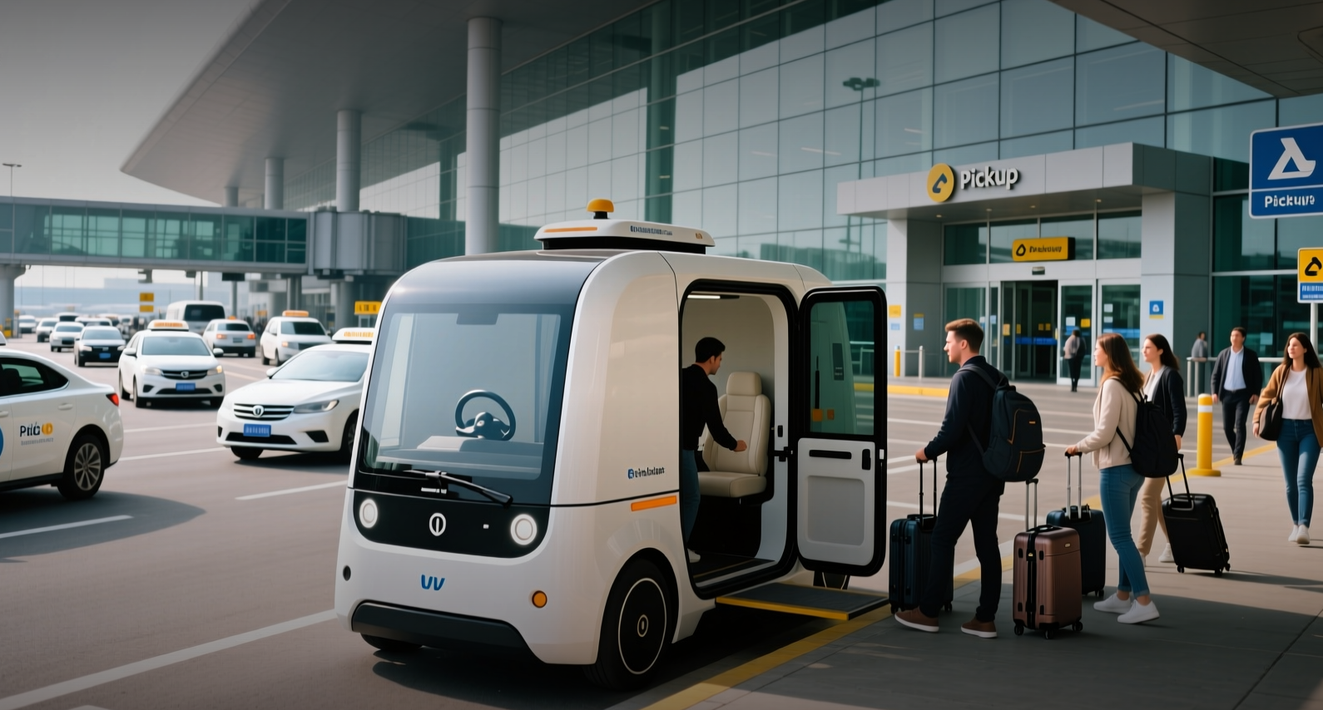
Zoox has become the first robotaxi operator to serve Las Vegas' Harry Reid International Airport, giving Amazon's autonomous vehicle unit a pickup edge over Uber and Lyft as Nevada authorizes up to 8,000 robotaxis countywide.
"Bringing autonomous transportation to one of the country's busiest airports requires true partnership, and we are grateful to the Clark County Department of Aviation and the state of Nevada for their continued support as we help shape the future of mobility," Ron Thaniel, senior director of policy and regulatory affairs at Zoox, said.
Zoox began charging for rides Aug. 10 after the National Highway Traffic Safety Administration granted a two-year commercial exemption covering eight federal motor vehicle safety standards and permitting deployment of up to 2,500 purpose-built robotaxis. The vehicles, which lack traditional controls such as steering wheels and pedals, pick up and drop off riders at both airport terminals near baggage claim. Uber and Lyft passengers arriving at the airport face a five- to ten-minute walk from baggage claim to an upper-level parking garage for pickup.
The airport launch follows Zoox's recent expansion into San Diego and Houston testing, bringing its footprint to 12 U.S. locations. But the competitive window is narrowing. Tesla, Uber, and Waymo all received permits last month from the Nevada Transportation Authority to operate commercial robotaxi services in Clark County, allowing combined deployment of up to 8,000 vehicles over the next 12 months. Uber plans to operate robotaxis through partnerships with Hyundai's Motional subsidiary and Zoox itself.
Waymo, Alphabet's autonomous vehicle unit, is moving faster on commercial rollout. It plans to begin public rides in Denver, San Diego, and Tampa, taking its U.S. footprint to 14 cities, with testing in Munich ahead of a potential German commercial launch in 2027. Waymo already operates paid services across multiple U.S. markets, giving it a first-mover advantage over Zoox and Tesla.
For Amazon, Zoox represents a bet that autonomous transportation can become a meaningful business beyond e-commerce and cloud computing. The company's financial resources could help Zoox absorb the enormous costs of vehicle production, mapping, software development, and fleet expansion. Zoox's purpose-built design — engineered specifically for autonomous operation rather than retrofitted from conventional vehicles — is a differentiator, though it adds manufacturing and regulatory complexity that retrofitted approaches avoid.
The economics remain unproven. Zoox must demonstrate it can manufacture robotaxis at scale, maintain them efficiently, and generate enough revenue per vehicle to justify the investment. Amazon is simultaneously spending heavily on AI infrastructure, and investors may question whether autonomous ride-hailing can deliver returns that justify its capital requirements. Robotaxis still account for a small fraction of U.S. rides, and widespread adoption faces technological, regulatory, and consumer-trust hurdles.
James Chrisley, Clark County director of aviation, framed the launch as a milestone for airport operations. "We're proud to welcome Zoox's purpose-built robotaxi to Harry Reid International Airport, marking a first for this technology in an airport environment," Chrisley said. "As we continue to modernize LAS, we have an opportunity to help shape how emerging technologies can be integrated within a complex airport environment."
Zoox spent several months testing vehicles and mapping roads near the airport to meet county service requirements before receiving clearance. Fare structures operate similarly to other ride-hailing services, with a base price that increases based on distance and time, plus destination fees for airport trips and high-traffic areas such as the Sphere.
For Amazon shareholders, the near-term financial impact is modest given the company's overall scale, but the strategic positioning matters. Zoox's expansion into paid service across more cities gives Amazon a foothold in what could become a substantial mobility market. Waymo's broader commercial footprint suggests Alphabet currently holds the stronger hand in proving the robotaxi business model, though Zoox's purpose-built approach could differentiate Amazon if the technology scales.
This article is for informational purposes only and does not constitute investment advice.
