The US Treasury chief delivered a stinging assessment of the AI industry's public engagement record Wednesday, handing hyperscalers a D-minus grade as data center construction inflates utility bills and consumer electronics prices across the country.
"The industry has done a terrible job, terrible job of explaining themselves," Bessent said at a Charlotte Economics Club event in North Carolina. The AI industry, along with government, bears responsibility "to explain to the American public how this benefits them both from a use case, from a national security case, from a quality of life case."
The Treasury chief's remarks follow his criticism last month of hyperscaler bond issuance strategies, when he suggested companies should sell more five-year "belly debt" rather than at the long end of the curve. Market participants have said heavy corporate issuance is one factor keeping Treasury yields elevated and mortgage rates with them. Alphabet completed a $25 billion bond sale in August spanning maturities from two to 40 years.
The escalating criticism comes as an anti-data center wave sweeps the US. Seven in 10 Americans oppose data center construction in their communities, according to a May Gallup poll. At least six Bay Area cities have imposed moratoria or begun rewriting development codes, and Monterey Park became the first US city to permanently ban data centers through a ballot measure that passed with 88 percent support. California lawmakers have sent seven data center bills to Gov. Gavin Newsom addressing utility cost allocation, water disclosure and environmental review.
Community resistance hardens into regulatory action
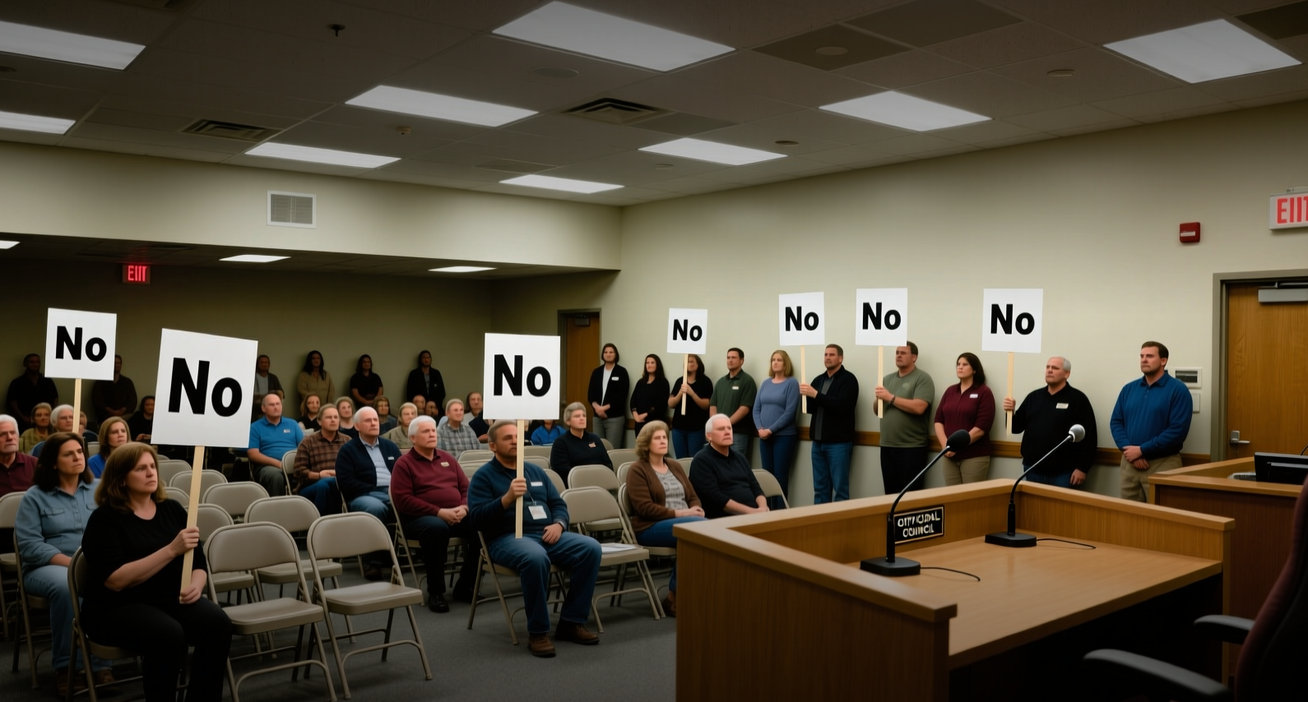
The backlash has moved beyond neighborhood complaints into binding policy. In Gilroy, south of San Jose, residents packed council chambers with signs reading "No Data Centers in Gilroy" after discovering an Amazon facility nearly the size of four football fields was already under construction. The city responded by requiring public hearings and community notifications for large developments. Pittsburg officials pledged public hearings for future data center applications, while Hayward is weighing a moratorium after outcry over a 310,000-square-foot hyperscale facility.
The political stakes are rising ahead of the 2026 midterms. A memo from the National Republican Senatorial Committee warned that data centers have defined the Ohio Senate race between Republican Sen. Jon Husted and former Democratic Sen. Sherrod Brown, calling data centers "the anchor hanging around Husted's neck." In California, industry groups are spending heavily to shape the outcome: PG&E logged $2.86 million in lobbying in the second quarter, its second-highest since 1999, while Amazon spent more than $500,000 on 33 pieces of legislation in the first half of the year.
Cost transmission hits households and ratepayers
Bessent said AI spending — particularly data center construction — has pushed up prices from utility bills to high-bandwidth memory used in consumer electronics. Pacific Gas & Electric estimates electricity demand in its service area will double over the next 20 years, with about a third of growth coming from data centers. The utility currently has about four gigawatts of data center demand under construction or in final approval stages — roughly four times the average peak demand of San Jose.
California's pending legislation would shift infrastructure costs from ratepayers to data center operators. Senate Bill 886 would require facilities drawing at least 25 megawatts to pay for grid upgrades their demand creates, while Senate Bill 887 would fast-track environmental review for projects that match every hour of electricity use with carbon-free power within five years. Assembly bills would mandate public disclosure of water-use plans and energy consumption data.
Despite the criticism, Bessent maintained his bullish view on AI investment. He reiterated that the US is "on the cusp" of a major productivity boom and predicted the capital-spending surge will prove "extremely disinflationary," with benefits visible within six months. He also flagged competitive urgency, saying the US holds 55 to 60 percent of global computing power and predicting that share will reach 80 percent by 2028. "The Chinese are right behind us," he said. "If they get ahead, everything else we do won't matter."
The widening scope of Bessent's criticism — from debt issuance to community relations — suggests the administration is weighing policy levers beyond public statements. California's seven pending bills could serve as a template for federal action, particularly on utility cost allocation and environmental disclosure. For hyperscalers including Alphabet, Microsoft, Amazon and Meta, the combination of community resistance, state regulation and federal scrutiny raises the cost and complexity of the AI infrastructure buildout they have committed hundreds of billions of dollars to execute.
This article is for informational purposes only and does not constitute investment advice.