
A nine-day search ended in relief Friday when Nepal's army recovered two survivors from the Trishuli 3A tunnel, offering hope for hundreds of workers still unaccounted for after the Aug. 26 flood disaster.
A nine-day search ended in relief Friday when Nepal's army recovered two survivors from the Trishuli 3A tunnel, offering hope for hundreds of workers still unaccounted for after the Aug. 26 flood disaster.
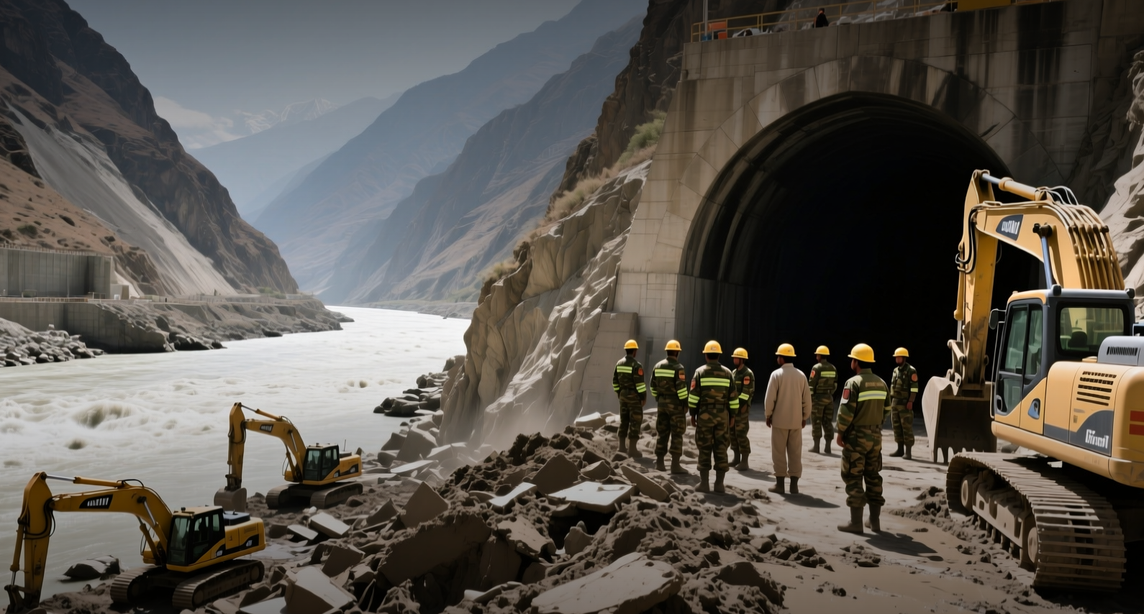
Rescuers in Nepal pulled two men alive from a hydropower tunnel on the Trishuli River on Friday, the first survivors recovered from the country's power projects since a glacier-collapse flood nine days earlier killed more than 1,250 people and left over 5,000 missing. The army called the rescue the "rebirth of two lives."
The two men, identified by the energy minister's office as Sanjay Sah, 30, a mechanical foreman, and Kabir Maharjan, 45, a mechanical supervisor, were found after rescuers heard voices from inside the tunnel Friday morning, according to Shri Ram Neupane, a ruling-party lawmaker and tunnel engineer involved in the operations. Both were in stable condition and flown by helicopter to a military hospital in Kathmandu, district police chief Bipin Regmi said.
Rescuers first reached the pair at the Trishuli 3A project after days of clearing mud and debris from the tunnel, where army engineers had conducted a controlled explosion and excavators were digging at a depth of about 30 feet. The operation involved 75 army troops and some 18 paramilitary personnel, army spokesman Brig. Gen. Raja Ram Basnet said. Sah told rescuers three or four more people could still be alive in the tunnel, and possibly more deeper inside, according to The Kathmandu Post.
The rescues raise hope in a nation still searching for roughly 900 workers missing from 12 hydropower projects along the Trishuli River, with about 500 believed trapped in tunnels and some 115 in the main tunnel at Trishuli 3A alone, according to the Independent Power Producers Association of Nepal. Many of the lengthy tunnels contain rooms where people could survive for days, officials and hydropower engineers say, and Nepal's Communication Minister Bikram Timilsina said officials remain hopeful more workers will be rescued. "We are waiting for the rescue of more and more people," he wrote on Facebook.
The Aug. 26 flood, likely triggered by the partial collapse of a glacier in the upper Trishuli, swept away towns and villages near Nepal's border with China's Tibet region, killing at least 1,259 people in Nepal and leaving more than 5,000 missing, according to the country's disaster management agency. China has reported 21 deaths and 541 missing on the Tibet side. The disaster destroyed property, housing and infrastructure worth at least 387.5 billion Nepalese rupees ($2.56 billion), said Dharma Raj Upreti, chief of the National Disaster Risk Reduction and Management Authority, with Nepal needing to rebuild around 20,000 houses, at least 7,500 of them destroyed.
The human toll extends beyond Nepali nationals, with at least 583 foreign nationals missing, many of them pilgrims and trekkers. Australia dispatched a 15-member team of drone specialists on Friday to join the search, as the government expressed "serious concerns" about its 36 missing citizens. Nepal has largely declined international help, though rescue efforts are being led by the army and police with assistance from experts from India, South Korea and China.
Dhan Bahadur Tamang, who escaped from a tunnel at the Upper Trishuli 1 project upriver from Friday's rescue, called the recovery of the two men a miracle that raised hopes of finding more survivors. The disaster ranks among the deadliest in Nepal's recent history, and the fate of hundreds of workers sealed inside mountain tunnels will determine whether Friday's rescue proves an isolated reprieve or the start of a broader recovery.
This article is for informational purposes only and does not constitute investment advice.
