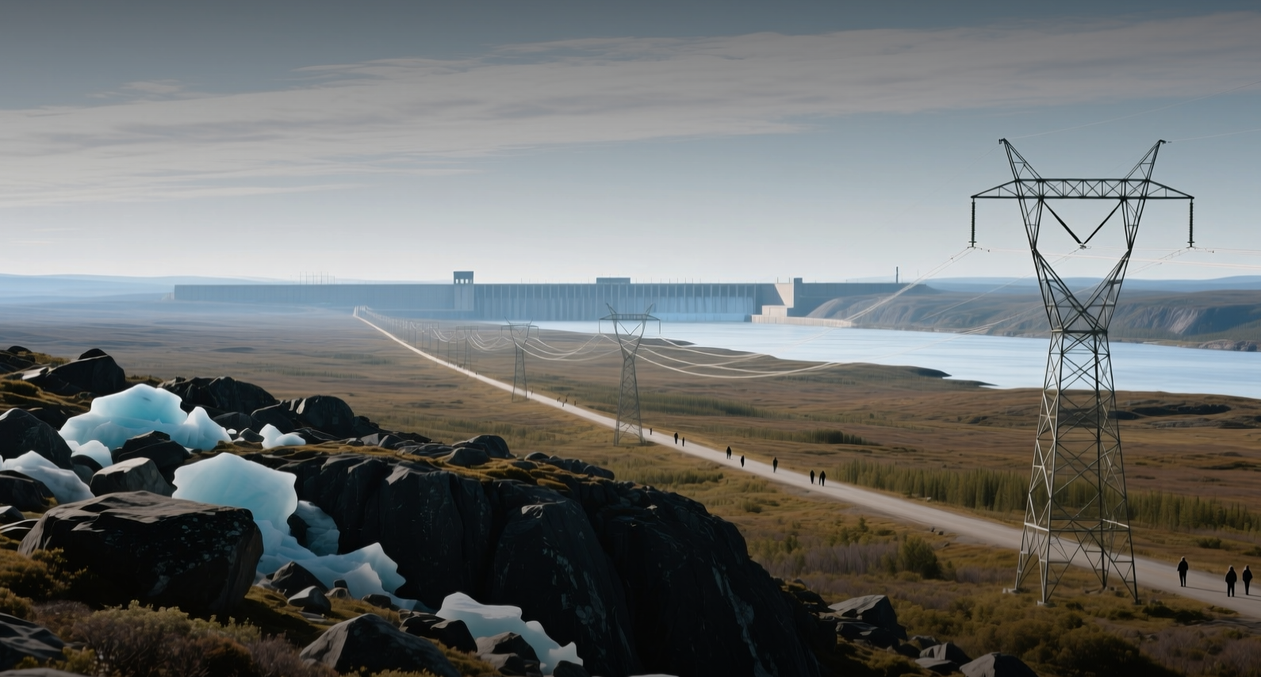
Canada pledged nearly $70 billion to Labrador clean energy and defense projects, a package SAGA Metals Corp. said strengthens the investment case for its critical-minerals portfolio in the region.
"Labrador is moving rapidly from resource potential to nation-building execution," Mike Stier, chief executive officer at SAGA Metals, said. "The scale of the commitments now being made across power generation, transmission, northern defence and mine-enabling infrastructure is exceptional."
The federal government will provide $10 billion in financing to upgrade and expand the Churchill Falls Generating Station, develop the 2,700-megawatt Gull Island hydroelectric project and build associated transmission, according to a government statement. The projects are expected to generate 14,000 megawatts, support 23,000 jobs and contribute $31 billion to Canadian GDP through the early 2040s. Up to $2.3 million is earmarked under the First and Last Mile Fund for a Labrador West transmission expansion study, while 5 Wing Goose Bay may receive up to $8 billion within a $32 billion northern basing program.
SAGA's three 100%-owned Labrador projects — Radar, Wolverine and Double Mer — provide exposure to titanium, vanadium, iron, heavy rare earth elements and uranium, materials central to energy, defense and advanced-manufacturing supply chains. The company said the infrastructure commitments could deepen Labrador's contractor base and skilled workforce, improving the environment for exploration and mine development.
Churchill Falls Expansion Adds 1,275 Megawatts
The program contemplates upgrades to Churchill Falls' 11 existing turbine units, adding 1,275 megawatts, plus an expansion of up to 2,500 megawatts. Gull Island, a proposed 2,700-megawatt development on the Churchill River, is expected to produce about 12 terawatt-hours annually, with more than 660 kilometers of transmission planned to the Québec border. The first component at 5 Wing Goose Bay is a $187 million energy performance contract replacing diesel heating with electric boilers, cutting greenhouse-gas emissions by about 19,000 tonnes a year.
SAGA's Labrador Portfolio
Radar, a titanium-vanadium-iron project spanning 24,175 hectares, encloses the Dykes River intrusive complex mapped at about 160 square kilometers, with 24,641 meters of drilling confirming a 29-square-kilometer lopolith. Wolverine, a heavy rare-earth system within a peralkaline caldera, has returned drill assays up to 2.03 percent TREO with about 28 percent HREO and surface samples up to 21.6 percent TREO. Double Mer, covering 25,600 hectares, shows an 18-kilometer uranium trend with samples as high as 0.428 percent U3O8. The company also holds the 72,701-hectare Legacy Lithium project in Quebec's James Bay region.
The scale of SAGA's holdings compares with peers exploring Labrador's critical-minerals belt, where federal policy now explicitly targets mine electrification and transmission for operations near Labrador City and Wabush. The Labrador West study, funded at up to $2.3 million, includes front-end engineering for lines intended to support existing mining and future critical-minerals development, with Hydro-Québec and Newfoundland and Labrador Hydro co-developing the power program.
This article is for informational purposes only and does not constitute investment advice.