Rivian Automotive's R2 electric SUV is converting reservations at a rate ahead of internal forecasts, giving the company cover to push through a costly production ramp while it races an autonomy roadmap that now leans on a $1.25 billion equity commitment from Uber. Speaking at Goldman Sachs' Communacopia and Technology Conference, executives detailed a vehicle launch that has found early product-market fit even as manufacturing costs weigh on near-term margins.
"Conversion rates from those reservations have been very good and are trending ahead of our prior expectations," Chip Newcom, Rivian's vice president of investor relations, said. The company has been collecting $100 refundable deposits and inviting customers in waves to configure vehicles, with interest holding as new trims such as the Coastal Cloud reach the market.
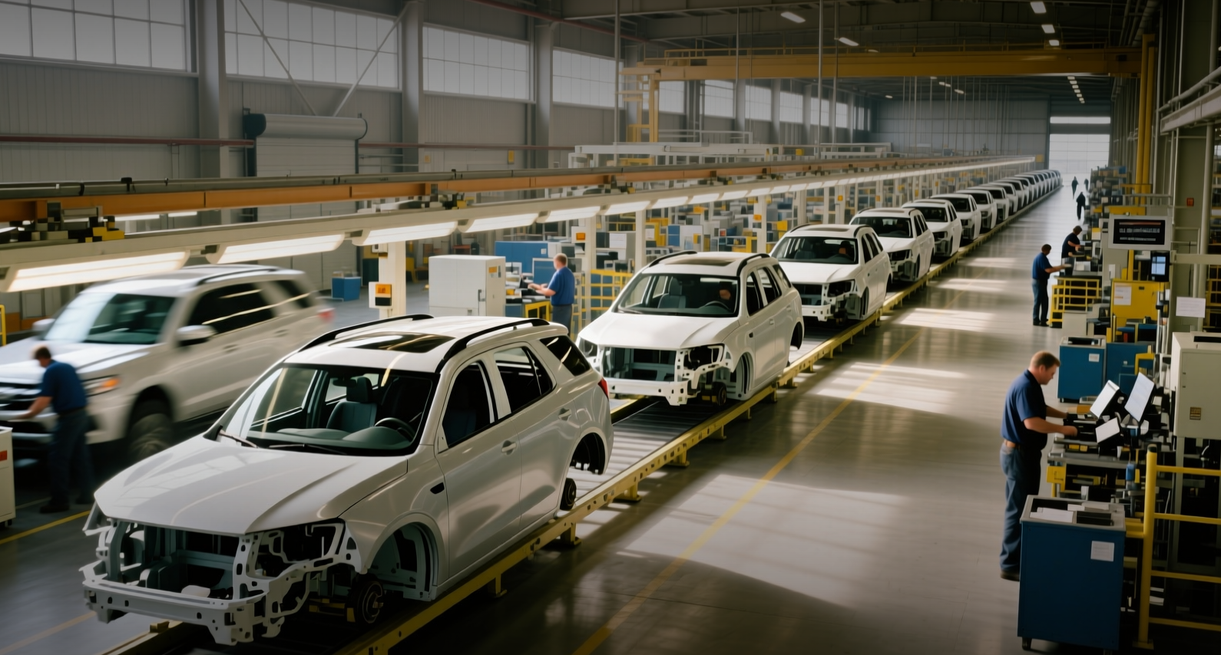
Rivian is still ramping R2 output at its Normal, Illinois, plant and expects to add a second production shift during the third quarter, with Newcom noting output can move only as fast as the slowest supplier. The ramp carried roughly $100 million in incremental cost of goods sold during the second quarter, and more is expected in the third quarter before those costs begin reversing in the fourth quarter as the company targets automotive gross-profit positive on an exit-rate basis by year-end. The longer-term goal remains a roughly 50 percent reduction in R2 bill of materials versus the R1 platform at full scale. "It's all about scaling and building more R2s," Newcom said.
The demand signal arrives as Rivian widens its technology ambitions beyond the vehicle itself. James Philbin, senior vice president of autonomy and AI, said supervised point-to-point driving is on track for introduction toward the end of 2026, with an eyes-off system targeted for 2027 built on the same end-to-end software stack. The company is testing on public roads, including construction zones and narrow-road negotiations, and has secured GPU capacity through Amazon Web Services, supported by its relationship with Amazon, to cover AI training needs for the next six to nine months. Autonomy+ adoption is tracking better than expected, Philbin said, describing the features as "sticky" once customers grow accustomed to them.
Custom silicon underpins the roadmap. Vidya Rajagopalan, senior vice president of electrical hardware, said Rivian's RAP1 processor, in-house for more than a year and a half, is tailored to physical-AI and autonomous-driving workloads rather than data-center-oriented merchant chips, with hardware characterization testing expected to be substantially complete within about a month and a half. The Gen 3 system remains on track for late 2026, with lower-performance configurations expected to cost less than Gen 2 hardware, and point-to-point functionality is slated for both Gen 2 and Gen 3 at launch.
The Uber partnership gives the autonomy story a commercial outlet. Uber is expected to provide $1.25 billion in equity capital over several years, of which Rivian has received $300 million, with another $250 million due upon a milestone later this year and the remainder tied to technical milestones for an L4-capable R2 robotaxi. The agreement covers an initial purchase of 10,000 vehicles by Uber or its fleet partners, with an option for 40,000 more, plus undisclosed software licensing fees. Testing is planned in San Francisco, Miami and Chicago by year-end, with expansion to as many as 25 markets globally, including at least one in Europe.
The stakes for investors are whether R2 conversion strength can carry Rivian through a quarter of elevated ramp costs to the gross-profit-positive exit rate it has promised, and whether the autonomy and robotaxi push can differentiate it from Tesla, which is also scaling driver-assistance and robotaxi ambitions. Rivian shares rose 2.7 percent on the session, while Uber fell 3.5 percent. The company's path to profitability now hinges on execution at Normal and on suppliers keeping pace, with the fourth-quarter cost reversal the first concrete checkpoint.
This article is for informational purposes only and does not constitute investment advice.