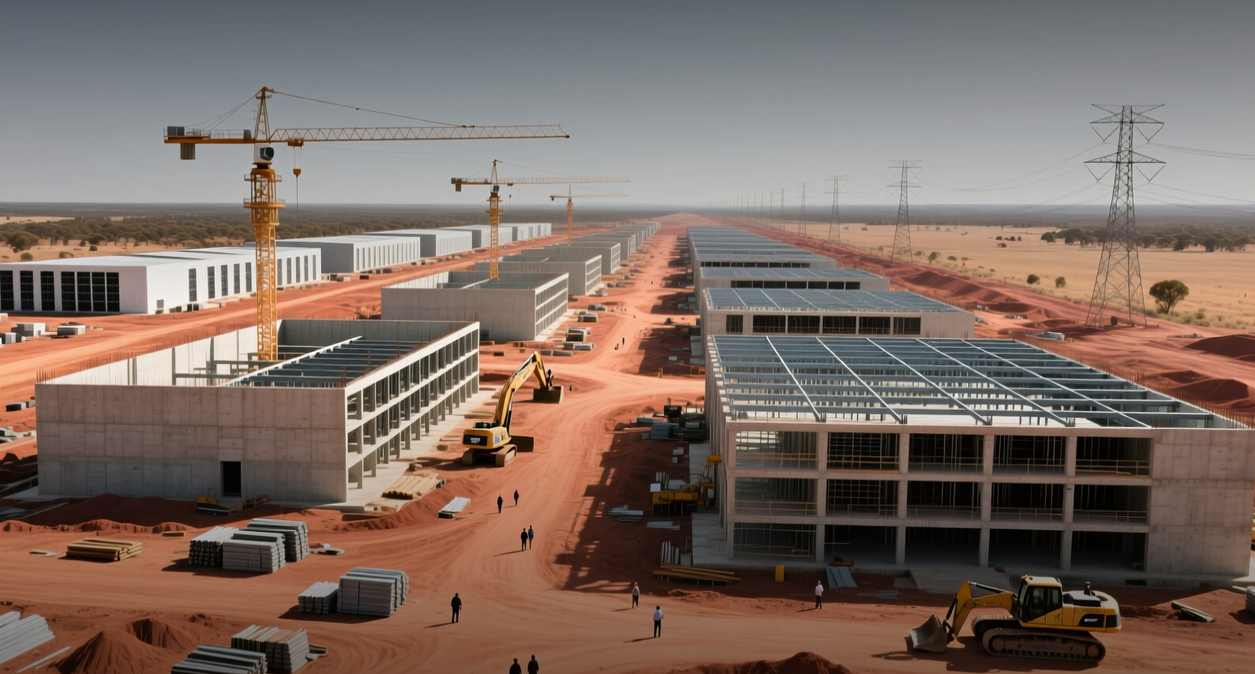
NVIDIA is pushing up to 2 gigawatts of AI data center capacity into Australia by 2027, a buildout across eight local partners that turns the country into a test case for how the chipmaker scales compute beyond the US hyperscalers. The expansion, announced Sept. 9 from Melbourne, pairs NVIDIA's DSX full-stack AI factory platform with land, power and shells owned by Firmus, Sharon AI, IREN, Megaport, ResetData, CDC, NEXTDC and AirTrunk.
"AI factories turn energy into intelligence — the essential resource of the AI economy," Raj Mirpuri, vice president of global AI clouds and infrastructure ecosystem at NVIDIA, said. He called DSX "a new investable asset class," compatible with the CUDA software ecosystem and enhanced through software over the life of the infrastructure.
The partners bring the physical scale. Sharon AI is deploying up to 68,000 NVIDIA GPUs wired with Quantum InfiniBand and Spectrum-X Ethernet networking. CDC runs more than 550 megawatts across Australia and New Zealand with another 800 megawatts under construction, all on 100 percent renewable electricity and zero-water direct liquid-to-chip cooling certified for NVIDIA accelerated computing. IREN is applying the DSX reference architecture across its portfolio, including an 800-megawatt Bundey campus in South Australia, while NEXTDC and AirTrunk are building liquid-cooled, high-density shells and Megaport is exposing capacity through its software-defined network via subsidiary Latitude.sh.
The push answers a demand surge from AI labs and AI-native startups that has strained compute supply outside North America. NVIDIA is betting that local access to accelerated computing and its open Nemotron models will seed applications built in Australia rather than imported. Heidi is combining Nemotron with clinical data to build voice-driven healthcare AI, and Atlassian is using the models to sharpen semantic search in its Rovo enterprise product.
For investors, the announcement extends NVIDIA's data center franchise beyond the handful of US hyperscalers that have driven its growth, adding a regional revenue stream tied to power and land rather than chip shipments alone. NVIDIA shares were down 2.01 percent before the release, a modest move that suggests the market has yet to price the Australian capacity into the data center segment that dominates its results. The eight operators, several of them privately held or thinly traded, stand to gain recurring colocation and GPU-as-a-service revenue as the factories come online through 2027, though execution risk rests on power availability and construction timelines in a country where grid connection queues have lengthened.
This article is for informational purposes only and does not constitute investment advice.