
Glacial collapse on the Nepal-Tibet border killed 470 and left 1,500 missing, the region's worst such disaster on record.
Glacial collapse on the Nepal-Tibet border killed 470 and left 1,500 missing, the region's worst such disaster on record.
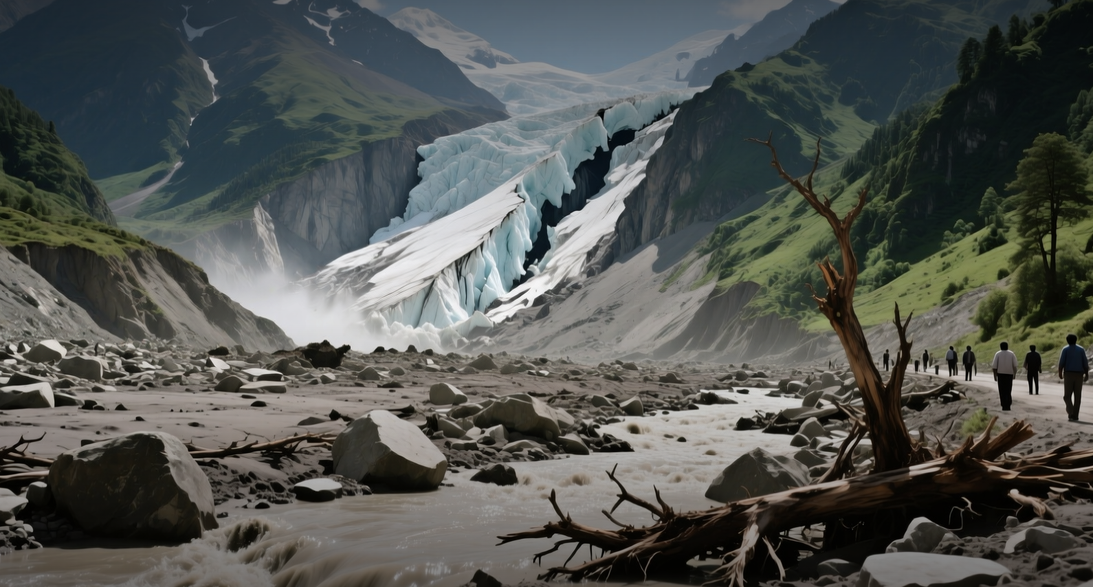
More than 1,500 people remain unaccounted for after a glacial collapse triggered flash floods along the Nepal-Tibet border Wednesday, with at least 470 confirmed dead across both countries. The U.S. Geological Survey traced the event to a massive rock-and-ice fall from roughly 16,000 feet that plunged 4,000 feet into the valley below, transforming into a wall of mud and debris that swept through towns and villages.
"Everything, probably directly or indirectly, is pointing the finger towards global warming," said Arun Bhakta Shrestha, a hydrologist specializing in Himalayan glaciers, who called this the worst glacial flood disaster he could recall.
The floodwaters carried people as far as 150 miles downstream to districts near Nepal's southern border with India. Chinese surveillance footage from the Tibetan side shows the torrent engulfing roads and buildings as residents flee. In Nepal, 469 bodies have been recovered, according to Nepal Police, while Chinese authorities confirm three deaths. Nepal's National Disaster Risk Reduction and Management Authority reports more than 970 missing in Nepal, including 517 foreign nationals.
The disaster struck as many Hindu and Buddhist pilgrims were transiting through the region to reach sacred mountain lakes. Among the missing are 65 U.S. citizens, 180 Indians, 33 from the United Kingdom, 35 from Australia and 25 from Canada, according to the Nepal Tourism Board. Chinese officials report 550 missing on the Tibet side, nearly half of them foreign tourists.
Rescue operations face severe obstacles. A dammed lake upstream of the Gyirong Port in Tibet has begun overflowing, forcing a temporary suspension of rescue work, according to Chinese state broadcaster CCTV. Nepali authorities have warned of additional flooding. Riaz Lodhi, country director for the World Food Programme in Nepal, said road access to the affected mountainous region is "impossible" under current conditions, with rescue workers digging people out of the mud and helicopters deployed for evacuation.
The U.S. State Department pledged $500,000 in aid and is deploying a disaster response adviser to the region. India has sent helicopters dropping tents, food and emergency supplies. The U.N. is mobilizing personnel and supplies, while the U.K., Canada and Australia have offered financial and search-and-rescue support. World Vision estimates more than 30,000 households will be impacted by the disaster.
At Kathmandu's Tribhuvan University Teaching Hospital, walls are covered with photos of missing persons and recovered remains. Dawa Wangmo Ghale, from Rasuwa district, was searching for her brother who traveled to the Nepal-China border the day before the disaster. "We couldn't find him anywhere," she said, holding his photo. "So far, we haven't heard whether he's dead or alive."
The region experienced similar flash floods in July 2025, when a glacial lake in Tibet overflowed due to high temperatures. Mohammad Farooq Azam of the International Center for Integrated Mountain Development (ICIMOD) told NPR the Himalaya region is warming faster than the global average, destabilizing many of the 60,000 glaciers there. The frequency of these deadly events has been increasing, yet experts lack sufficient data to identify which areas face the highest risk of future disasters.
The 2015 Nepal earthquake, which killed more than 1,000 people, demonstrated the country's disaster-response capabilities. But aid workers say these floods are unprecedented. "We are very much worried about children, women and people with a disability," said Dhruba Gurmachhan of World Vision. "They are in the open sky. They don't have anything to eat, they don't have sanitation."
The disaster threatens the Gyirong Port, a major border crossing and trade route between Nepal and China, with implications for regional commerce. As rescue operations continue, the broader question of how to monitor and prepare for glacial lake outburst floods across the Himalaya remains unresolved, with experts calling for expanded monitoring infrastructure and early-warning systems.
This article is for informational purposes only and does not constitute investment advice.
