

Ford aims to sell more than 100,000 units of its $30,000 Fathom electric truck in its first year, betting on cost-cutting manufacturing to overcome a 48% drop in US EV sales after the federal tax credit expired.
Ford aims to sell more than 100,000 units of its $30,000 Fathom electric truck in its first year, betting on cost-cutting manufacturing to overcome a 48% drop in US EV sales after the federal tax credit expired.
Ford Motor is betting that a $30,000 electric pickup built on a radically simplified assembly line can crack 100,000 first-year US sales — a volume only Tesla has achieved for a single EV model — even as the broader market contracts 48 percent year-over-year after the federal tax credit expired.
The Fathom, which starts at $28,350 before a $1,595 destination charge, will be produced on a new assembly line at Ford's Louisville, Kentucky plant beginning in the first quarter of 2027, with customer deliveries later that year. Ford executives have described the truck as the company's "Model T moment," a reference to the vehicle that put America on wheels a century ago.
"Our total addressable market is much bigger than just the EV under $40,000," Andrew Frick, president of Ford's electric- and gas-vehicle divisions, said in an interview.
The sales target comes at a difficult moment for US electrification. Electric vehicles represented 5.7 percent of all US sales in August, down from 10.3 percent a year earlier, according to data from Motor Intelligence. Overall EV sales fell 48 percent year-over-year after the $7,500 federal tax credit was phased out by the Trump administration and Congress.
Ford's earlier EV push proved costly. The company halted production of the F-150 Lightning late last year after the electric pickup racked up billions in losses alongside other battery-powered models. CEO Jim Farley has said those vehicles carried more parts and higher costs than necessary.
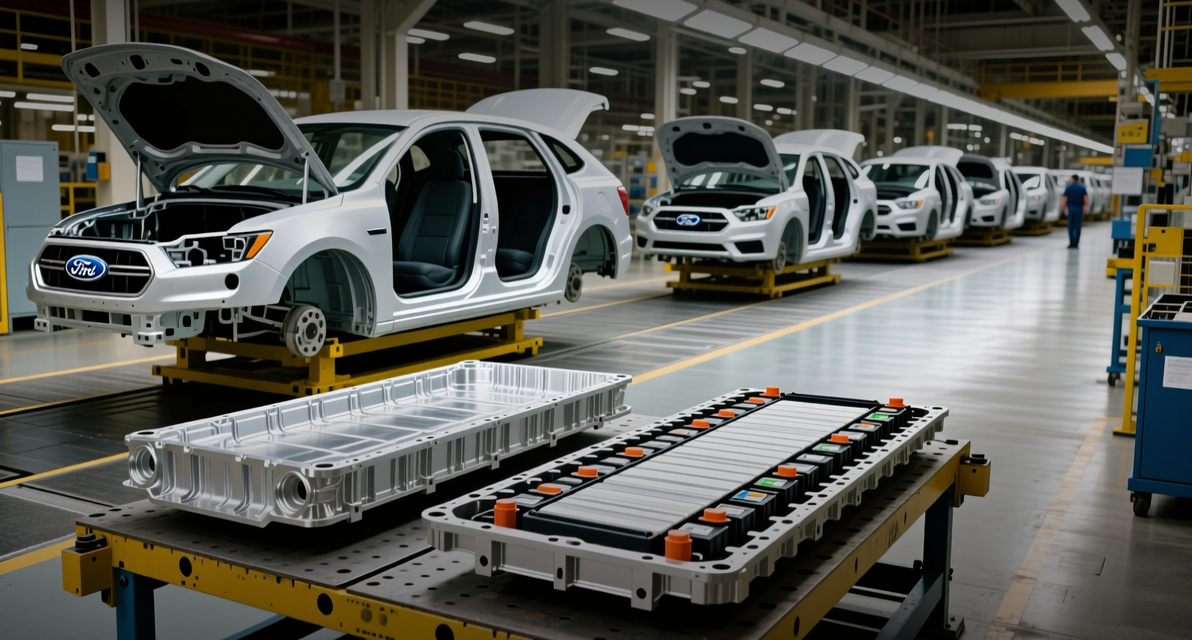
The Fathom is designed to address that directly. Built on Ford's new Universal EV Platform, the truck uses a structural battery pack with prismatic LFP cells (lithium iron phosphate, a lower-cost chemistry than nickel-based alternatives) as the vehicle's floor. Ford says the architecture requires 20 percent fewer parts, 25 percent fewer fasteners, and 15 percent less assembly time than a typical vehicle. Two large aluminum castings replace 146 separate components.
The base rear-wheel-drive model targets the sub-$30,000 price point, while a dual-motor all-wheel-drive variant with a larger battery aims for roughly 300 miles of range. Every trim includes BlueCruise hands-free highway driving, bidirectional charging for powering tools or home appliances, and Apple Maps navigation.
If Ford meets its target, the Fathom would join Tesla's Model Y — which sold about 357,000 units last year — and Model 3 at more than 190,000 as the only single EV models to exceed 100,000 annual US sales. General Motors sold nearly 170,000 all-electric vehicles in 2025, but spread across three brands.
Wall Street analysts and some Ford dealers have questioned whether the Fathom can achieve mainstream adoption in a market where EV enthusiasm has cooled. The truck's conventional four-door pickup silhouette — revealed in recent prototype photos from desert testing near Las Vegas — may help attract traditional truck buyers, but it also shows Ford is not betting on radical design to drive demand.
The Fathom's pricing undercuts many gas-powered Ford Maverick configurations, positioning it against both EVs and internal-combustion competitors. Ford is also targeting commercial and fleet buyers, where the truck's bidirectional charging capability could serve as a mobile generator for contractors.
Ford shares rose 2.17 percent following the announcement. The company will begin taking customer orders early next year, with full trim breakdowns and option pricing locked in closer to launch. The Fathom's success or failure will shape whether Ford can convert its earlier EV losses into a profitable mass-market strategy — and whether the UEV platform can support the additional models Farley has said are planned, including a revived electric Escape expected in 2029.
This article is for informational purposes only and does not constitute investment advice.
