


The global data center thermal cooling market is on track to nearly quintuple to $128.3 billion by 2033 as next-generation AI chips push power densities beyond air cooling's limits.
The global data center thermal cooling market is on track to nearly quintuple to $128.3 billion by 2033 as next-generation AI chips push power densities beyond air cooling's limits.
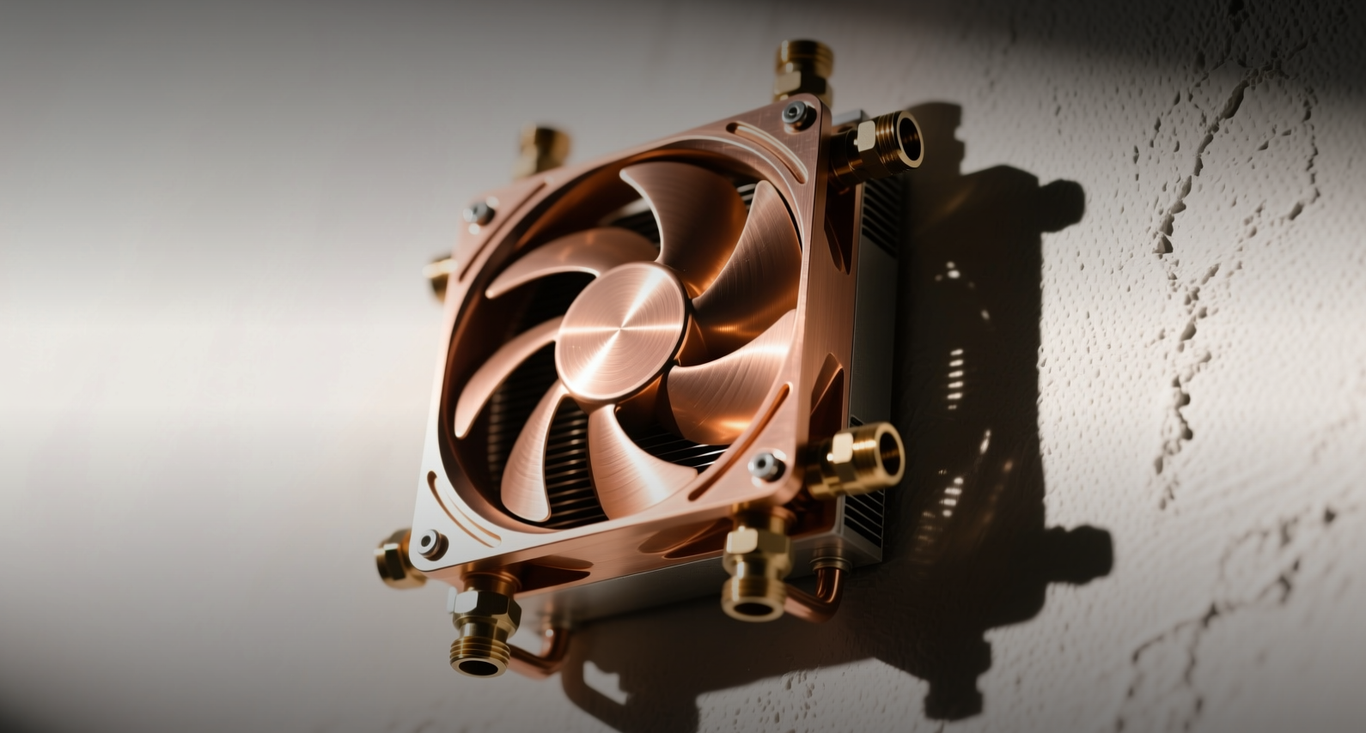
The global data center thermal cooling market is projected to grow from $26.3 billion in 2025 to $128.3 billion by 2033, a nearly fivefold expansion driven by AI chips that now exceed 2,300 watts per unit — far beyond the roughly 800-watt ceiling where traditional air cooling becomes ineffective. Two of the largest deals in the sector's history closed within eight months of each other: Eaton's $9.5 billion acquisition of Boyd Thermal in March 2026 and Ecolab's $4.75 billion purchase of CoolIT Systems in July 2026, together totaling $14.25 billion.
"Liquid cooling is no longer a question of whether, but how fast," said Paulo Ruiz, chief executive officer of Eaton, after closing the Boyd Thermal deal. "Combining Boyd's cooling technology with our power infrastructure lets us serve data center customers from the chip to the electrical grid."
Vertiv, the closest thing to a listed data-center-infrastructure pure play, posted Q1 2026 revenue of $2.65 billion, up 30% year over year, with Americas organic sales expanding 44%. Modine Manufacturing, a legacy automotive radiator maker, saw its AI data center cooling revenue surge 158% in the same quarter after landing a single $180 million order from an AI infrastructure developer. In China, Envicool reported record 2025 revenue of 6.07 billion yuan ($835 million), and Google's procurement team visited the company in March 2026 to discuss liquid cooling equipment for its AI data centers.
The shift is structural, not cyclical. Nvidia's upcoming Rubin architecture, expected to draw 2,300 watts per chip, will require liquid cooling as a baseline — the company has said air cooling is physically insufficient at that density. In China, liquid cooling penetration among servers jumped to 28% in the first half of 2026 from 12% a year earlier, and all 40-plus newly built WanKa-level AI data centers — those with 10,000-GPU clusters — adopted liquid cooling exclusively. The domestic liquid cooling market is expected to reach roughly 300 billion yuan ($41 billion) by 2026 and surpass 1 trillion yuan ($137 billion) by 2030, according to industry estimates.
The thermal cooling supply chain is splitting into distinct tiers with different margin profiles. At the top, integrated power-and-cooling vendors like Eaton and Vertiv sell complete systems — combining switchgear, power distribution units, and liquid cooling loops — capturing the highest value per megawatt. Eaton's Electrical Americas segment saw data center orders surge 240% year over year in Q1 2026, with its total electrical backlog growing 48%. Vertiv's backlog reached $15 billion after Q4 2025 orders grew 252%, giving it a book-to-bill ratio near 2.9 times.
A second tier consists of component specialists — cold plate manufacturers, pump suppliers, and coolant distributors — many of them based in China and Taiwan. Yinlun, a Chinese maker of microchannel cold plates, is expanding into overseas chip-packaging and server customers. AVC, a Taiwanese thermal solutions provider, reported annual revenue of 139.6 billion New Taiwan dollars ($4.3 billion), while Japanese motor giants Nidec and MinebeaMitsumi — whose fan and motor businesses serve data center cooling — reported annual sales of 2.61 trillion yen ($17.4 billion) and 1.66 trillion yen ($11.1 billion), respectively.
The most capital-efficient opportunity may lie in the third tier: second-tier suppliers that manufacture components for larger integrators. A Guangdong-based fan company, for example, has grown revenue to nearly 1 billion yuan ($137 million) and is seeing its AIDC-related revenue double every quarter as it supplies cooling fans for Alibaba Cloud and other hyperscale operators.
China's liquid cooling market presents a timing mismatch that investors are watching closely. While North American hyperscalers have already deployed GB200 and GB300 liquid-cooled servers at scale — generating immediate orders for cold plates, CDUs, and heat exchangers — China's market remains dominated by air-cooled servers, partly because domestic AI chips have not yet reached the power densities that force a switch.
That dynamic is expected to change as next-generation Chinese AI chips push past the 800-watt air-cooling threshold. Industry estimates project China's liquid cooling market will grow at a compound annual rate above 45% from 2025 to 2030, reaching more than 1 trillion yuan by the end of the decade. For companies like Envicool, which supplies CDUs for Google's TPU clusters, and Yinlun, which is pursuing overseas chip customers, the export channel already provides a second growth curve while the domestic market builds.
The valuation gap between the two markets is stark. Vertiv trades at roughly 52 times forward earnings, reflecting the market's confidence in its 50% plus earnings growth trajectory. Eaton trades at about 30 times forward earnings after its 26% year-to-date gain. Chinese cooling companies, by contrast, trade at lower multiples despite similar growth trajectories, partly because their domestic end-market has not yet fully converted to liquid cooling. If China's data center cooling market follows the same trajectory as North America's — and the 45% CAGR projection suggests it will — the re-rating opportunity for Chinese suppliers could be significant.
This article is for informational purposes only and does not constitute investment advice.
