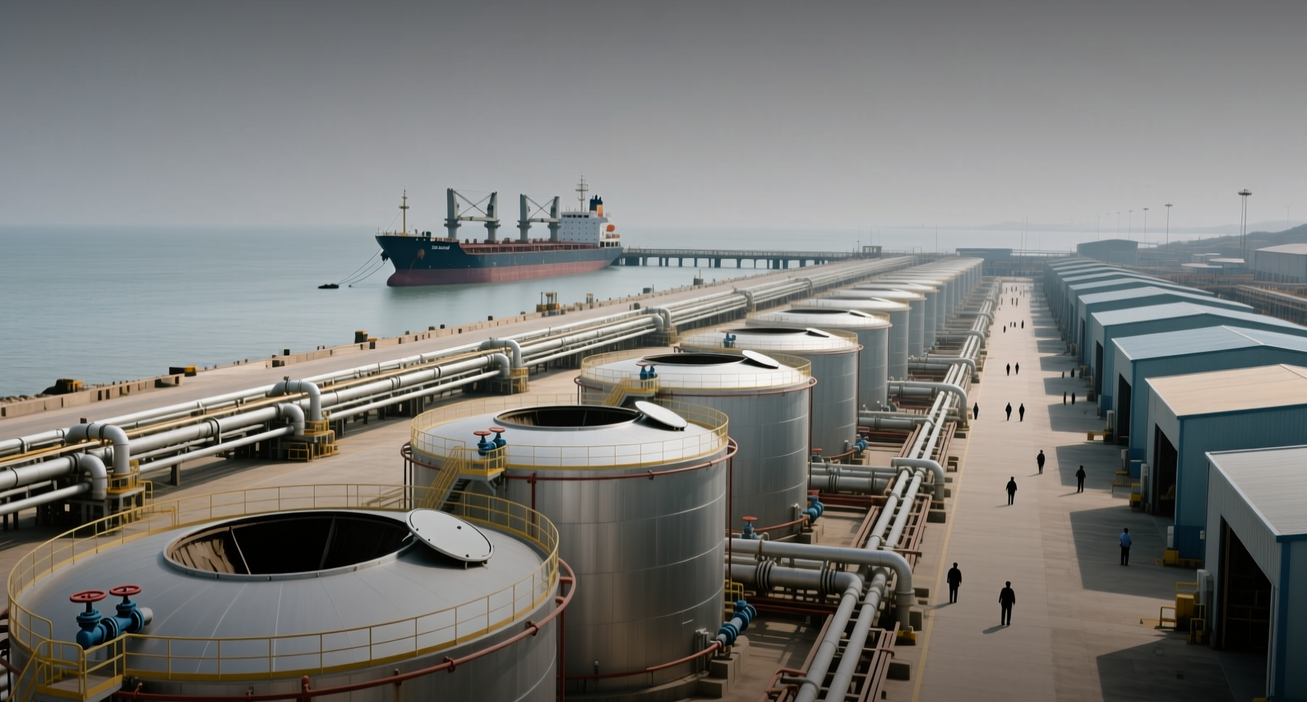
China's crude reserve drawdown absorbed the Hormuz supply shock and held Brent near $80 for months. With imports rebounding 22% in July, that cushion is now shrinking into a market that has already lost 20% of global energy supply.
"China kind of saved the day," Paul Gruenwald, global chief economist at S&P Global Ratings, said at a conference in Singapore on Thursday, referring to the world avoiding what he called a "doomsday scenario" when the Strait of Hormuz closure choked off a fifth of global energy supply.
The numbers behind that cushion are large. The U.S. Energy Information Administration estimates China held 1.4 billion barrels of strategic crude inventories, including commercial stocks, as of December 2025, against 825 million barrels in the U.S. Chinese crude imports fell below 8 million barrels a day in May and June, the first time since 2016, according to EIA data. Official trade data show imports then rebounded 22% month on month in July and a further 6.2% in August, still well below year-earlier levels.
The stakes are the price of the world's marginal barrel. Brent eased to around $80 before crossing $100 on Wednesday as hostilities between Iran and the U.S. resumed in the Gulf. Goldman Sachs economist Daan Struyven warned in a recent note that prices could reach $120 if the war, now in its seventh month, keeps disrupting shipping. Krishna Srinivasan, director for the Asia and Pacific Department at the International Monetary Fund, said that if China returns to pre-war import pace, the drag on global growth from elevated oil prices would deepen well beyond current estimates.
Four months of cover, and a law requiring more
The buffer's durability rests on more than volume. China holds roughly four months of crude in national reserves, and an energy law enacted last year requires major oil companies to hold additional reserves on top of normal commercial inventories, according to Dan Wang, China director at Eurasia Group. "The economy is basically cushioned from this oil crisis," Wang said Thursday.
Coal did part of the work. It still supplies about 53% of China's energy mix by Wang's estimate, letting the economy substitute away from oil when prices spiked. Kai Guo, executive president and senior fellow at the China-focused CF40 Institute, said Beijing had built redundancy that let oil consumption fall without denting economic activity, and that the crisis vindicated years of government investment in stockpiling and clean energy.
That model carries a cost. Wang said "this particular China model" would not work well in a normal economy given the wasted investment it implies, but that "when something uncertain like this happens, especially in Eurasia, it works." She expects the Gulf standoff to last at least a year, with oil holding between $85 and $100 a barrel through 2027.
Refiners stalled, and a second chokepoint
The demand side has already adjusted. Global oil demand fell nearly 5% in the second quarter of 2026 from a year earlier to 99.1 million barrels a day, according to International Energy Agency estimates, with declines concentrated in Asia and Europe. Chinese diesel consumption fell an estimated 10% in May from a year earlier, gasoline demand declined 5%, and petrochemical feedstock use slumped 17%. China's refiners cut processing rates by 18% in June versus June 2025, pushing output to the lowest level since March 2020, Reuters reported.
A second route is now under threat. Saudi Arabia exported around 5 million barrels a day from its west coast since March, more than double prewar levels, with roughly four-fifths transiting the Bab el-Mandeb Strait, according to Kpler data. A Houthi blockade declared in July pushed many Asia-bound cargoes around Africa instead, adding at least four weeks to a typical voyage and more than doubling sailing times.
The last time a comparable share of global supply was removed — the 1973 Arab embargo — crude prices roughly quadrupled within months and global growth fell into recession the following year. The current shortfall is larger as a share of world supply than either 1973 or 1979, according to a Congressional Research Service report published in August.
For traders, the buffer is the variable that matters. Every barrel China pulls from inventory rather than buys on the water is a barrel of demand withheld from a market missing a fifth of its supply. As that drawdown slows, the same Hormuz disruption has to be absorbed by price. J.P. Morgan Global Research projects Brent averaging $86 in the third quarter, $80 in the fourth and $78 at year-end, a forecast that assumes the reserve releases continue and the conflict does not widen. Watch China's monthly customs import print and the EIA's weekly inventory series for the first hard evidence of which way the buffer is moving.
This article is for informational purposes only and does not constitute investment advice.