

CATL's battery-swap arm is betting that 100 stations in one city can prove the economics of swapping batteries at gas-station density.
CATL's battery-swap arm is betting that 100 stations in one city can prove the economics of swapping batteries at gas-station density.
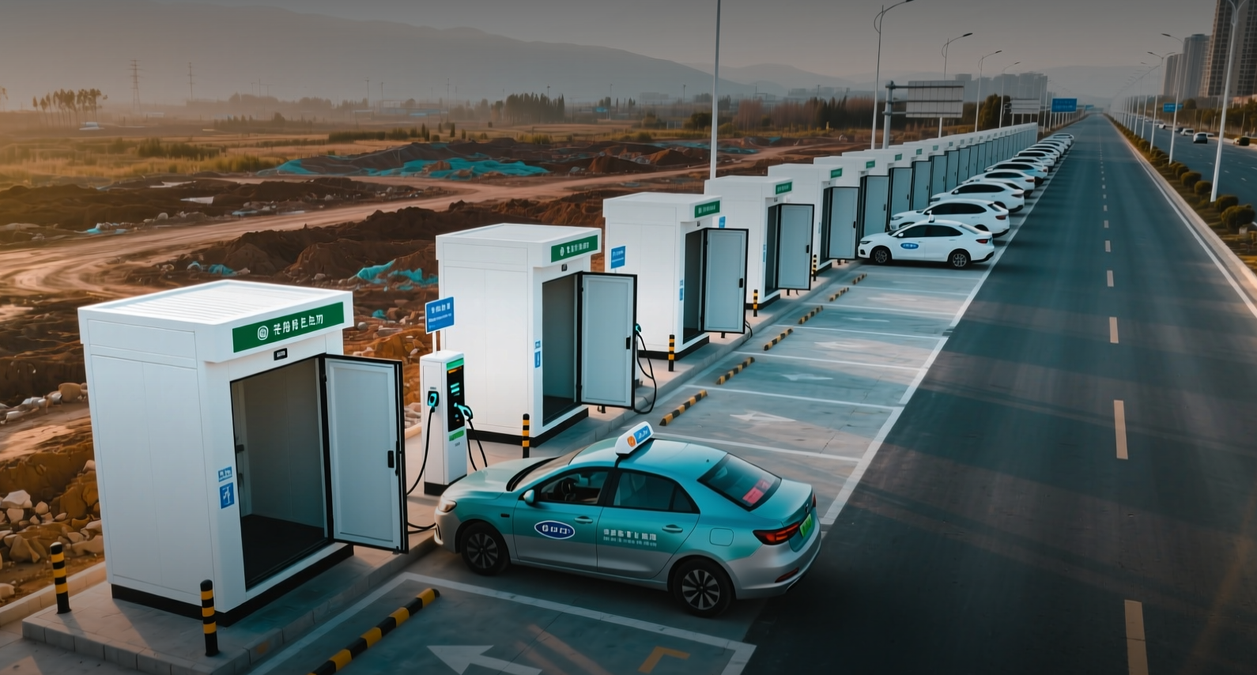
CATL's battery-swap brand EVOGO signed a strategic agreement Aug. 26 with Kunming Development New Energy, a subsidiary of the Kunming State-owned Assets Supervision and Administration Commission, to jointly build 100 swap stations in the Yunnan provincial capital. The deal shifts asset-heavy station investment onto the local state platform while CATL supplies the swap standards, operational systems, and digital platform.
The agreement, announced by Contemporary Amperex Energy Service Technology (CAES), CATL's battery-swap subsidiary, puts Kunming Development New Energy in charge of land acquisition, vehicle replacement resources, and local coordination. Both parties will unify battery configurations, pricing, and service standards under a model the companies describe as "state-owned capital holding plus EVOGO operations."
The Kunming deal marks an acceleration of CATL's swap network rollout. EVOGO stations grew from 1,470 at end-April to 2,000 by end-June, spanning 180 cities. In April, EVOGO announced partnerships with 11 automakers covering 18 passenger-vehicle brands and 25 models, including BAIC's Arcfox S3 swap version and co-developed models with Chery Automobile.
The 100-station single-city push is a bet that density, not breadth, will unlock the battery-swap business model. But dedicated swap vehicles remain scarce — most current models are modified from charging-based platforms, with purpose-built models not expected until late 2026 or early 2027. The gap between station deployment and vehicle availability will test whether Kunming's state-backed infrastructure can absorb the capacity.
Kunming Development New Energy brings more than capital. The agreement requires the state-owned entity to resolve land parcels and vehicle replacement resources — the two hardest constraints in battery-swap deployment. For CATL, this means CAES can accelerate station construction while retaining control over battery standards and the operating system.
The "Kunming model" — state-owned capital holding infrastructure while EVOGO operates it — is designed to be replicable. If it works, CATL could export the template to other second- and third-tier cities, where land costs are lower and local governments are eager to build new-energy infrastructure.
But the model carries risk. Slower-than-expected vehicle adoption would extend the payback period for Kunming Development New Energy's asset investment. And with 100 stations concentrated in a single market, utilization pressure is concentrated too — if swap-compatible vehicles don't arrive at the same pace as stations, idle assets pile up.
The vehicle side remains the bottleneck. Most swap-compatible models on the market today are adapted from existing charging-based platforms rather than designed for swapping from the ground up. Dedicated swap models from partners like Chery are not expected until late 2026 or early 2027.
CATL has been working to close this gap. The April partnership with 11 automakers covering 18 brands and 25 models was designed to broaden the swap-compatible fleet. BAIC's Arcfox S3 swap version is already on the market, and Chery is co-developing dedicated models with CATL.
According to sources cited in the announcement, CAES will announce several more single-city 100-station projects following Kunming. That means parallel delivery across multiple cities — each requiring asset investment from local state capital, land coordination, and vehicle replacement programs. A delay in any single link could drag down the entire rollout.
On the Hong Kong market, CATL (03750.HK) fell HK$3.000, or 0.483%, on Aug. 26, with short-selling turnover reaching HK$204 million (approximately $26.0 million) and a short-selling ratio of 40.498%. The stock's modest decline suggests the market has yet to fully price in the battery-swap expansion's capital requirements or its potential to standardize the industry.
NIO, which operates the largest battery-swap network in China, remains the benchmark for swap infrastructure at scale. CATL's approach differs by partnering with state capital rather than building stations on its own balance sheet — a structure that could let it scale faster without the same capital intensity, but one that depends on local government commitment.
This article is for informational purposes only and does not constitute investment advice.
