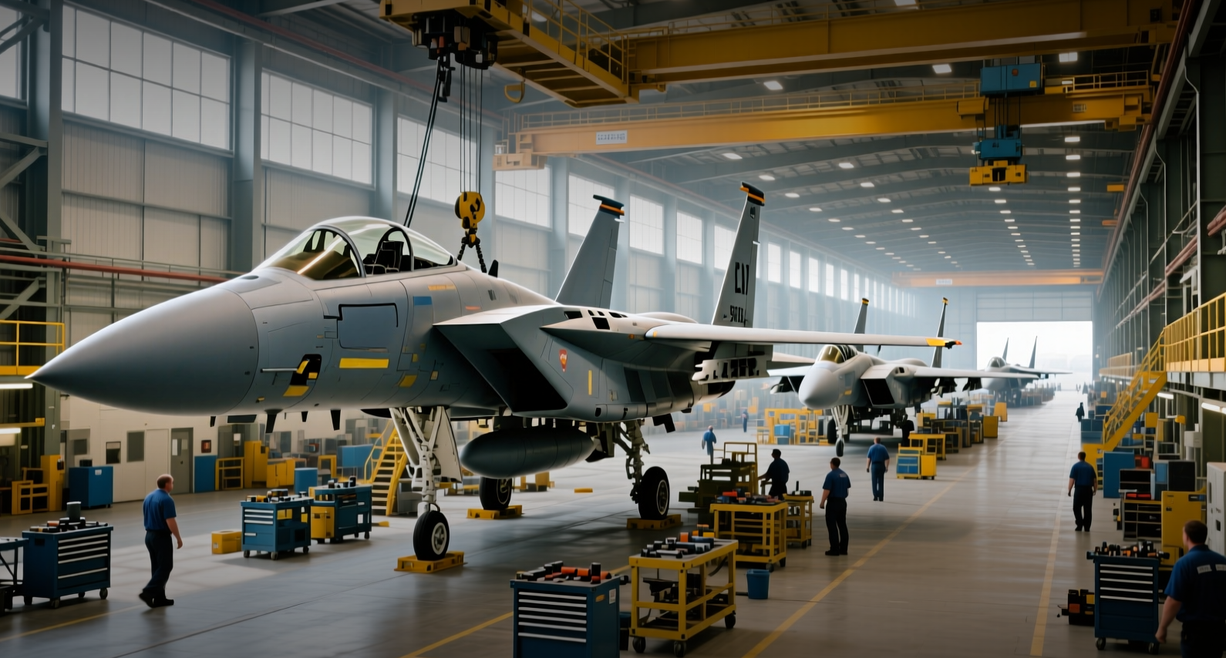
Boeing's defense business, profitable again after two years of losses, landed a $131.2 billion contract to build and modernize F-15 fighters through 2037.
Boeing shares rose 0.29 percent to $211.08 after the Air Force awarded a $131.2 billion F-15 contract.
Wells Fargo's David E. Strauss maintained a $250 price target, while Bernstein's Douglas Harned kept his at $298, according to TipRanks data.
The indefinite-delivery/indefinite-quantity award covers aircraft production, systems integration, modernization, and sustainment for F-15 fleets across the U.S. Air Force, Air National Guard, and foreign military sales customers in Japan, Israel, Saudi Arabia, South Korea, Singapore, Indonesia, and Poland. Work will be conducted in St. Louis, Missouri, with ordering through August 2031 and options extending to 2036.
The award could add more than $13 billion per year to Boeing's defense segment, which generated roughly $27 billion in annual revenue. Boeing's defense unit posted a $218 million operating profit in 2026 after losing money in 2024, when the company reported $12 billion in total losses.
The F-15 Eagle Crest contract, announced in the Defense Department's daily digest on Aug. 24, is structured as an umbrella agreement with a ceiling value of $131.23 billion. The Pentagon obligated $343,740 in fiscal 2026 research, development, test, and evaluation funds to initiate the program. Boeing was awarded the contract on a sole-source basis as the original equipment manufacturer for the F-15 platform, which was originally designed by McDonnell Douglas before its 1997 merger with Boeing.
The contract also includes a separate $163 million award for B-52 bomb rack modernization kits, announced by the Air Force on Tuesday.
Defense turnaround takes hold
Boeing's defense, space, and security segment lost money in 2024, when the company reported $12 billion in total losses and burned through more than $14 billion in negative free cash flow. By 2025, commercial airplane losses had narrowed to above $7 billion while BDS approached breakeven. So far in 2026, BDS has returned to profitability with a $218 million operating profit.
The F-15 contract follows Boeing's win last year of the F-47 Next Generation Air Dominance fighter program, estimated to bring $20 billion to $50 billion in revenue. Together, the two awards provide long-term visibility for Boeing's St. Louis production lines and supplier networks through the late 2030s.
Technical picture remains weak
Despite the contract news, Boeing's stock remains in a consolidation phase. The shares trade below their 60-day moving average of $220.67 and 20-day moving average of $225.49, with the relative strength index at 37.93, below the 50 midline. Key support sits near $203.72, a level that has repeatedly capped losses over the past year.
To the upside, resistance lies between $220.67 and $225.49, followed by $235 and the previous high of $244.21. A breakout above $244.21 would suggest the range-bound consolidation of the past year may resolve higher.
The contract win strengthens Boeing's defense backlog at a time when its commercial division continues to navigate production and labor challenges. With 17 of 18 analysts rating the stock a Buy and an average price target of $274.68, Wall Street sees roughly 30 percent upside from current levels. BNP Paribas upgraded Boeing from Underperform to Outperform in early August, raising its target to $300.
This article is for informational purposes only and does not constitute investment advice.