

Southern pulpwood prices have collapsed to their lowest level in nearly 40 years, threatening the region's forest economy and its replanting pipeline.
Southern pulpwood prices have collapsed to their lowest level in nearly 40 years, threatening the region's forest economy and its replanting pipeline.
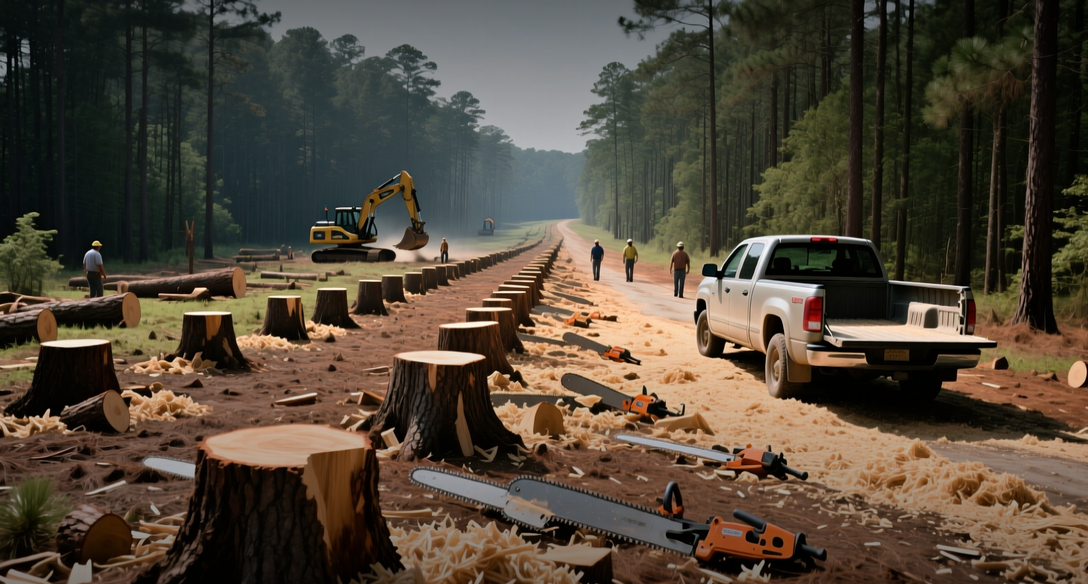
Pulpwood prices across the US South fell to $0-$5 per ton, a near 40-year low, after International Paper closed two Georgia containerboard mills.
"We went from the best pulpwood market in the nation to the pits," Bill Howard, whose family has run a sawmill in Statesboro, Ga., since 1898, said. "$16 a ton for it last year — that's the number everyone talks about at the breakfast club. Now, it's zero to $5."
The US shed roughly 10 percent of its containerboard production capacity last year as recycled boxes, cheap imported pulp, and more efficient e-commerce packaging cut demand. International Paper's closures in Savannah and Riceboro removed about 3 percent of national capacity, eliminating key buyers for pulpwood and sawmill residuals across southeast Georgia. The Savannah mill, which opened in 1936 and employed more than 5,000 at its peak, is now for sale on a roughly 735-acre site.
The collapse threatens replanting — ArborGen, one of the world's largest loblolly seedling suppliers, reported sales down more than 20 percent over two fiscal years — which could create long-term timber supply shortages. Weyerhaeuser, the South's largest timberland owner with 6.6 million acres across 11 states, is spending hundreds of millions on new facilities to convert pulpwood surpluses into engineered lumber and metallurgical coal alternatives.
The price collapse traces to a structural shift in paper demand. US box shipments surged to a record in 2021 during the pandemic shopping spree, but per-capita demand peaked in 1999, according to Sakonnet Research. Shippers including Amazon made strides sending items in the smallest box possible, while plastic mailers and paper envelopes took market share. New containerboard mills process recycled boxes rather than wood pulp, and cheaper eucalyptus from Brazil has displaced domestic pulp.
International Paper said its Savannah mill became uncompetitive. Rather than spend $300 million on a new roof and other repairs, the Memphis company invested $250 million in a more modern facility in Selma, Ala., to boost production of lightweight containerboard.
The low prices are reshaping land-use decisions across the South, where more than six million owners hold at least 10 wooded acres. In Georgia, the top US timber-industry state, 88 percent of woodlands are owned by individuals and businesses.
Joe Hopkins, who manages 75,000 acres of pine in southeast Georgia, said he struggles to net a 1 percent return for shareholders. Selling parcels for weekend homes is tempting given how land values have risen relative to what timber earns. "The day a forest landowner becomes wealthy is the day he quits being a forest landowner," Hopkins said.
Family-owned Superior Pine Products has replaced some timber on its 110,000 acres with blueberries and is exploring solar and carbon markets. Bill Howard is planting fewer seedlings per acre to reduce upfront costs. Some growers are, for the first time, paying to have pulpwood removed — an Arkansas thinning cost Superior $1.50 a ton.
The industry is searching for new demand sources. Lobbyists are pushing for laws to encourage burning wood pellets for electricity. Cellulose-based jet fuel, battery materials, and fabrics are being touted. European Union officials will visit next month to discuss lifting a ban on sulfuryl fluoride, which would enable wood chip exports.
"Without a pulpwood market, there is a real question about the long-term viability of our forest industry in the US South," said Frank Peeples, who runs a bulk-shipping terminal downriver from the closed Savannah mill.
This article is for informational purposes only and does not constitute investment advice.
