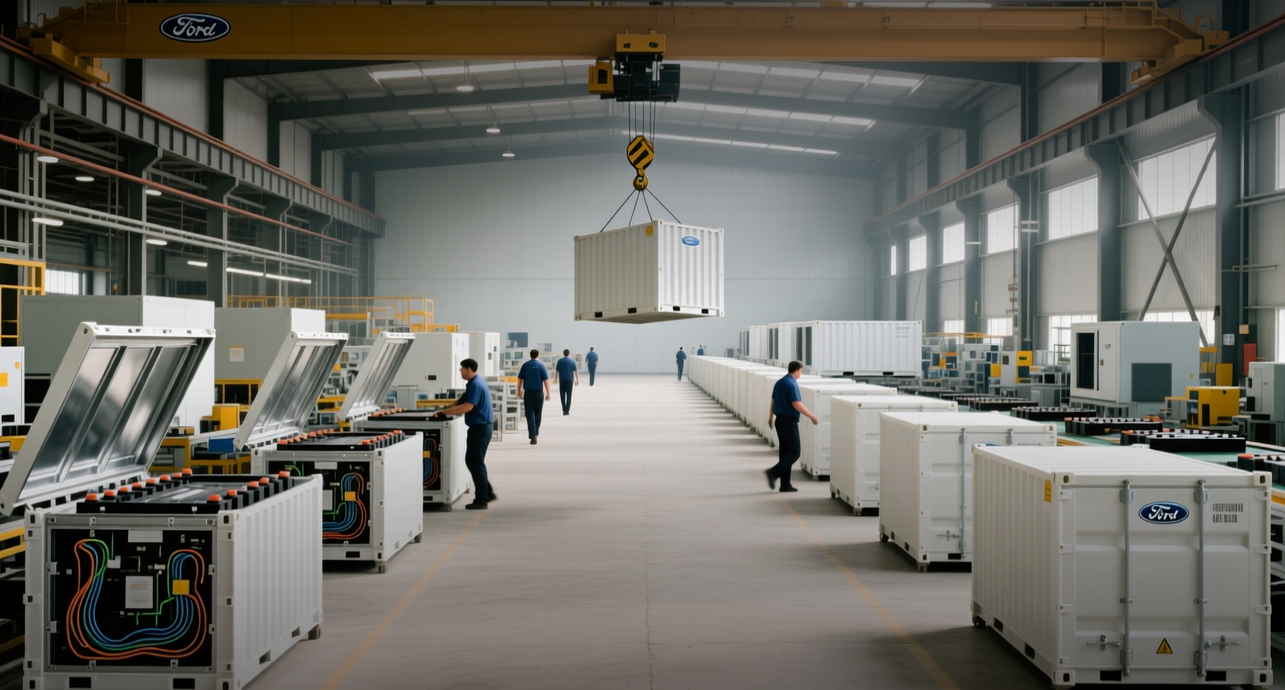
Ford's new Ford Energy battery-storage unit could add more than $4 billion in annual revenue by decade-end, yet the near-50% May stock surge that recast the legacy automaker as an AI-infrastructure supplier has already given back about half as investors weigh real contracts against hype.
"Energy storage is a new business, but they have the right technology," a group of Morgan Stanley analysts led by Andrew Percoco wrote in a note. "[W]e see this as an opportunity for Ford to deploy capital into a strategic growth area with a structure that preserves operational control and regulatory alignment."
Ford Energy, a wholly owned subsidiary unveiled in May, will manufacture battery cells, assemble modules and containers, and sell and service large battery energy storage systems (BESS) for utility customers, AI data centers, and other industrial clients. Its DC block is engineered for stable, predictable performance over roughly two decades. The unit targets 20 gigawatt-hours of annual capacity, which J.P. Morgan analysts estimate could produce over $4 billion in revenue and $250 million to $500 million in annual operating profit by the end of the decade.
The stakes reach beyond a fresh revenue line. Ford Energy could absorb output from underutilized electric-vehicle battery plants, helping push the money-losing Model e division toward profitability sooner than EV scale alone would allow. Model e has lost more than $18 billion combined between 2022 and the second quarter of 2026.
Why AI data centers need the batteries
AI workloads run intense computing that strains the electrical grid, and data centers require an uninterrupted power supply. Ford's BESS provide backup during grid fluctuations or blackouts, charge when electricity is cheap, and discharge when prices peak, lowering costs while guarding against downtime. EDF Power Solutions has already signed a five-year agreement to buy up to 20 gigawatt-hours of large BESS, with deliveries beginning in 2028.
The move puts Ford in direct competition with Tesla's Megapack and other grid-scale storage suppliers that have ridden the same data-center power crunch. Tesla's energy-storage deployments have grown sharply as hyperscalers lock in backup capacity, and Ford's entry signals the automaker sees the same demand curve — but with a manufacturing base it already owns.
The hype question
The EDF contract is real, but so is the scale gap. Even at the high end of J.P. Morgan's estimate, $500 million in operating profit would move the needle only modestly against Ford's $6.8 billion in adjusted earnings before interest and taxes for 2025. The stock, which still trades as a traditionally low-margin automaker, has surrendered about half of its May advance, leaving investors to decide whether the pullback is an entry point or a correction toward fundamentals.
Ford shares, down 4.24% in the session cited, are not a pure-play AI stock. But the battery business, combined with higher-margin software-defined services spreading through vehicles, gives industrial and automotive investors a way to own the AI-infrastructure theme without the valuation of a dedicated data-center supplier. The open question is whether Ford Energy's $4 billion revenue target by 2030 — and the EDF agreement underpinning it — justifies the repositioning, or whether the market has already priced in more than the unit can deliver.
This article is for informational purposes only and does not constitute investment advice.