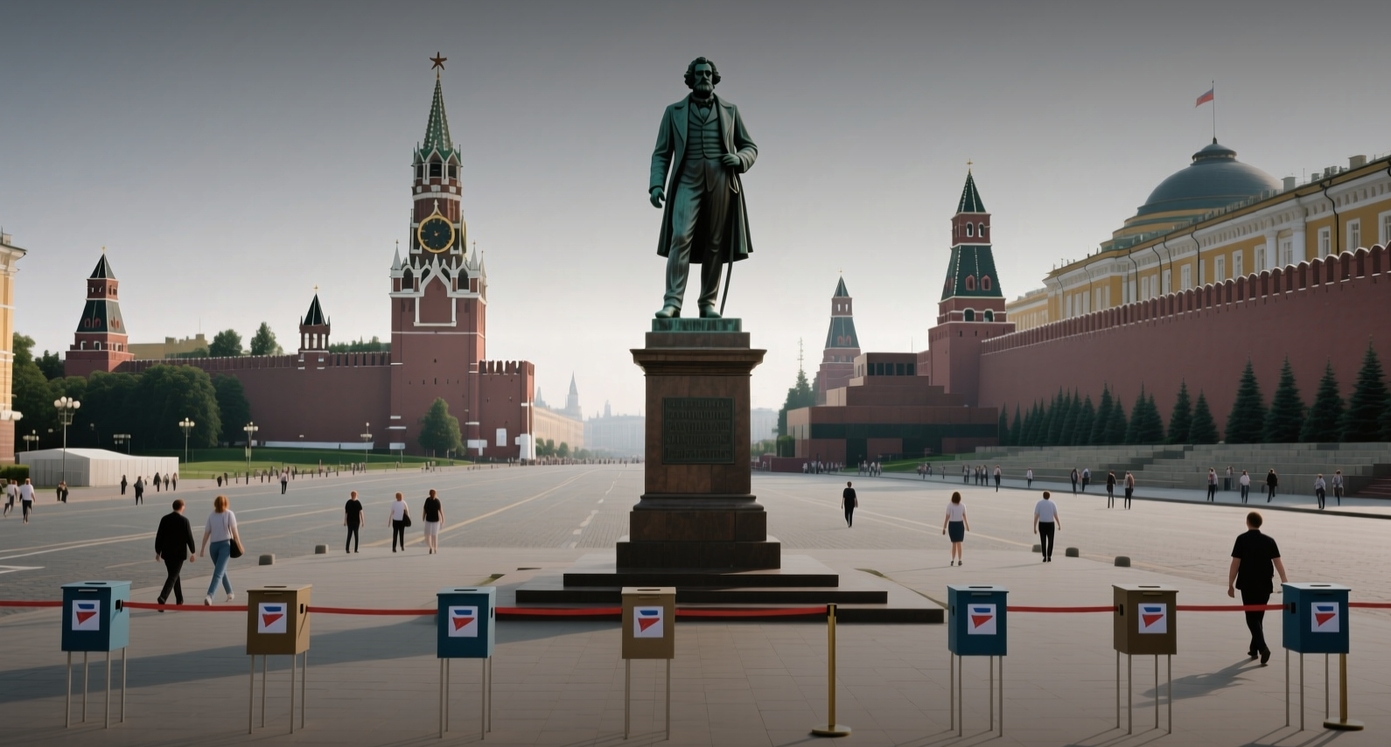
Moscow residents cast nearly 750,000 ballots Friday in a city referendum on whether to move the statue of poet Alexander Pushkin about 100 yards across Pushkin Square — a rare exercise in direct democracy that Kremlin critics say exposes how little room remains for meaningful debate in President Vladimir Putin's managed political system. The majority voted to keep the 40-foot monument where it stands, at the entrance to the square a short walk from the Kremlin.
"This is partly an attempt to generate interest in the elections which have become completely meaningless following the removal of the Yabloko party," said Andrei Kolesnikov, a Russian political analyst and columnist at the Russian-language New Times.
The ballot came less than a month before parliamentary elections scheduled for Sept. 18-20, and the city said the electronic vote would serve as a test run for the national poll. The contrast was stark: while Moscow residents were invited to weigh in on the statue's location, the only party that campaigned on an openly antiwar platform was removed from the federal ballot. Russia's Supreme Court struck Yabloko from the State Duma election on Aug. 10 after a pro-Kremlin nationalist party filed a complaint citing copyright violations in the party's application paperwork, and an appeal failed on Aug. 17.
The statue vote underscores how civic life in the capital has been channeled into urban-planning questions while political dissent is squeezed out. Yabloko, founded in the early 1990s, won 45 seats in the 1995 parliamentary election but slid to the margins during Putin's early presidency, losing its final four seats in 2007. It has polled around 1 percent for several election cycles — far below the 5 percent threshold parties need to enter parliament via the national list — yet recent polling suggested it could reach at least 3 percent while campaigning for a ceasefire in Ukraine.
That prospect appears to have triggered the crackdown. Medusa, an independent Russian outlet now based in Latvia, quoted a political strategist with Kremlin connections as saying authorities first allowed Yabloko to register to observe the impact once campaigning began, then removed the party as a form of "risk mitigation" after its numbers improved. Another consultant working with the presidential administration told Meduza that Yabloko had become a "mouthpiece amplifying the signal of the opposition in exile."
The party's leadership has been hit hard. Deputy chairman Lev Shlosberg was sentenced to 11 years in prison on Aug. 17 for "discrediting" the armed forces, and fellow deputy chairman Maxim Kruglov received a seven-year sentence in June for expressing sadness over deaths in Ukraine in two Telegram posts from 2022. Thousands of Russians have been detained or fined for antiwar views since the invasion began, and many opponents have left the country.
The removal of Yabloko leaves the Duma's four opposition parties — A Just Russia, New Russia, the Communists, and the ultranationalist Liberal Democratic Party — operating within boundaries set by the Kremlin, a system analysts describe as "managed opposition." United Russia holds at least 312 seats against 122 shared by the four parties, none of which contests the war or political repression. Putin took 88 percent of the vote in the 2024 presidential election against carefully managed rivals.
Igor Gretskiy, a research fellow at the International Centre for Defence and Security in Tallinn, said the barring of Yabloko, following the earlier blocking of Boris Nadezhdin from the 2024 presidential race, suggests the Kremlin no longer sees value in maintaining even a controlled version of pluralism. "We're at the point in which Russia is in the process of a totalitarian consolidation of its political system," he said, arguing that the war and Western sanctions have increased economic risk, prompting authorities to reduce any remaining domestic political uncertainty.
For exiled activist Andrei Pivovarov, who was freed in August 2024 in the largest prisoner swap between Russia and Western intelligence agencies since the Cold War, the Yabloko case is a "small victory" for the opposition even without a "chance to vote for peace." "It's not a win for the opposition, but it's a loss for the Kremlin because they show his weakness," he said, adding that the decision to ban a weak party would be noted by the war elite and figures in the FSB.
The election itself is not expected to deliver surprises. United Russia is expected to cruise to another commanding majority, with its candidate list this time including army veterans from the war in Ukraine. The mixed electoral model — combining single-seat constituencies with party-list mandates — is expected to leave the managed opposition with roughly the same combined seat total. But the statue referendum, which drew nearly 750,000 voters, offered a glimpse of the alternative: a civic exercise where the outcome was genuinely uncertain, even if the stakes were limited to a monument's location.
This article is for informational purposes only and does not constitute investment advice.