Advanced Micro Devices' data center business has crossed a threshold that changes how the market values the company. Data Center revenue more than doubled year over year to a record $6.0 billion, a figure that turns AMD from a distant second supplier of AI accelerators into the only credible alternative to Nvidia at scale.
The milestone lands with AMD (NASDAQ: AMD) already up roughly 6,800% over 10 years, a run that has been driven less by its legacy CPU franchise than by the market's willingness to underwrite a second AI infrastructure supplier. That willingness is now being tested against revenue rather than roadmap slides.
"Every hyperscaler wants a second source, and AMD is the only one with the silicon, the software stack and the foundry capacity to be it," said Rachel Kim, semiconductor analyst at Edgen, who covers AI infrastructure buildouts. "The question was never whether the demand existed. It was whether AMD could ship it."
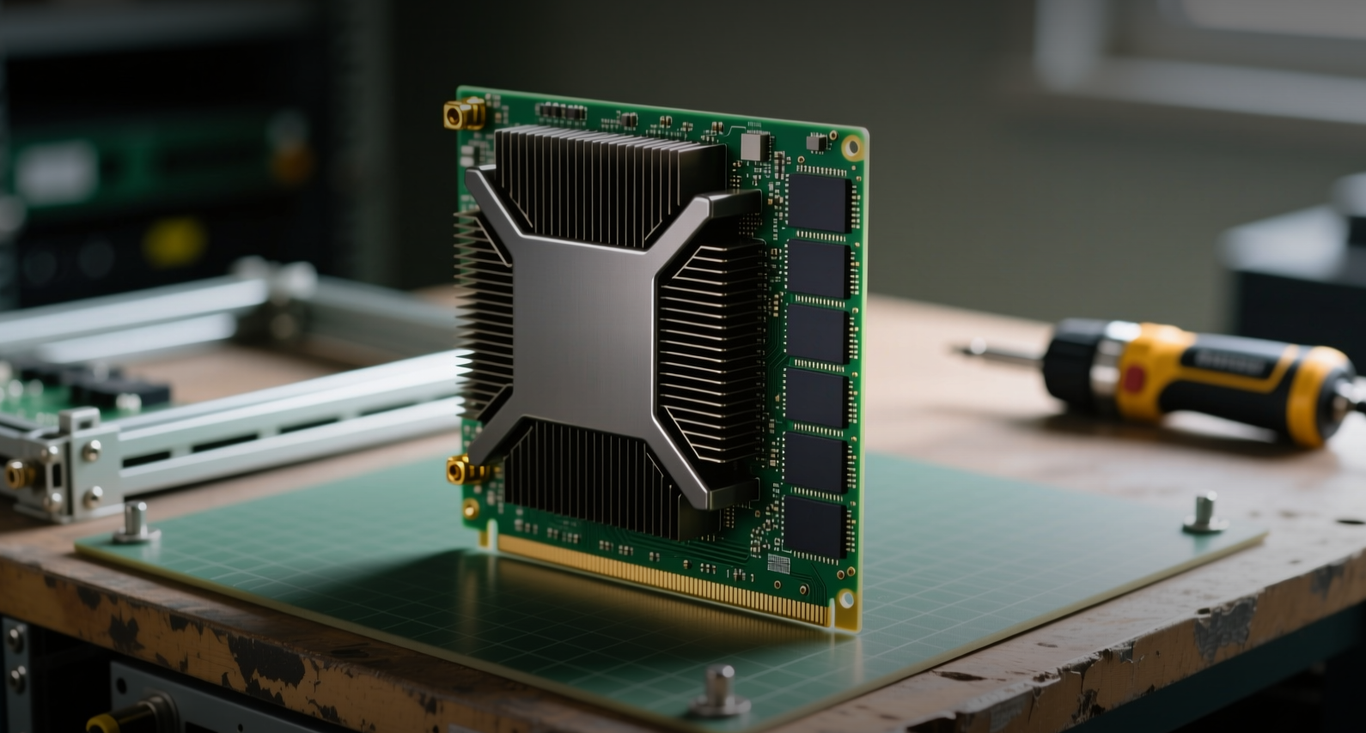
The $6.0 billion quarter matters because of what it implies about the rest of the stack. AMD's Instinct MI300X accelerators carry 192 gigabytes of HBM3 memory, more than the 80GB on Nvidia's H100, a specification advantage that matters for inference workloads where large models must sit in memory rather than be shuttled back and forth. Both companies rely on TSMC for leading-edge wafers and on advanced packaging capacity — CoWoS for Nvidia, a mix of CoWoS and TSMC's SoIC for AMD — which makes packaging, not design, the binding constraint on how fast either can convert demand into revenue.
That constraint cuts both ways. Nvidia's data center business remains several times AMD's size, and its CUDA software layer still holds most enterprise AI developers. AMD's answer is ROCm, an open software stack that has closed much of the gap on the most common training and inference frameworks but has not eliminated the switching cost for teams with years of CUDA-optimized code. The practical result is a market that splits by workload: Nvidia keeps the frontier training clusters, while AMD wins share in inference and in the second-source slots that procurement teams now mandate.
Hyperscaler capex, not product launches, sets the ceiling
The demand side of that equation is being written by four customers. Microsoft, Amazon, Google and Meta have all committed to multi-year data center buildouts, and each has an incentive to keep at least two accelerator vendors qualified. That procurement logic is what makes a $6.0 billion quarter possible for a challenger, and it is also what caps the upside: AMD's revenue is a function of how much of that capex budget gets allocated to a second source, not of how good the silicon is in isolation.
The supply chain adds a second ceiling. Advanced packaging capacity at TSMC has been the tightest link in AI accelerator production for several quarters, and both AMD and Nvidia are competing for the same lines. AMD has also leaned on Samsung Foundry and ASE for portions of its packaging and assembly, a diversification that reduces single-source risk but adds qualification time. Any acceleration in AMD's data center revenue therefore depends on packaging capacity coming online, not on design wins alone.
For investors, the re-rating question is whether AMD should be valued as an AI franchise or as a cyclical chipmaker with an AI option. The stock's 10-year performance — roughly 6,800% — already reflects a substantial amount of the former. AMD trades at a premium to its own historical multiple, and the market has priced in continued data center growth rather than a plateau. The risk is not that AI capex stops; it is that the second-source share AMD captures settles at a level below what the current multiple assumes.
The next checkpoint is the company's forward guidance, which will show whether the $6.0 billion quarter was a step change or a peak. Watch three things: whether data center revenue grows sequentially again, whether management quantifies MI300X or its successor volume for the first time, and whether gross margin holds as the accelerator mix shifts away from higher-margin server CPUs. Nvidia's own data center print, due in the same reporting cycle, will frame the share-shift debate from the other side.
This article is for informational purposes only and does not constitute investment advice.