

XPENG's humanoid robots will reach mass production by Q4 2026, with CEO He Xiaopeng personally taking the helm of the robotics unit to drive the company's expansion beyond electric vehicles.
XPENG's humanoid robots will reach mass production by Q4 2026, with CEO He Xiaopeng personally taking the helm of the robotics unit to drive the company's expansion beyond electric vehicles.
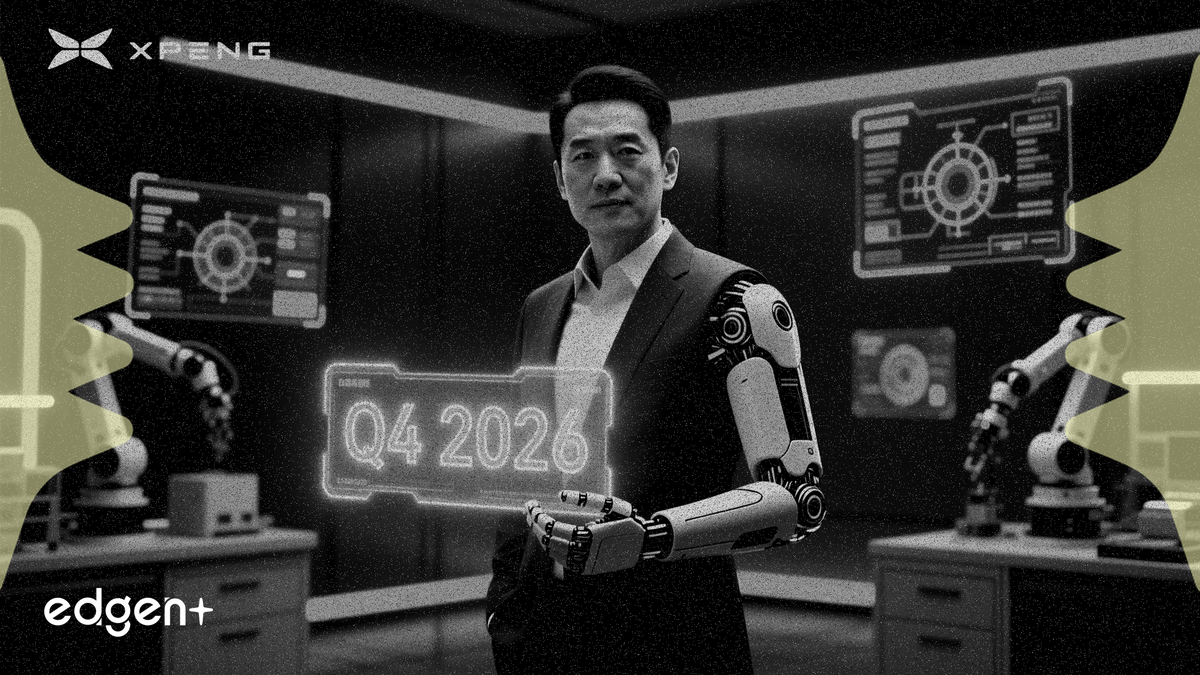
XPENG's humanoid robots will reach mass production by Q4 2026, with CEO He Xiaopeng personally taking the helm of the robotics unit to drive the company's expansion beyond electric vehicles.
XPENG's push into humanoid robots places it in direct competition with Tesla's Optimus and a growing field of startups, with the Chinese EV maker targeting household adoption by 2028 as it seeks a second growth engine beyond its core auto business.
"The group is standing at a historic inflection point, with XPENG's robotics arm entering the eve of mass production and commercialization," He Xiaopeng, Chairman and CEO of XPENG, said in an internal letter today. He will serve as CEO of the robotics business with immediate effect, in addition to his group CEO role.
Under the plan, XPENG will begin mass producing humanoid robots in the fourth quarter of 2026, introduce them into offline stores for sales assistance by the first quarter of 2027, expand to overseas markets by the second quarter of 2027, and target household entry by 2028. He compared the current stage to the period eight years ago when XPENG was preparing to launch its first vehicle, the G3 — suggesting the robotics business is at a similar pre-delivery inflection point. The company's vision centers on developing elegant, aesthetically pleasing and safe humanoid robots capable of close human interaction, differentiating from industrial-focused competitors.
XPENG's humanoid robots differ from those of other manufacturers in technology, product positioning and commercialization roadmap, He said, without disclosing specific technical specifications or pricing. The company has not yet revealed the robot's form factor, degrees of freedom, or battery life — details that would allow comparison with Tesla's Optimus Gen 2, which can walk, squat and handle objects weighing up to 10 kilograms. Boston Dynamics' Atlas, meanwhile, has demonstrated parkour and backflips but remains a research platform with no announced production timeline.
The robotics push comes as XPENG's core EV business faces intensifying competition in China, the world's largest auto market. The company delivered 18,000 vehicles in May, trailing peers like Nio and Li Auto. Diversifying into humanoid robots — a market Goldman Sachs estimates could be worth $6 billion by 2030 and $154 billion by 2035 — offers a potential new revenue stream, though the technology remains years from meaningful commercial returns. Figure AI, backed by Microsoft and OpenAI, has raised over $750 million to develop general-purpose humanoid robots, while Amazon has invested in Agility Robotics' Digit for warehouse automation.
XPENG's household-focused strategy sets it apart from most competitors targeting industrial and logistics applications first. The company aims to develop robots capable of close human interaction, requiring advanced safety systems, natural language processing, and dexterous manipulation — capabilities that remain technically challenging even for well-funded rivals. He is betting that XPENG's experience in autonomous driving, computer vision, and battery systems from its EV business will transfer to robotics, reducing development costs and timelines.
XPENG shares fell 5.5 percent on Wednesday, with short selling reaching $241.3 million — 34.7 percent of total turnover — reflecting near-term skepticism about execution risks and capital allocation. Morgan Stanley reiterated its overweight rating with a HKD96 price target, signaling long-term confidence in the company's strategic direction despite the stock's current weakness. At the current price, XPENG trades at a discount to Nio and Li Auto on a price-to-sales basis, partly reflecting uncertainty around the robotics investment's return profile.
This article is for informational purposes only and does not constitute investment advice.
