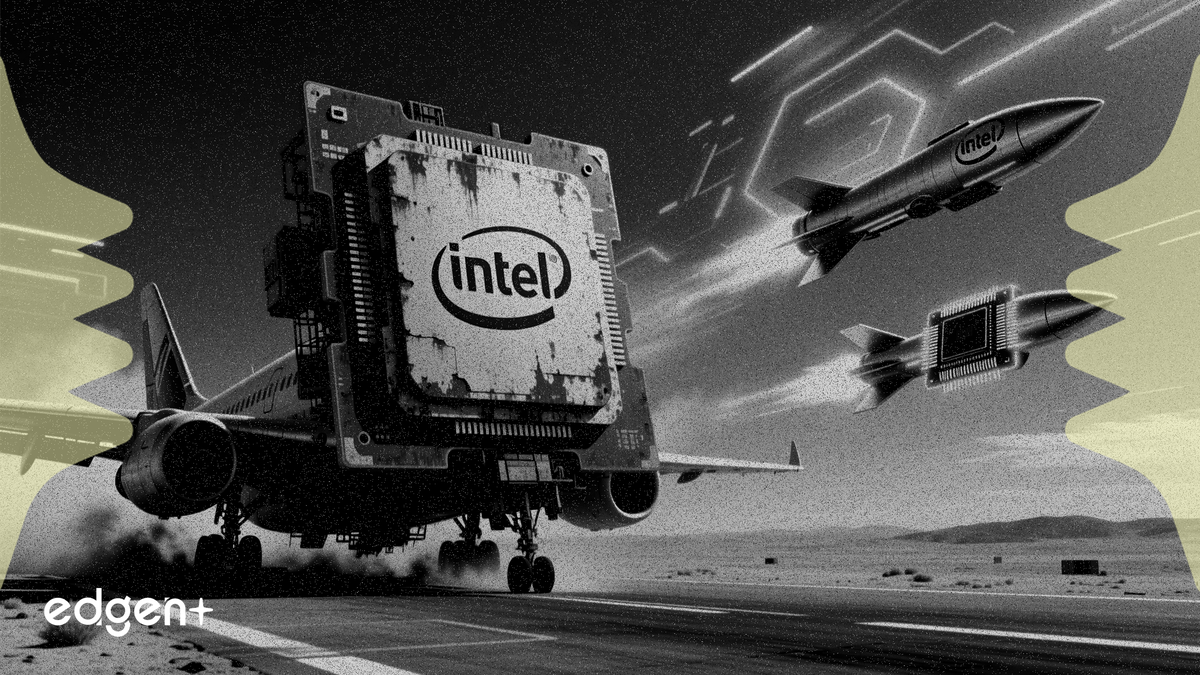
An emerging Wall Street view suggests valuing Intel not against its semiconductor peers, but as an industrial turnaround story akin to Boeing, where massive execution risk is balanced by enormous long-term potential.
Intel’s stock has surged to the consternation of many analysts, whose valuation models struggle to justify a price-to-earnings ratio of 94 times expected earnings. This valuation appears stretched when compared to the iShares Semiconductor ETF's average of 28 times, but the comparison to chip peers like Nvidia or Taiwan Semiconductor Manufacturing Co. may be flawed. A better analogy might be Boeing, another American industrial giant in the midst of a multi-year turnaround.
"Semiconductor foundries trade based on book value," says Melius analyst Ben Reitzes, who was early to identify Intel's comeback potential. This valuation framework shifts the focus from near-term earnings, which are depressed by heavy investment, to the long-term value of the company's manufacturing assets.
The disconnect is why only 33 percent of analysts covering Intel rate its shares a Buy, far below the S&P 500 average of 55 percent. Boeing faces similar skepticism, trading at 160 times forward earnings while its peer Airbus trades at 22 times. For both companies, investors are looking past depressed 2026 earnings toward 2028, when Boeing’s free cash flow is expected to top $10 billion and Intel's is projected to turn positive.
The central question is the ultimate value of Intel's foundry services. The market is assigning a high probability that the division will reach high-margin steady state by 2028. If Intel can successfully build out its capacity and prove it can manufacture chips as efficiently as TSMC, the foundry business alone could be worth nearly $1 trillion, a significant jump from Intel's current $600 billion market capitalization.
Foundry Momentum Gains With 2 Major Client Wins
Intel's foundry ambitions, once viewed with skepticism, are now backed by tangible progress and major customer commitments. The company's 18A process node, its most advanced, has entered commercial production with yields reportedly ahead of schedule. This is a critical proof point, as manufacturing yield has historically been a challenge for Intel at leading-edge nodes.
Two significant client wins have underscored this momentum. Apple and Intel have a preliminary agreement for Intel to produce a portion of the chips for Apple devices, according to recent reports. A deal with Apple would reduce the tech giant's reliance on TSMC in Taiwan and represent a major validation of Intel's manufacturing capabilities. Separately, Elon Musk's Terafab initiative, which aims to build a U.S.-based AI computing stack for Tesla and xAI, will use Intel's design and manufacturing. The Terafab deal also served as the first public commitment for Intel's next-generation 14A node.
This progress is underpinned by substantial government support. Through the U.S. CHIPS Act, Intel is set to receive approximately $8.5 billion in grants and has access to $11 billion in loans. This funding de-risks a portion of the massive capital expenditure required for its new fabrication plants in Arizona and Ohio, effectively making the foundry's success a federal strategic priority amid ongoing U.S.-China trade frictions.
The $1 Trillion Question: Can Intel Match TSMC's Margins?
While momentum is building, the investment case hinges on financial execution. Valuing Intel on a book value basis, as suggested by Reitzes, reveals significant potential. TSMC trades at more than 12 times its book value, while Intel trades for about five times. If Intel's foundry division were to become as profitable as TSMC's, with its 45 percent net margins, some analyses project it could be worth roughly $1.2 trillion once all planned capacity is online around 2031.
A more conservative estimate from another analysis suggests that capturing 7.5 percent of a global semiconductor market expected to exceed $1.6 trillion by 2030 would generate $120 billion in annual foundry revenue for Intel. Assuming 30 percent net margins—well below TSMC's—that would imply $36 billion in profit, supporting a potential $900 billion valuation for the foundry segment alone. Outside the foundry, Intel still has a chip design business slightly larger than AMD, which boasts a market value over $700 billion.
This upside is not guaranteed. Intel must prove it can consistently deliver on its technology roadmap and run its fabs at high utilization rates. However, the narrative is shifting. As AI workloads evolve from pure training (favoring GPUs) to a mix of training and inference, CPUs are reclaiming a central role as the coordination layer. This trend benefits Intel's established CPU business while its foundry ramps up, positioning the company to capture value from both sides of the AI build-out.
This article is for informational purposes only and does not constitute investment advice.