

Escalating hostilities between the US and Iran pushed global risk assets lower for a fourth consecutive session, with Brent crude surging past $94 a barrel and Bitcoin falling to $73,000.
Escalating hostilities between the US and Iran pushed global risk assets lower for a fourth consecutive session, with Brent crude surging past $94 a barrel and Bitcoin falling to $73,000.
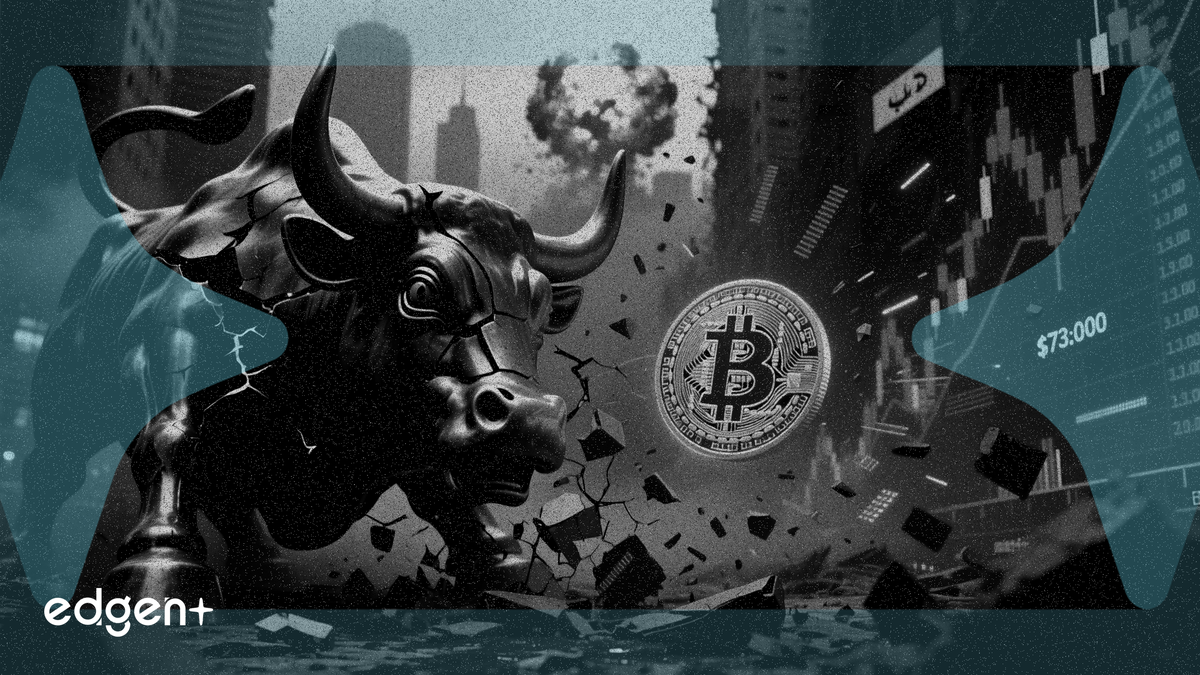
Escalating hostilities between the US and Iran pushed global risk assets lower for a fourth consecutive session, with Brent crude surging past $94 a barrel and Bitcoin falling to $73,000.
Wall Street ended lower and Bitcoin slid to $73,000 as escalating US-Iran hostilities fueled inflation fears and complicated the Federal Reserve's rate path.
"The conflict in the Middle East has become a key factor shaping the global economic outlook," the Organization for Economic Cooperation and Development said in a report, warning that a prolonged standoff could trigger a decline in global GDP and rising unemployment.
Brent crude rose 3.34 percent to $94.16 a barrel after Iran's Islamic Revolutionary Guard Corps attacked US-linked targets in the region, including a Kuwait airport and a Fifth Fleet headquarters in Bahrain. The Strait of Hormuz blockade has disrupted fertilizer output and supply, a key factor behind rising food crisis risks, according to Nadezhda Orlova, director of the Institute for Agrarian Studies at the Higher School of Economics. In Asia, India's Sensex fell 508 points, or 0.68 percent, to 74,267, its fourth consecutive decline, while Japan's Nikkei ended higher despite the Bank of Japan signaling an 80 percent probability of a June rate hike to 1 percent.
The selloff reflects a broader rotation out of risk assets as investors price in a prolonged period of elevated energy costs and tighter monetary policy. The OECD outlined two scenarios: a quick resolution that would restore Gulf energy production and support global GDP growth, or a protracted conflict lasting through 2027 that would keep energy and fertilizer prices elevated, tighten financial conditions, and raise recession risks.
The Trump administration added to the uncertainty by proposing double-digit tariffs of 10 percent to 12.5 percent on imports from dozens of major trading partners, including the European Union, China, India, Japan and the UK, following a forced labor investigation. The proposal drew immediate criticism from Beijing, which warned of rising trade tensions.
The VIX, Wall Street's fear gauge, remained elevated as traders weighed the dual shocks of geopolitical conflict and trade policy uncertainty. The US 10-year Treasury yield fluctuated as investors recalibrated expectations for Federal Reserve rate cuts, with inflation fears delaying the timeline for any easing.
For Bitcoin, the drop to $73,000 marked a retreat from recent highs as the digital asset traded in lockstep with equities during the risk-off move. The cryptocurrency's correlation with the S&P 500 has strengthened in recent weeks as macro factors override token-specific narratives.
Asian markets bore the brunt of the selloff. India's benchmark indices fell for a fourth straight session as foreign institutional investors offloaded Rs 21,105.86 crore worth of equities on Friday, exchange data showed. "The Nifty opened marginally higher but gradually came under sustained selling pressure as hopes of a near-term diplomatic breakthrough faded," said Ponmudi R, chief executive officer at Enrich Money.
The Bank of Japan is widely expected to raise rates to 1 percent at its June 16 meeting, with Governor Kazuo Ueda emphasizing the need to address rising inflation. Higher oil prices are increasing inflationary pressures in Japan, though they also pose risks to economic growth given the country's reliance on imported energy.
The Strait of Hormuz blockade has created long-term risks for the food industry, said Oleg Kobyakov, director of the UN Food and Agriculture Organization's Russia Liaison Office. Disruptions in fertilizer output and supply are a key factor, with nitrogen fertilizer production dependent on natural gas and maritime routes both affected by the conflict.
"Global food security cannot recover on its own, through market forces alone," said Anatoly Tikhonov, director of the Center for Agribusiness and Food Security at the Russian Presidential Academy. "The process requires political will, cooperation, and an end to the perception of food as a weapon."
This article is for informational purposes only and does not constitute investment advice.
