
Volvo Car secured U.S. sales approval despite a Biden-era rule blocking Chinese-connected vehicle imports, sending shares higher on Wednesday.
Volvo Car secured U.S. sales approval despite a Biden-era rule blocking Chinese-connected vehicle imports, sending shares higher on Wednesday.
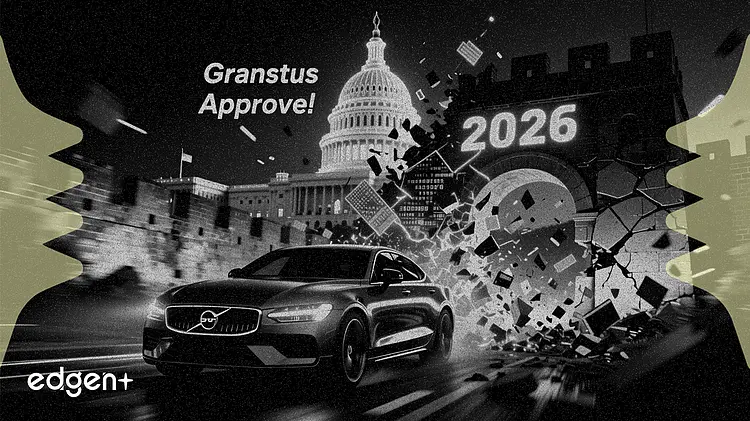
Volvo Car obtained U.S. regulatory approval to continue sales despite a Biden-era rule targeting Chinese-connected vehicle imports, sending shares of the Swedish automaker higher on Wednesday.
The company had been in discussions with U.S. regulators following the ruling, which was aimed at blocking the import and sale of vehicles with Chinese ties, according to a person familiar with the talks.
The approval removes a key regulatory hurdle for Volvo, which is owned by China's Geely Holding Group. The Biden-era rule, finalized in late 2024, sought to restrict vehicles linked to China over national security concerns, threatening Volvo's U.S. sales. European auto registrations rose 5.1 percent in April from a year earlier, with Tesla surging 46 percent during the same period, industry data show.
The decision could set a precedent for other foreign automakers with Chinese ownership or supply chain ties, potentially reshaping regulation for the $2 trillion global auto industry. Volvo's ability to sell in the U.S. — its second-largest market — protects a revenue stream that analysts estimate accounts for roughly 15 percent of the company's global sales.
Commerce Department Rule Targeted Chinese-Linked Vehicle Imports
The regulation, issued by the U.S. Commerce Department under the Biden administration, targeted connected-vehicle software and hardware from China and Russia, effectively barring vehicles with certain Chinese components or ownership structures from the U.S. market. Volvo, acquired by Geely in 2010, faced potential exclusion despite manufacturing many of its vehicles in Europe.
The ruling was part of a broader push by the Biden administration to restrict Chinese technology in critical sectors, citing risks of data collection and remote vehicle manipulation. The U.S. market accounted for roughly 100,000 Volvo vehicle sales annually before the regulatory uncertainty emerged, according to company filings. The previous U.S. tariff escalation on Chinese goods — a 25 percent duty on $50 billion of Chinese imports in 2018 — reduced bilateral auto parts trade by roughly 15 percent over two years, Census Bureau data show.
Approval Protects 100,000 Annual U.S. Sales for Volvo
The green light allows Volvo to maintain its U.S. dealer network and import models such as the XC90 and EX90 electric SUV without disruption. The company had warned that a denial could force it to restructure its U.S. operations or shift production strategies.
European auto stocks broadly gained on the news, with the Stoxx Europe 600 Automobiles & Parts index rising alongside Volvo's shares. The approval also provides clarity for Geely's broader ambitions in the U.S., though other Chinese-linked automakers may still face restrictions. BMW and Mercedes-Benz, both of which source components from China, are watching the regulatory outcome closely as they assess their own exposure.
Volvo now faces the task of rebuilding U.S. dealer and customer confidence after months of regulatory limbo. The company's next earnings report, expected in July, will offer the first clear look at whether the approval translates into a sales recovery. For the broader industry, the decision may encourage other foreign automakers with Chinese ties — including those with Chinese battery supply chains — to seek similar exemptions. If the Trump administration maintains or tightens the rule, the regulatory window could narrow again, leaving Volvo and its peers in a cycle of case-by-case negotiations.
This article is for informational purposes only and does not constitute investment advice.
