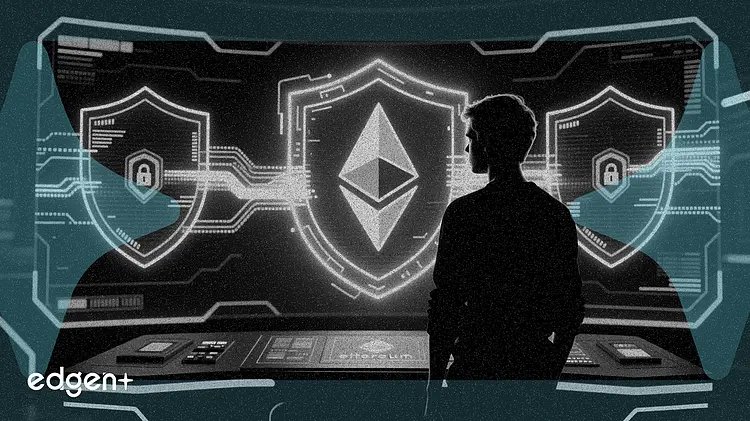
(P1) Ethereum co-founder Vitalik Buterin announced three near-term technical upgrades designed to build native privacy features directly into the world's largest smart contract blockchain, a move aimed at improving censorship resistance and data protection.
(P2) "This replaces the single sender nonce with (nonce_key, nonce_seq), giving frame transactions independent replay domains," pseudonymous researcher soispoke.eth said, explaining the improvement from Keyed Nonces.
(P3) The three initiatives are Account Abstraction (AA) combined with FOCIL (fork-choice enforced inclusion lists), Keyed Nonces, and new access-layer tools like the Kohaku privacy toolkit. AA and FOCIL work together to make private transactions more difficult to censor at the validator level. Keyed Nonces prevent observers from linking multiple private transactions to a single account. Access-layer work focuses on allowing users to query blockchain data without exposing their activity to third-party node providers.
(P4) The integration of native privacy is seen by many as a critical step for Ethereum's long-term utility and value. By making privacy a core feature rather than a third-party workaround, Ethereum aims to attract institutional investors who require confidentiality and strengthen ETH's properties as a form of money. None of the changes are live yet, but the announcement signals a clear direction for the network's development.
Uncensorable Private Transactions with AA and FOCIL
Currently, when a user sends a private transaction on Ethereum using a mixer like Tornado Cash, it enters a public waiting area where block builders can see and potentially exclude it, leading to censorship. The proposed FOCIL (fork-choice enforced inclusion lists) upgrade would allow a committee of validators to propose a list of transactions that block builders must include, making censorship much harder. This is combined with Account Abstraction, which upgrades user accounts to be more like programmable smart contracts, enhancing flexibility and security.
Keyed Nonces to Prevent Transaction Linking
Every Ethereum account has a "nonce," a sequential number that increases with each transaction. While this prevents transaction replays, it also allows observers to link different private transactions back to the same account. The introduction of "keyed nonces" replaces this single counter with a more complex structure, making it significantly more difficult to trace a user's activity across multiple private transactions on the chain.
Private Data Queries with Kohaku
Even if transactions themselves are private, a user's activity can be tracked by the third-party node providers their wallet relies on to read blockchain data. These providers can log IP addresses and wallet identities. The Kohaku privacy toolkit, introduced in 2025, gives wallet developers tools to query blockchain data privately, so nodes can answer requests without learning what specific information the user is asking for.
This article is for informational purposes only and does not constitute investment advice.