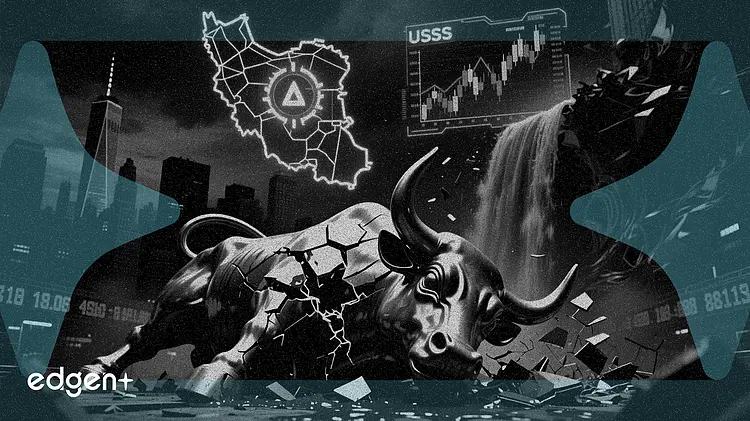
Wall Street's record-breaking run hit a wall as escalating US-Iran hostilities pushed stock futures sharply lower, threatening to end the S&P 500's longest winning streak in four decades.
US stock futures fell across the board Wednesday after the US military struck Iranian targets, escalating Middle East tensions and snapping a nine-week winning streak that had carried the S&P 500 above 7,600 for the first time.
"The momentum has been incredibly strong, but we are moving past earnings season into the summer lull, and geopolitical risk remains on the horizon," Meghan Shue, head of investment strategy at Wilmington Trust, said.
S&P 500 futures declined 0.98%, while Dow Jones Industrial Average futures dropped 1.20% and Nasdaq 100 futures fell 0.73%. The Russell 2000 index of small-cap stocks slid 1.46%, the steepest decline among major benchmarks. The selloff in futures followed a historic regular session Tuesday that saw the S&P 500 close above 7,600 for the first time at 7,609.78, with the Dow adding 228.91 points to 51,307.79.
The retreat puts at risk the S&P 500's nine-week winning streak, the longest since 1985. Investors now face a choice between riding the artificial-intelligence-driven rally that has powered equities to repeated records and hedging against a geopolitical shock that has pushed oil above $96 a barrel.
Geopolitical Catalyst Intensifies
The selloff followed US Central Command's announcement that it had carried out "self-defense strikes" on Iran's Qeshm Island after American forces defeated Iranian ballistic missiles and drones. The Kuwait army earlier reported that air defense systems were "intercepting hostile targets." President Donald Trump said on Truth Social that negotiations with Iran were "continuing, at a rapid pace," even as military operations escalated.
Oil futures extended gains in response, with Brent crude rising nearly 1% to around $96.89 a barrel and West Texas Intermediate climbing to about $94.60. The 10-year Treasury yield stood at 4.459%, while gold fell to roughly $4,474 an ounce.
Sector Rotation Underway
Tuesday's regular session showed the rotation already beginning beneath the surface. Seven of 11 GICS sectors closed higher, led by utilities at plus 1.93%, materials at plus 1.16% and industrials at plus 1%. Communication services was the worst performer, sliding 2.61%, followed by health care at minus 0.99% and consumer discretionary at minus 0.71%.
The divergence between defensive sectors and tech-heavy communication services suggests investors were already repositioning before the overnight futures decline. The VIX, Wall Street's fear gauge, is expected to rise from recent lows when cash trading resumes.
What's Next
Traders will watch Wednesday's ADP National Employment Report for May, along with factory orders data and the Federal Reserve's Beige Book for regional economic conditions. The May nonfarm payrolls report due Friday will be the week's main event, offering the next test of whether the economy can sustain the AI-led rally without overheating.
This article is for informational purposes only and does not constitute investment advice.