
Key Takeaways:
- US oil supply fell to 20.38 million bpd in March, the lowest since November 2025
- Texas production dropped to 5.78 million bpd, the lowest since January 2026
- The supply decline compounds record SPR drawdowns amid the Iran conflict
Key Takeaways:
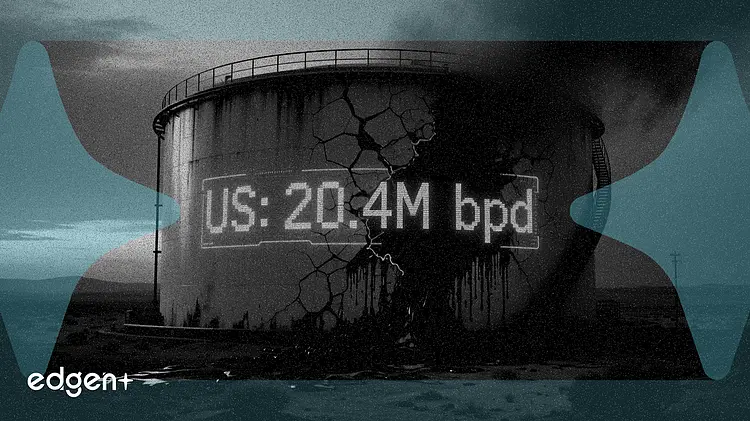
US crude production slipped to its lowest in six months in March, driven by declines in Texas and North Dakota that underscore the challenge of sustaining record output amid depleting shale wells.
US oil supply fell to 20.38 million barrels per day in March, the lowest since November 2025, as production in Texas — the nation's largest oil-producing state — dropped to a four-month low of 5.78 million bpd, Energy Information Administration data showed.
"The production dip in Texas and North Dakota is a reminder that US shale output isn't a straight line upward — it's lumpy and subject to well-level depletion," said Kevin Liu, an oil and gas analyst with Bloomberg Intelligence. "The broader question is whether the industry can sustain 13 million-plus bpd of crude output as the best acreage gets drilled out."
North Dakota production fell to 1.21 million bpd, the lowest since December 2025, while New Mexico held steady at 2.31 million bpd. Gasoline supply rose to 8.85 million bpd, the highest since October 2025, suggesting resilient consumer demand even as crude production slipped. Refined products supply dropped to 3.90 million bpd, the lowest since December 2025.
The supply decline comes as the US Strategic Petroleum Reserve has been drawn down to about 365 million barrels — near four-decade lows — to offset disruptions from the Iran conflict and the near-standstill at the Strait of Hormuz. With WTI crude hovering around $90 a barrel and the US having released about 50 million barrels of the 172 million committed in March, any further production weakness could tighten an already strained market.
Texas Leads the Pullback
The 5.78 million bpd from Texas in March was down from recent peaks and marked the lowest since January 2026. The Permian Basin, which accounts for roughly half of the state's output, has seen operators shift from Tier 1 drilling locations to less productive Tier 2 acreage, a trend that typically accelerates decline rates. The EIA's monthly data lags weekly estimates by about two months, meaning the March figures may not yet capture the full impact of operational changes in response to the Iran-driven price environment.
The US was producing more than 13 million bpd of crude alone as recently as late 2025, compared with roughly 5.5 million bpd when the SPR was last near full capacity in the 2010s. That production growth has fundamentally altered the strategic calculus around emergency reserves, though it has not eliminated vulnerability to supply shocks.
Supply Squeeze Meets Geopolitical Strain
The production dip coincides with the most aggressive SPR drawdown in history. The US withdrew a record 9.92 million barrels in the week ended May 15, and another 9.1 million barrels the following week, leaving reserves at 365 million barrels — roughly half of the 714 million barrel capacity. Energy Secretary Chris Wright said in March that the oil removed would be replaced by about 200 million barrels within the next year, but replenishment depends on congressional funding and could take years, according to Jason Bordoff, founding director at Columbia University's Center on Global Energy Policy.
If the Strait of Hormuz disruption persists through August, prices could reach $140 to $150 a barrel, ESAI Energy's Sarah Emerson warned. The US's ability to respond with additional SPR releases is limited by the maximum drawdown rate of 4.4 million bpd and the remaining 300 million barrels projected by the end of the current release cycle. The last time the US faced a comparable supply-demand tension was during the 2022 Ukraine crisis, when the SPR was drawn down by 7.41 million barrels in a single week — a record that has since been surpassed twice in May 2026 alone.
This article is for informational purposes only and does not constitute investment advice.
