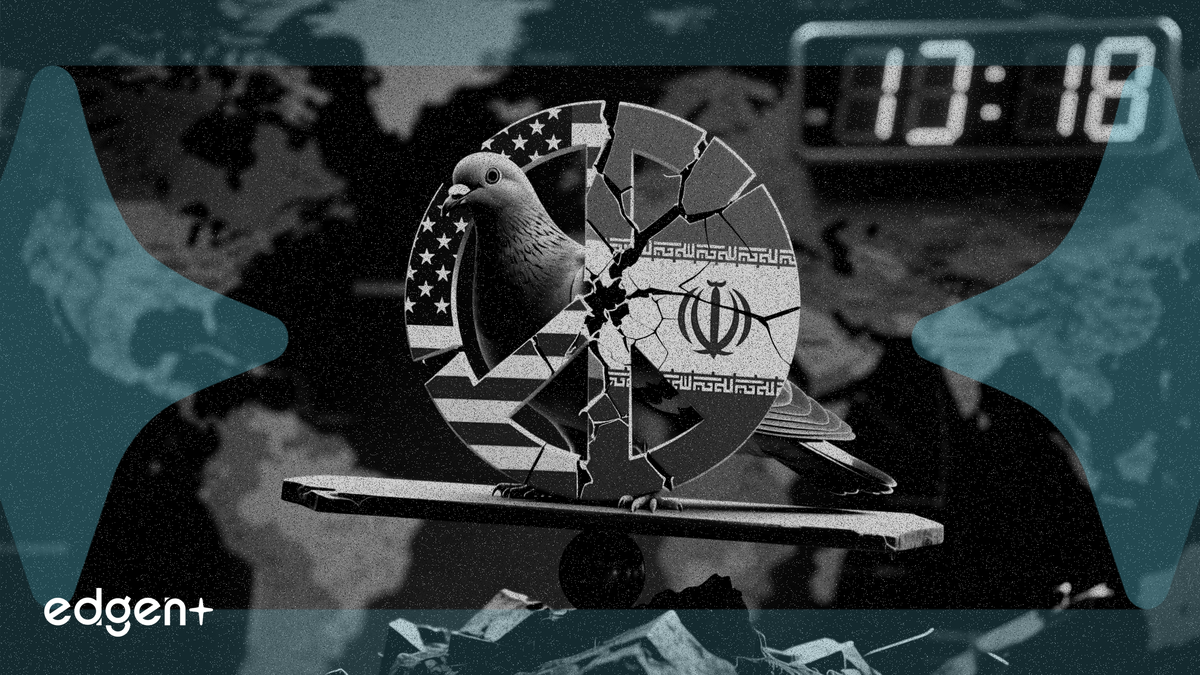
US Secretary of State Marco Rubio said he expects a response from Iran on Friday regarding a one-page American peace proposal, even as he affirmed the US would retaliate against any missile attacks, highlighting the tension between diplomacy and recent military clashes that have rattled global oil markets.
"We hope that what they are proposing is a serious proposal," Rubio said during a media interview in Italy. "We hope that the current situation can push both sides into a serious negotiation process."
The statement follows a volatile 24 hours where both nations exchanged fire in the Strait of Hormuz, a critical oil chokepoint. Brent crude futures swung from losses to gains, settling near $100 a barrel, while the S&P 500 fell 0.4 percent as investors weighed the conflicting signals.
The global economy is watching if the two sides can agree to a 30-day truce to negotiate a comprehensive deal, including the future of Iran's nuclear program. A failure to de-escalate risks a broader conflict that could send oil prices soaring and tip the world economy into recession, a scenario outlined by economist Nouriel Roubini.
A Fragile Cease-fire Tested
The diplomatic overtures are occurring under the shadow of renewed conflict. On Thursday, U.S. Central Command reported that its forces had "intercepted unprovoked Iranian attacks" involving missiles and drones against three American destroyers. In response, the U.S. military struck Iranian military facilities on Qeshm Island and near Bandar Abbas.
Iran, however, accused the United States of violating the cease-fire first by firing on an Iranian oil tanker. An Iranian military spokesman stated they had "retaliated by attacking U.S. military vessels."
President Trump sought to minimize the exchange, dismissing the Iranian attacks as a "trifle" and boasting that "We blew them away." Yet, he also issued a stark warning that if a deal is not signed fast, Iran could become "one big glow."
The 1-Page Deal on the Table
The proposal at the center of the talks aims for an immediate de-escalation. According to Iranian officials, the plan includes three core points: the lifting of the U.S. blockade on Iranian ports, the opening of the Strait of Hormuz to commercial traffic, and a 30-day cessation of hostilities to allow for comprehensive negotiations.
The primary obstacle remains the future of Iran's nuclear program. The U.S. is demanding that Iran agree in principle to hand over its stockpile of highly enriched uranium and suspend its enrichment activities for 20 years. Tehran has countered with a proposal to dilute some uranium and transfer the rest to a third country, possibly Russia, with a shorter 10 to 15-year suspension.
The situation has drawn a wide range of expert analysis. Economist Nouriel Roubini expressed skepticism, suggesting investors are underpricing the risk of a breakdown in talks. He laid out a worst-case scenario where a renewed conflict triggers a global recession and a bear market for stocks. In contrast, Beni Sabti, an Iran researcher at INSS, argued that the "Iranian hubris is overflowing" and that the regime will not negotiate seriously without renewed military pressure from the US and Israel.
This article is for informational purposes only and does not constitute investment advice.