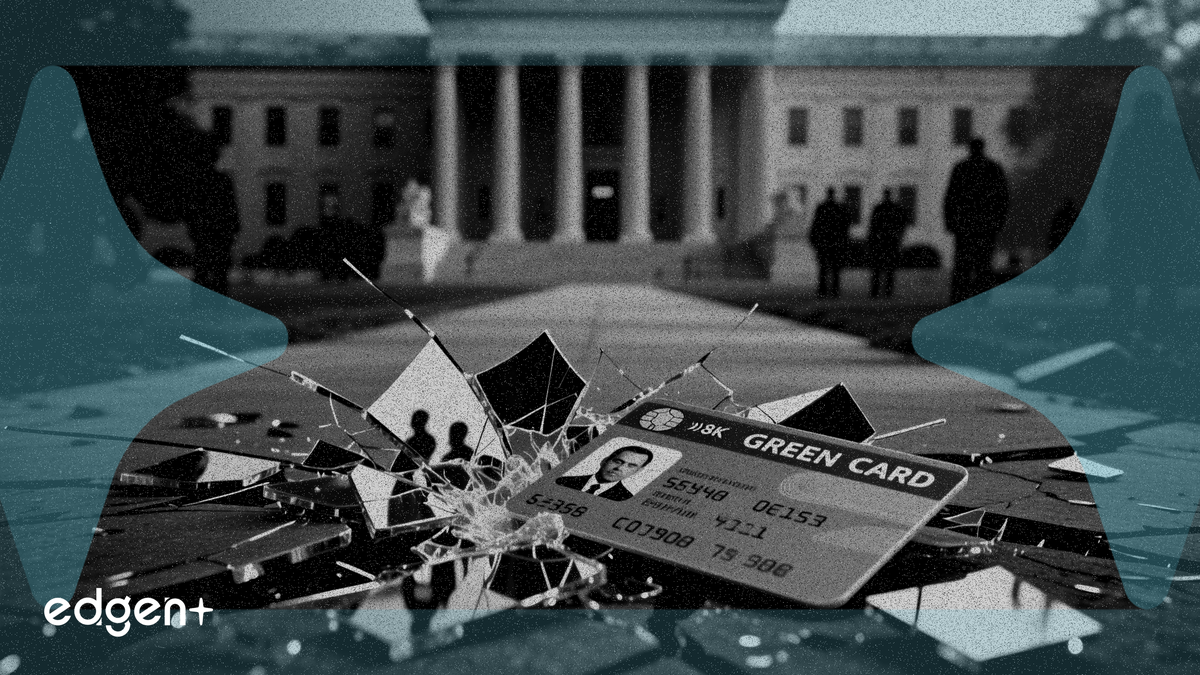
The Trump administration has ended a 70-year precedent allowing temporary visa holders to apply for permanent residency from within the US, a move that could force over one million people to leave the country.

The Trump administration will now require most temporary visa holders to return to their home countries to apply for permanent residency, a major policy shift ending a long-standing practice and affecting more than 1.2 million people currently in green card backlogs.
"From now on, an alien who is in the US temporarily and wants a Green Card must return to their home country to apply, except in extraordinary circumstances," USCIS spokesman Zach Kahler said in a statement Friday.
The policy primarily impacts H-1B workers, students, and other nonimmigrants who could previously use the "adjustment of status" process to apply for a green card without leaving the country. The move follows a 38.5 percent drop in H-1B registrations for fiscal year 2027 and what the Cato Institute reports as a 50 percent cut in green card approvals over the past year.
The change threatens to disrupt the US technology sector by forcing high-skilled workers, many from India, to leave their jobs for an uncertain consular process that could last years. The new guidance is part of a broader immigration review triggered by a November 2025 shooting in Washington D.C., with USCIS now reframing in-country applications as "extraordinary relief" rather than standard procedure.
The announcement drew immediate condemnation from the technology industry, which relies heavily on H-1B and other visas to fill high-skilled roles. LinkedIn co-founder Reid Hoffman called the move "damaging for tech, for business, and for America," questioning if AI researchers would be forced to wait in multi-decade backlogs from abroad. The policy could create significant operational disruption for companies with key personnel caught in the transition.
Immigration lawyers and advocates echoed those concerns, challenging the administration's legal justification. "It’s a legal immigration process stipulated in the regulations," said New York-based immigration attorney Eva Golinger, noting that visas like the H-1B and O-1 are explicitly designated as dual-intent, allowing holders to pursue permanent residency. FWD.us, an immigration advocacy group, called the policy a "deeply harmful upheaval of more than 70 years of legislative, administrative, and judicial precedent."
The impact is expected to be most severe for Indian nationals, who constitute the majority of the employment-based green card backlog, which now exceeds 1.2 million applicants according to the Cato Institute. Due to per-country caps, wait times for Indian professionals in the EB-2 and EB-3 categories already stretched for years, and in some cases, decades. Forcing them to return to India for consular processing adds another layer of uncertainty and potential family separation.
Some attorneys warned the policy could be a "trap," as certain individuals who leave the US could be subject to three- or ten-year bars on re-entry. Charles Kuck, a former president of the American Immigration Lawyers Association, said he anticipates litigation, arguing the policy was not properly vetted and violates multiple provisions of the Immigration and Nationality Act.
USCIS maintains that the change restores the original intent of immigration law, where adjustment of status is a discretionary benefit, not an entitlement. The agency stated the shift would allow it to better allocate resources to other priorities, such as humanitarian visas and naturalization applications, while reducing the incentive for visa overstays.
This article is for informational purposes only and does not constitute investment advice.