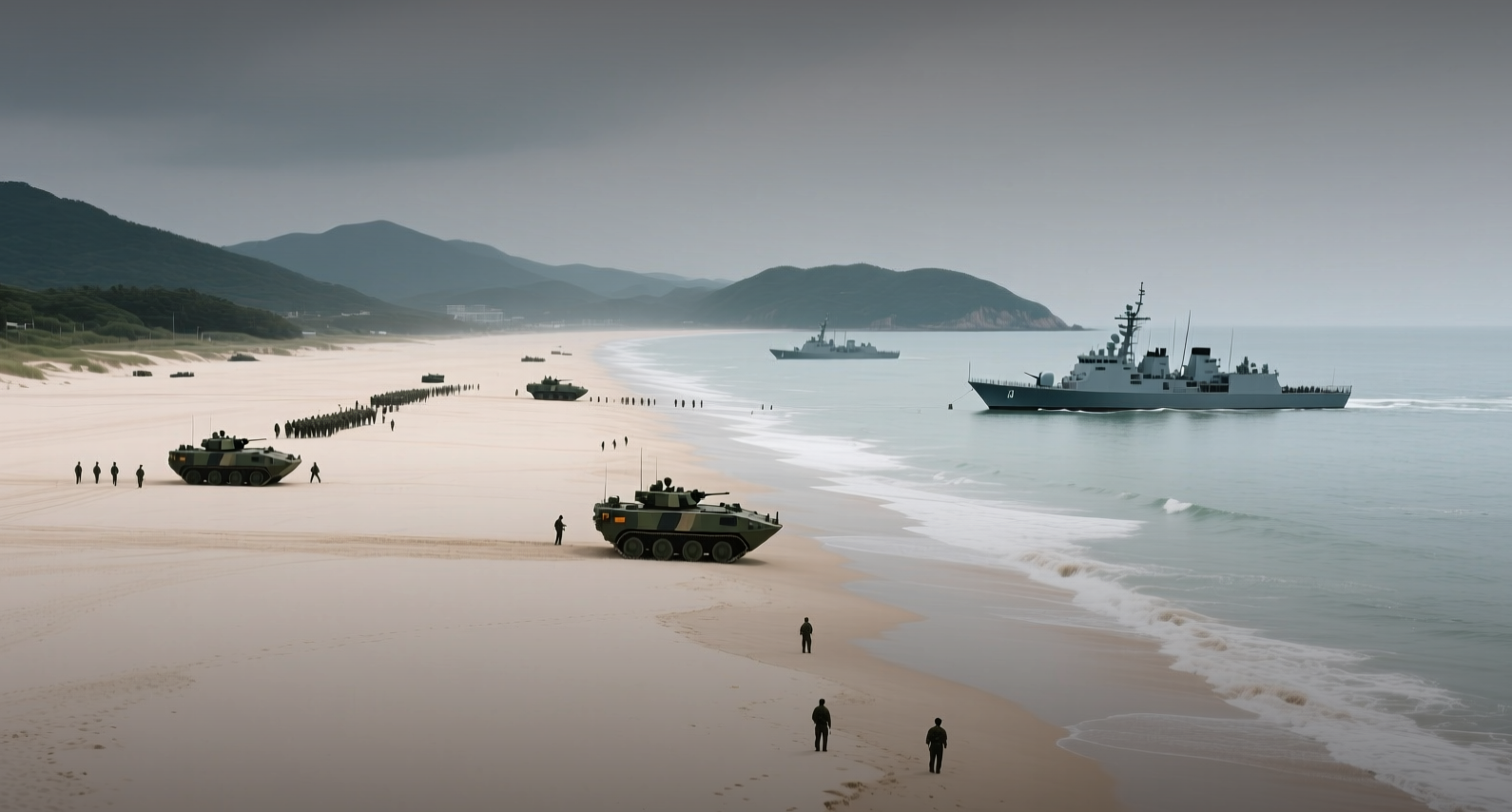
The US has canceled the Twin Dragons amphibious exercise with South Korea, the second joint drill scrapped or scaled back this year as the war in Iran drains American forces from the Pacific.
The US canceled the Twin Dragons amphibious exercise with South Korea scheduled for next month, the second joint drill cut this year as the Iran war pulls American forces from the Pacific.
"The U.S. Marine Corps formally notified our forces in June that its ability to deploy forces during this year's Ssangyong exercise would be constrained due to the situation in the Middle East," Han Seung-jeon, a South Korean Marine Corps spokesperson, said.
More than 2,000 US Marines stationed in Japan were transferred to the Middle East in March, and the USS George Washington aircraft carrier has replaced the USS Abraham Lincoln, which had been deployed for more than 250 days. The cancellation follows President Donald Trump's order to end the Ulchi Freedom Shield exercises six days early on Friday, cutting the 11-day drill to five.
The pullback has intensified doubts over Washington's commitment to deterrence on the Korean Peninsula, with both Democrats and Republicans warning the curtailment risks undermining the alliance. North Korea, which fired 10 short-range ballistic missiles last week, dismissed the scaled-down exercises as "unworthy of comment."
The Twin Dragons drill, known as Ssangyong, is a biennial, division-level exercise that in a typical iteration brings more than 10,000 Marines from both countries to a beachfront landing on South Korea's southeastern coast. The 2024 edition featured more than 13,000 personnel, over 20 naval vessels, 30 aircraft and 40 amphibious-assault vehicles, the US Navy said.
The cancellation marks the second time the exercise has been shelved under Trump. It was paused starting in 2018, when Trump made similar calls to scale back US-South Korea exercises during his first-term diplomacy with North Korean leader Kim Jong-un, and resumed in 2023 under the Biden administration. The last time the drills were halted, Pyongyang used the pause to open a negotiating channel with Washington, a dynamic Trump has sought to revive.
Trump has questioned why Washington should fund joint drills when Seoul has declined to take part in the conflict with Iran. South Korea's president publicly opposed the withdrawal of US air defense assets from the country this spring, and a South Korean bulk carrier was struck by what Seoul said was likely an Iranian missile in the Strait of Hormuz in May. The war has depleted critical US munitions stockpiles and forced a realignment of assets from Asia to the Middle East.
Trump wrote on his Truth Social platform that the Ulchi Freedom Shield drills sent "a signal that was totally inappropriate and hostile" to a country that has been "unthreatening and respectful" during his presidency. North Korea has long condemned the joint exercises as rehearsals for invasion, and despite the reduction it fired 10 short-range ballistic missiles last week while denouncing the exercises.
The curtailment carries market-relevant implications for the region. South Korean defense contractors, which have benefited from the alliance's joint training commitments, face uncertainty over future procurement as the US reallocates forces, while investors weigh whether Washington can manage concurrent conflicts in the Middle East and the Pacific. The allies remain in close consultations on resuming the drills, Han said, though he did not specify measures to prevent future cancellations or make up for lost training. US Forces Korea did not immediately respond to a request for comment.
This article is for informational purposes only and does not constitute investment advice.