

The DOE's $500 million battery grants mark a first step against China's supply chain dominance, but insiders say the scale and timeline fall far short of what's needed to close a gap built over decades.
The DOE's $500 million battery grants mark a first step against China's supply chain dominance, but insiders say the scale and timeline fall far short of what's needed to close a gap built over decades.
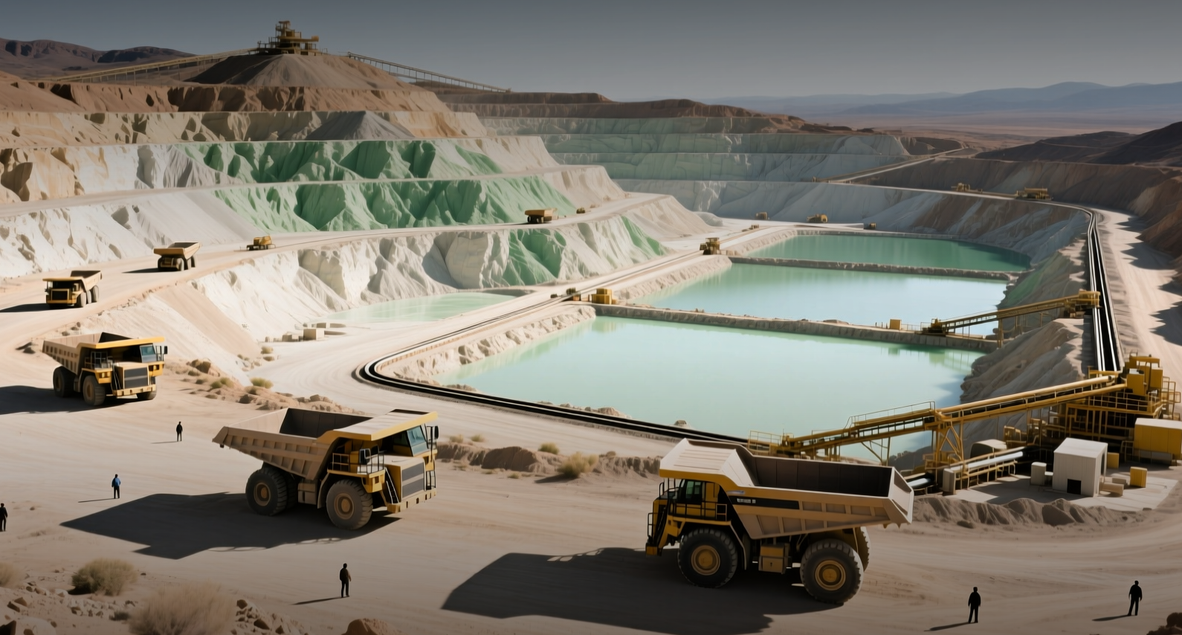
The Department of Energy's $500 million in battery grants is Washington's opening salvo against China's 80 percent share of global cell production, but executives and analysts say the funding barely registers against a lead built over decades of state-backed investment.
"It takes decades and tens, if not hundreds of billions of dollars to achieve the kind of full scale across the supply chain that China now has," Tu Le, founder and managing director of Sino Auto Insights, said. "We don't have decades. We have five, six, seven years to try to become competitive."
The August awards went to seven companies spanning mineral processing, materials, manufacturing and recycling — the first disbursement from two $3 billion DOE programs created under the Infrastructure Investment and Jobs Act. Recipients include Coreshell Technologies, which received $50 million to make battery anodes from domestically sourced silicon instead of Chinese graphite, and Lilac Solutions, which took $100 million for a lithium extraction method that bypasses spodumene refining, a stage where China controls 95 percent of global capacity, according to the International Energy Agency.
For Albemarle, the world's largest lithium producer and a bellwether for US battery materials exposure, the policy signal matters more than the dollar figure. The company's shareholders sit at the intersection of Washington's onshoring ambitions and the structural reality that China refines 95 percent of hard-rock lithium, produces 85 percent of cathode active material and more than 90 percent of anode material.
The competitive gap is widening as China's domestic EV market expands faster than the US market. New energy vehicles — hybrids, battery-electrics and extended-range models — captured 65 percent of Chinese passenger car sales in July, according to the China Passenger Car Association, while electrified vehicles accounted for about 24 percent of US sales in the second quarter, per the Energy Information Administration. US total new car sales reached 16.3 million in 2025 versus 23.7 million in China, according to Cox Automotive.
The Trump administration has simultaneously ended federal tax credits for EVs and other battery-related funding. Since January 2025, nearly $24 billion in announced battery projects have been canceled, according to Atlas Public Policy, a think tank. That reversal compounds the challenge for US firms trying to scale production.
Richard Wang, CEO of Voya Energy, a battery technology company, pointed to CATL, the world's largest EV and energy storage battery manufacturer, as evidence of how far Chinese producers have advanced. "They have built up an incredible lead in terms of technology and manufacturing capabilities across the world," Wang said. "They are one of the only battery companies in the world that's not only high in revenue, but is significantly profitable because of how strong their manufacturing and supply chain capabilities are."
Beyond the core $500 million, the DOE's Office of Critical Minerals and Energy Innovation separately distributed $117 million across 56 industrial projects, while the Pentagon issued a $1.4 billion loan to expand a Washington state battery factory. Energy Secretary Chris Wright framed the effort in national security terms: "For too long, America has depended on foreign actors for critical materials essential to modern life that underpin our economy, energy security, and national security."
US startups are producing novel approaches to bypass China's choke points. Lilac Solutions CEO Raef Sully said his company's technology can produce battery-grade lithium carbonate or hydroxide at the extraction site, skipping the spodumene processing step that China dominates. "You're bypassing that important step, that processing step that China has a chokehold on today," Sully said.
But scaling from prototype to mass production remains the bottleneck. "These small fledgling companies are super innovative, but getting and building prototypes of what they're trying to sell is one thing," Le said. "Being able to mass produce them at a high quality level, repeatably in the millions of units is another thing entirely."
Gene Berdichevsky, CEO of Sila Nanotechnologies, a silicon anode maker, said private investment depends on stable federal policy. "It takes an immense amount of time and effort to expand and do this right," he said. "And for investors to bet on that, they need confidence that we have the right policies to support this kind of industry and not just let it go offshore."
Energy storage demand is rising — averaging 70 percent growth since 2022, according to the EIA — even as EVs still account for more than 70 percent of total lithium-ion battery deployment, per the IEA. Tom Moerenhout, critical minerals initiative lead at Columbia University's Center on Global Energy Policy, said the defense sector alone cannot underwrite a full battery supply chain. "If you really want to onshore supply chains, you need electric vehicles, it's as simple as that," he said.
For Albemarle shareholders, the calculus is straightforward: the $500 million grants show continued federal commitment to domestic lithium demand, but the structural gap with China's refining and manufacturing capacity means US battery material prices and volumes will remain pressured until domestic processing scales meaningfully. Sully said the grants represent an early step. "So early days, but a step in the right direction," he said.
This article is for informational purposes only and does not constitute investment advice.
