
Rising Treasury yields are forcing investors to reassess equity valuations as the 5-year note hits its highest level since February 2025.
Rising Treasury yields are forcing investors to reassess equity valuations as the 5-year note hits its highest level since February 2025.
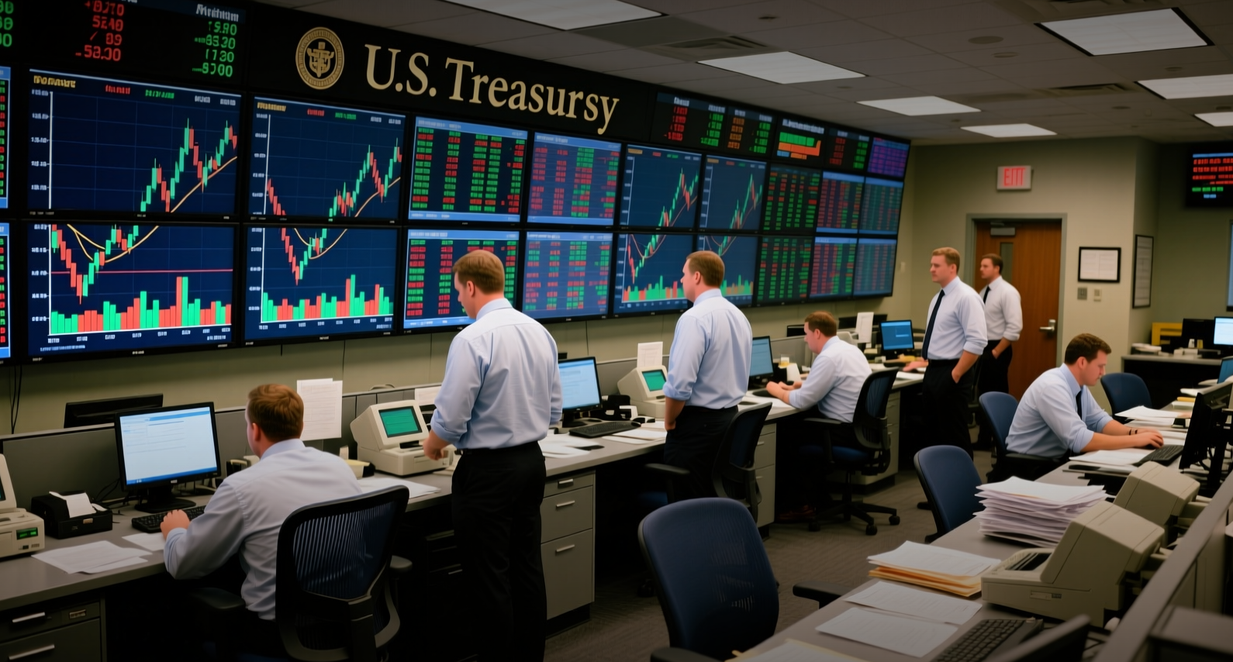
The 5-year Treasury yield climbed to 4.48%, the highest since February 2025, extending a surge that has pushed the 10-year to 4.71% and the 30-year to 5.33% — a level not seen in nearly two decades.
"The move reflects investors demanding greater compensation for inflation and fiscal risk," said Scott Bessent, U.S. Treasury Secretary, who announced plans to repurchase over $4 billion in long-dated bonds to signal that current yields "do not reflect the underlying fundamentals."
The yield surge has hit growth stocks hardest, with the technology-heavy Nasdaq Composite swinging sharply as higher discount rates compress the present value of future earnings. Financials have outperformed, with the S&P 500 Financials sector gaining as higher rates improve net interest margins. The S&P 500, which touched an all-time high of 7,610 on June 2, has since drifted into the 7,350-7,400 range as investors weigh the rate outlook.
With core PCE running at 3.4% in May — the highest in three years — and the national debt topping $40 trillion, investors face a higher-for-longer rate regime that could keep equity valuations under pressure into the December FOMC meeting.
The 5-year note's rise to 4.48% caps a months-long repricing driven by two forces: inflation running well above the Federal Reserve's 2% target and mounting concern over fiscal sustainability. The government is running a roughly $1.8 trillion deficit this fiscal year, and the national debt has just topped $40 trillion. When the Treasury issues more debt to finance spending, the added supply pushes prices down and yields up — especially when investor demand fails to keep pace.
The Fed finds itself caught between competing pressures. Newly installed Chairman Kevin Warsh, sworn in May 22, has signaled a preference for lower rates, but nine of the 12 Federal Open Market Committee members favored at least a quarter-point hike at the mid-June meeting. Markets have priced in a "higher-for-later" path, with the 2-year note at 4.16% suggesting limited expectations for aggressive easing.
The rate shock has accelerated rotation within equities. Financials have drawn inflows as higher rates widen net interest margins, while utilities and real estate investment trusts — prized for dividend yields — have lost ground as Treasuries become more competitive income alternatives. Energy has been the strongest sector this year, up in the low-20% range year-to-date, while information technology has gained mid-teens. The Russell 2000 has led the major benchmarks, up 22.2% at the end of June.
Nvidia's August earnings report showed how fundamental strength can cut through the rate headwind. The AI chip leader delivered revenue of roughly $8.5 billion, beating consensus, even as its stock traded about 8% below its May record high heading into the print. The results reassured investors that AI capital spending by cloud providers remains intact despite higher borrowing costs.
For equity investors, the yield environment argues for emphasizing quality — companies with strong balance sheets and pricing power — while managing fixed-income duration to capture higher yields without excessive rate sensitivity. The 30-year bond now yields more than top dividend payers like Ford Motor, whose trailing yield sits near 4.2%, and Coca-Cola, at 2.33%. Argus Research raised its 2026 S&P 500 earnings forecast to $340 a share, implying 24.8% growth, and sees $390 in 2027.
Crude oil has climbed 66% year-to-date, adding to the inflation pressure that keeps the Fed on hold. The next test comes at the December 9 FOMC meeting, where the CME FedWatch tool shows a near-even split between rates holding at 3.75%-4.0% and rising to 4.0%-4.25%. A sustained break above 5% on the 10-year would likely trigger further equity weakness, while stabilization in yields could support a relief rally in rate-sensitive sectors.
This article is for informational purposes only and does not constitute investment advice.
