

The UK's decision to sanction HTX has made automated compliance tools unreliable by tainting millions of legitimate wallet addresses tied to the exchange's $3.3 trillion in annual trading volume.
The UK's decision to sanction HTX has made automated compliance tools unreliable by tainting millions of legitimate wallet addresses tied to the exchange's $3.3 trillion in annual trading volume.
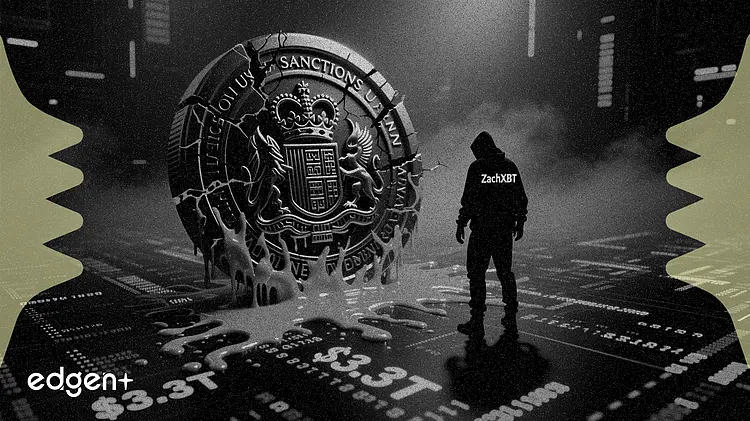
The UK's decision to sanction HTX has made automated compliance tools unreliable by tainting millions of legitimate wallet addresses tied to the exchange's $3.3 trillion in annual trading volume.
The UK's May 26 sanctions against HTX have rendered on-chain risk scores functionally useless, according to blockchain investigator ZachXBT, as compliance tools now flag any wallet that has ever touched the exchange — including addresses with no connection to illicit activity.
"Basically now I've had to ignore the sanctions category when tracing cases by exposure since 'risk' itself has become meaningless," ZachXBT, a pseudonymous on-chain sleuth, said in a June 9 post.
The UK Foreign, Commonwealth and Development Office designated Huobi Global S.A., the Panama entity behind HTX, on May 26, naming 18 entities and accusing the exchange of routing over $1.5 billion to Russian networks including A7 and Garantex. It marked the first time Britain applied Regulation 17A — a banking-style blanket prohibition on payment processing — to a cryptocurrency exchange. HTX processed roughly $3.3 trillion in trading volume over the past year, according to industry data, meaning its wallet clusters are linked to a vast portion of the broader crypto ecosystem.
The breadth of the designation has created a cascading compliance crisis. FixedFloat now suspends Huobi-originating funds for additional verification. Hyperliquid banned HTX-linked addresses on June 3, and OpenSea subsequently restricted every wallet in the affected profiles. World Liberty Financial, the Trump-linked DeFi project, froze HTX-linked addresses after compliance reviews, prompting HTX to delist the platform's USD1 stablecoin and suspend several trading pairs.
Why the Sanctions Broke Risk Scoring
ZachXBT contrasted the HTX sanctions with past designations of Hydra and Garantex, which carried high illicit-activity rates. HTX, he noted, serves a large Asian retail base, and compliance tools struggle to separate pre- and post-sanction activity. A Global Ledger report showed HTX processed about $21.06 billion in high-risk crypto flows between 2021 and May 2026, with at least $7.64 billion linked to Russian entities and darknet markets including Garantex, Grinex, A7A5 and Hydra.
One affected user said wallets holding 99.5% of their net worth were frozen after a few post-sanction HTX withdrawals. ZachXBT advised moving funds several hops away through decentralized bridges, adding that reversing the high-risk tags is not currently possible since protocols defer bans to third-party tools while those firms leave the decision to clients.
The episode tests how regulators balance precise targeting against the blunt reach of financial sanctions. For users on a major exchange like HTX, the coming weeks will show whether compliance firms refine pre- and post-sanction logic — or whether the current approach permanently dilutes the signals investigators rely on to chase genuine illicit flows.
This article is for informational purposes only and does not constitute investment advice.
