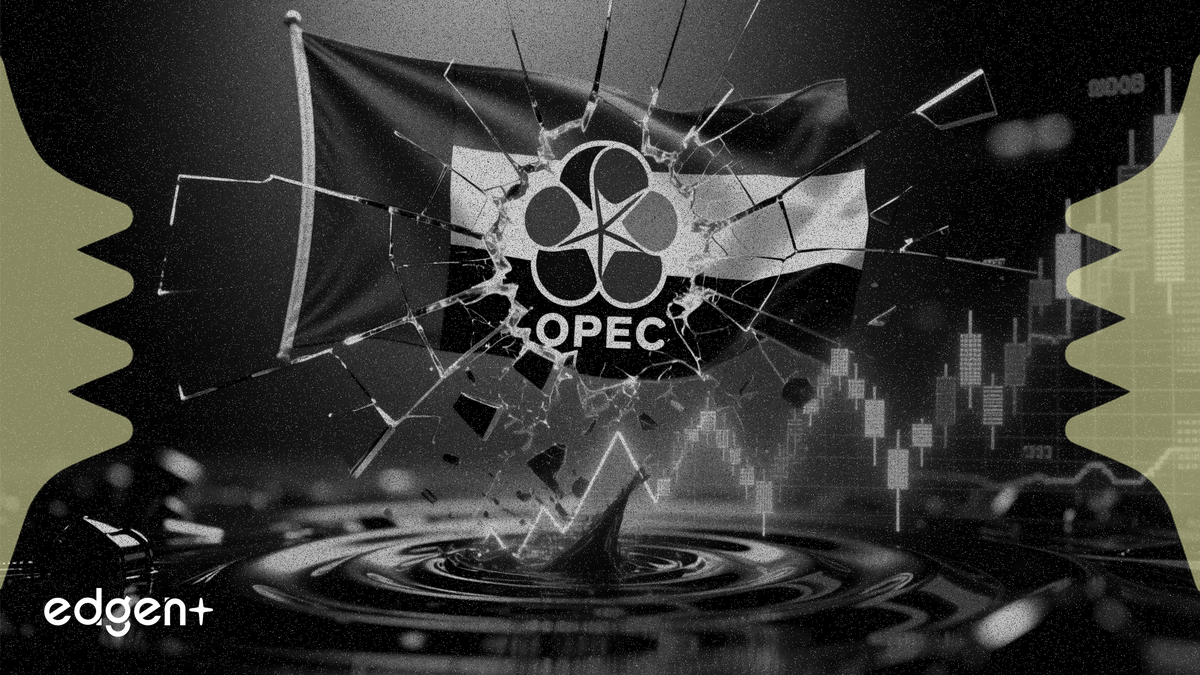
The United Arab Emirates will withdraw from OPEC and the OPEC+ alliance on May 1, a stunning move that deals a heavy blow to the Saudi-led producer group amid a historic energy shock and rising geopolitical turmoil. The news sent Brent crude tumbling 1.1% to $103.90 a barrel, while WTI fell 1.2% to $99.39.
"The Gulf Cooperation Council countries supported each other logistically, but politically and militarily, I think their position has been the weakest historically," Anwar Gargash, a senior diplomatic adviser to the UAE president, said at a forum in Dubai, criticizing a lack of support against Iranian attacks.
The departure shatters decades of policy coordination and follows a period of intense strain within the alliance. Gulf producers have struggled to ship exports through the Strait of Hormuz, a chokepoint for a fifth of the world’s energy, due to Iranian attacks. The resulting supply shock is battering Gulf economies, with S&P Global Market Intelligence forecasting contractions of 6.0% in Qatar and 4.4% in Kuwait for 2026.
The UAE's exit fractures the unified front of Gulf producers, potentially weakening OPEC's ability to manage global oil supply and creating a victory for U.S. President Donald Trump's campaign against high oil prices. This raises questions about the future of oil diplomacy and could trigger a new era of competition among national oil companies, introducing significant volatility into energy markets.
Economic Fallout Spreads Across Gulf
The decision reverberates through Gulf economies already reeling from the war between Iran, Israel, and the U.S. A Reuters poll of economists shows a sharp reversal of fortunes for the region. Qatar, Kuwait, and Bahrain, previously expected to grow, are now projected to shrink 6.0%, 4.4%, and 2.9% respectively this year. The UAE’s own growth is forecast to stagnate, a stark downgrade from the 5.0% expansion predicted just three months ago.
"We do not expect a simple return to the pre-war growth path," said Ralf Wiegert, head of MENA economics at S&P Global Market Intelligence. "It will take the entire second half of 2026 to rebuild damaged assets and re-establish supply chains."
Even Saudi Arabia, the world’s largest crude exporter, is not immune. Its growth forecast was slashed to 2.6% from 4.3%, according to the survey. The disruption to the non-oil economy, particularly tourism and retail, represents a second-layer shock for nations that had been rapidly diversifying.
A Geopolitical Realignment
The UAE's withdrawal is as much a political statement as an economic one. It signals a divergence from the Saudi-dominated consensus that has governed OPEC for decades. The public criticism from Anwar Gargash points to deep frustration within the UAE over the Gulf Cooperation Council's perceived inaction in protecting member states from Iranian aggression.
This move aligns the UAE more closely with U.S. interests, a significant shift for one of Washington's most important regional allies. President Trump has repeatedly accused OPEC of "ripping off the rest of the world" and linked U.S. military support for the Gulf to oil prices. The UAE's departure could empower the U.S. in its quest for lower global energy costs.
For OPEC, the loss of its third-largest producer is a severe blow. It creates disarray and weakens the group's leverage at a time of unprecedented market stress. The departure could embolden other members with grievances over production quotas or geopolitical disagreements, threatening the long-term viability of the cartel.
This article is for informational purposes only and does not constitute investment advice.