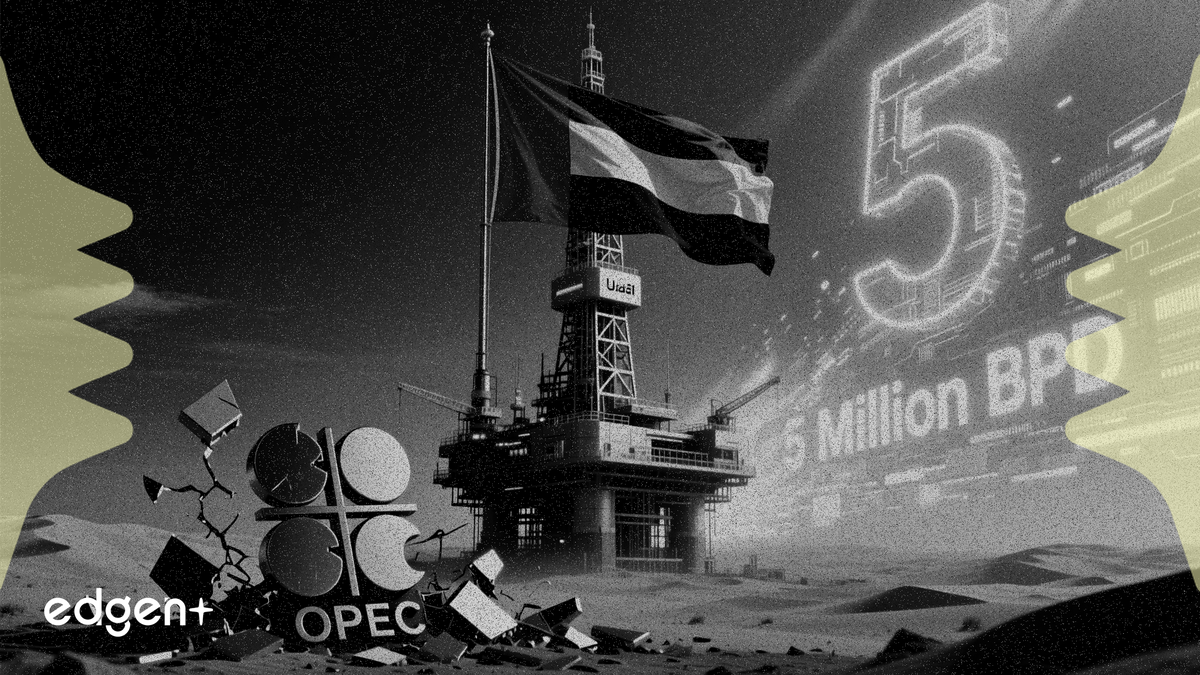
The United Arab Emirates is breaking from the Arab order, choosing to prioritize its own production capabilities in a move that could shatter the 60-year-old oil cartel.

The United Arab Emirates will withdraw from OPEC and OPEC+ effective May 1, a strategic pivot that aims to boost its crude output by nearly 67% and could permanently alter the global energy landscape. The move comes as the region grapples with a war-induced blockade of the Strait of Hormuz that slashed supply by nearly 8 million barrels per day in March.
"The United Arab Emirates' decision to withdraw from OPEC and OPEC+ was a sovereign and strategic choice based on a comprehensive assessment of its production policy and future capabilities," the UAE energy minister said on Saturday, adding the move was not politically motivated.
Under the constraints of the cartel, the UAE was limited to a quota of around 3 million barrels per day. Following its exit, the nation plans to ramp up production to 5 million bpd by next year, a level that would have been impossible under the group's coordinated restraint. The decision follows a period of extreme market turbulence, with the blockade of the Strait of Hormuz contributing to a 1.5 million barrel-a-day fall for the UAE in March alone.
The departure challenges the authority of de facto OPEC leader Saudi Arabia and raises existential questions for the cartel. With the second-highest spare production capacity in OPEC, the UAE is betting it can capture more market share and revenue by operating independently. The move could trigger a domino effect, with other nations like Iraq potentially following suit to escape production quotas.
The UAE's decision is not just about production numbers; it's a move to reshape the region's energy logistics. Frustrated by the vulnerability of the Strait of Hormuz chokepoint, Emirati officials are fast-tracking plans for new pipelines from Abu Dhabi's oil fields to the port of Fujairah, bypassing the strait entirely. This mirrors Saudi Arabia's own 1,200-kilometer East-West pipeline to the Red Sea, built in the 1980s for the same reason.
"By stepping outside the quota framework, it reshapes future expectations and weakens OPEC+'s control over spare capacity," said Priya Walia, an oil analyst at consultancy Ryland Energy. This strategic realignment underscores a growing rivalry with Saudi Arabia, as the UAE is no longer content playing "second fiddle," according to Phil Flynn, senior market analyst at The PRICE Futures Group.
Analysts are divided on whether this signals the end of the influential cartel. Some see it as a fatal blow. "I think we're now seeing one of the final nails in the coffin for OPEC," said Elaine Dezenski, head of the Foundation for the Defense of Democracies' center on economic and financial power. History suggests cartels are inherently unstable, as members have a strong incentive to cheat on production quotas, a factor that could lead to a complete breakdown, according to Pete Earle at the American Institute for Economic Research.
However, others believe the cartel will endure. "I believe OPEC+ can continue to function and thrive," said Salman Al-Ansari, a Saudi geopolitical analyst, who views the UAE's move as more symbolic than influential. "The institution has managed internal differences before, and its strength ultimately depends on disciplined coordination rather than political signaling."
For consumers, the long-term effect could be lower but more volatile gasoline prices as competition replaces coordinated supply cuts. While this may benefit drivers, the resulting price instability could threaten the economies of oil-dependent nations like Iraq and Nigeria.
This article is for informational purposes only and does not constitute investment advice.