
Sungrow Power Supply has secured over 20 GWh of energy storage orders in the Middle East, challenging the dominance of battery cell makers and signaling a market shift toward integrated system solutions.
Sungrow Power Supply has secured over 20 GWh of energy storage orders in the Middle East, challenging the dominance of battery cell makers and signaling a market shift toward integrated system solutions.
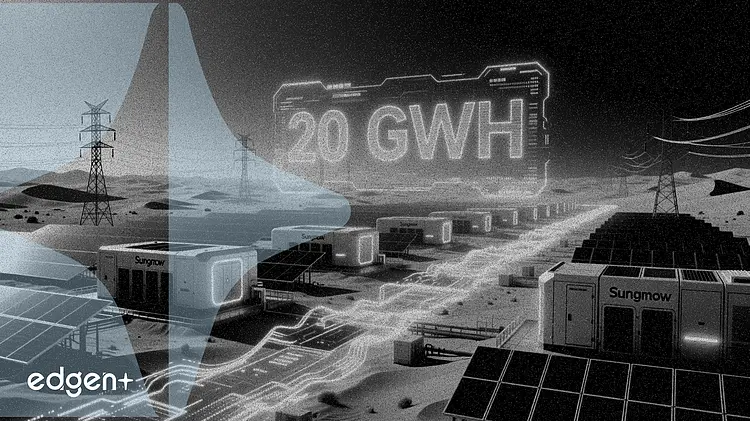
Sungrow Power Supply has secured over 20 GWh of energy storage orders in the Middle East, challenging the dominance of battery cell makers and signaling a market shift toward integrated system solutions.
Sungrow Power Supply's recent 7.5 GWh deal in the UAE, part of a 19 GWh project, underscores a major shift in the energy storage market where system integration and grid-side technology are becoming more critical than battery cell manufacturing alone.
"RTC reimagines the potential of renewable energy by overcoming intermittency," developers Masdar and Emirates Water and Electricity Company (EWEC) noted, highlighting the project's goal to provide gigascale baseload renewable energy at a globally competitive tariff for the first time.
For the project, which is expected to come online in 2027, Sungrow will supply its PowerTitan 3.0 liquid-cooled systems, which can operate at 55°C without derating and achieve a 90 percent round-trip efficiency. This follows a 7.8 GWh project in Saudi Arabia, bringing Sungrow's total contracted capacity in the region to over 15.3 GWh.
This pivot to system-level performance and reliability in harsh climates puts pressure on battery-focused players like CATL and BYD, suggesting that the ability to deliver a complete, bankable power asset—not just the cells—will determine the winners in the multi-billion dollar global energy storage race.
For years, the energy storage narrative has been dominated by battery cell manufacturers like CATL and BYD, whose expertise in electrochemistry and massive production scale gave them a powerful cost advantage. However, Sungrow's success in the Middle East, a region with some of the world's most demanding environmental conditions, demonstrates that the game is evolving.
The UAE project requires the system to deliver uninterrupted, 24/7 clean power. This involves an 8-hour charging cycle and a 16-hour discharging cycle, a grueling schedule that tests the limits of thermal management and system durability. Sungrow's PowerTitan 3.0, featuring a liquid-cooled design and a high-efficiency Silicon Carbide Power Conversion System (PCS), is engineered specifically for these challenges, promising stable operation in temperatures up to 55°C without any reduction in performance.
The success of these projects hinges on more than just the battery. A white paper recently published by Sungrow, citing 2024 data from the Clean Energy Association, revealed that system-level design flaws account for 48 percent of safety incidents in energy storage, compared to just 30 percent for the battery cells themselves. This data reframes the safety and performance conversation, moving the focus from the cell to the entire integrated system, including the PCS, Battery Management System (BMS), and thermal management.
For large-scale asset owners and financiers in projects like the UAE's, the key metrics are not just the cost per kilowatt-hour of the battery. They are evaluating the levelized cost of storage (LCOS), system availability, round-trip efficiency, and the bankability of the provider. A system that can withstand extreme heat, minimize downtime, and guarantee grid stability offers a far more compelling long-term return on investment, even if the initial component cost is higher. This is where system integrators like Sungrow, with deep expertise in power electronics and grid integration from their legacy in PV inverters, are finding a new edge.
The competition is no longer just about producing cheaper batteries; it's about delivering a reliable, long-duration power asset. As the global energy storage market for large-scale projects was 375.25 GWh in 2025, according to InfoLink, the ability to provide a full-stack, proven solution will be the deciding factor. While Tesla, Sungrow, and BYD were the top 3 in system integration that year, Sungrow's recent wins show that a background in power electronics is a formidable advantage in the new era of grid-scale storage.
This article is for informational purposes only and does not constitute investment advice.
