

Key Takeaways: STMicroelectronics is betting silicon photonics and power management can turn AI data centers into a $2 billion revenue stream by 2027.
Key Takeaways: STMicroelectronics is betting silicon photonics and power management can turn AI data centers into a $2 billion revenue stream by 2027.
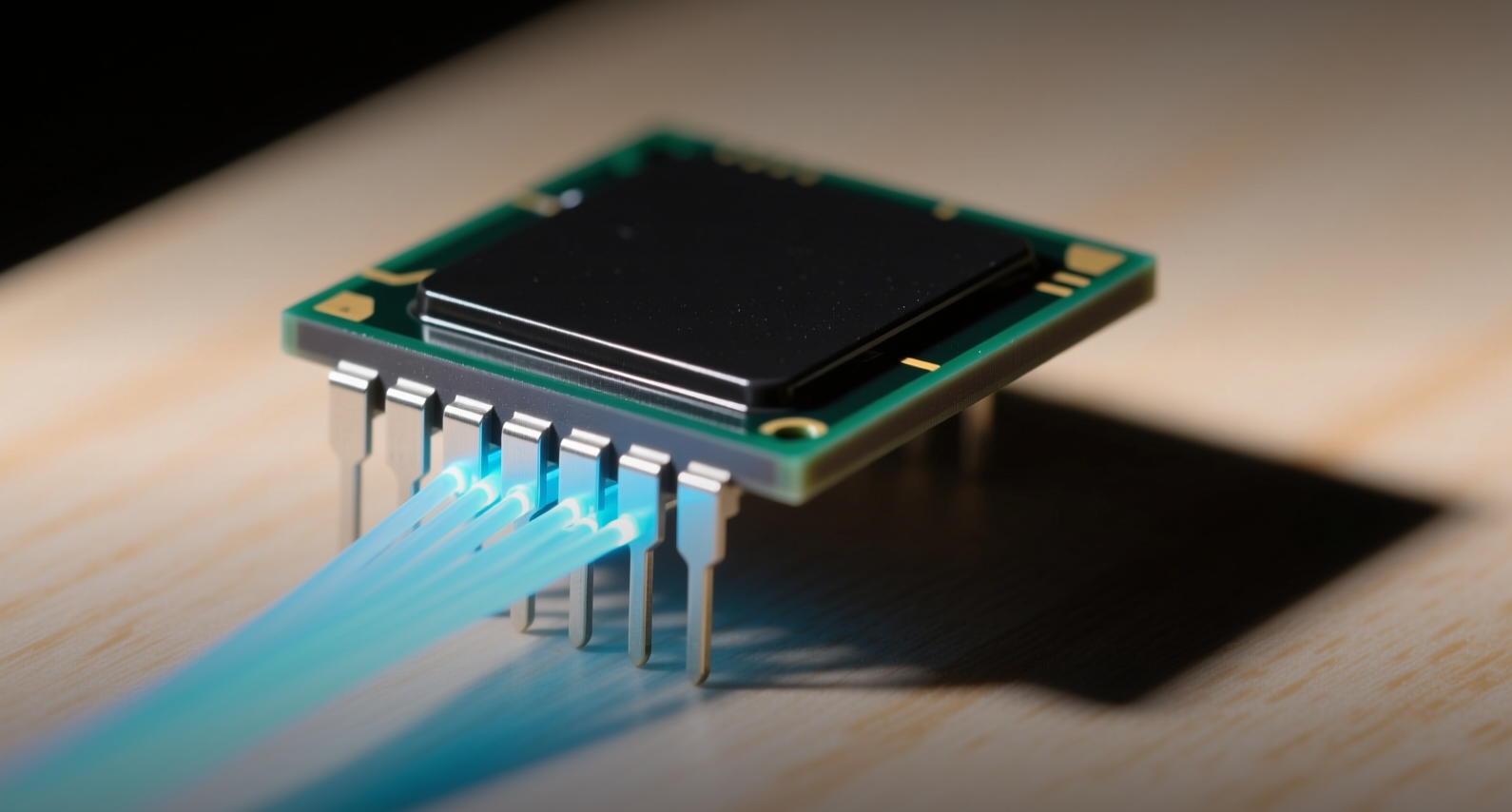
STMicroelectronics NV is targeting more than $2 billion in annual revenue from AI data centers by 2027, betting its silicon photonics and power management technology can capture a slice of the infrastructure buildout.
"We see AI data centers as a multiyear growth engine that plays directly to our strengths in power and connectivity," Jean-Marc Chéry, president and chief executive officer of STMicroelectronics, said. The company plans to use its silicon photonics technology — which transmits data using light instead of electrical signals — alongside advanced power management chips to serve the energy demands of AI clusters.
The $2 billion target represents a significant ramp from STM's current data center exposure. The company's power solutions address one of the most pressing challenges in AI infrastructure: electricity consumption. A single Nvidia DGX cluster can draw more than 10 kilowatts per GPU, driving demand for efficient power management chips. STM's silicon photonics portfolio targets high-speed data transmission between processors, a bottleneck that intensifies as AI models grow larger and require more inter-GPU communication.
The AI data center chip market is projected to exceed $100 billion by 2027, according to industry estimates, with power management and optical interconnects representing a fast-growing subset. STM's push puts it in competition with Infineon Technologies AG and ON Semiconductor Corp. in power management, while its silicon photonics efforts pit it against Intel Corp. and Marvell Technology Inc. in optical connectivity. STM shares have declined this year after the company cut its Q3 revenue guidance in July, citing weaker automotive demand, making the AI data center pivot a critical growth offset.
STMicroelectronics' silicon photonics technology aims to solve a fundamental problem in AI data centers: moving data between thousands of GPUs fast enough to keep them utilized. Traditional copper interconnects consume more power and generate more heat as data rates increase, making optical links an increasingly attractive alternative. Intel has shipped silicon photonics products for data center interconnects since the early 2020s, while Marvell's PAM4 optical DSPs power many of the world's largest cloud networks. STM enters the market with a focus on integrating photonics directly onto silicon chips, potentially reducing cost and power consumption compared with discrete optical modules.
For investors, the $2 billion target provides a tangible revenue catalyst for a company whose automotive business — historically its largest segment — faces headwinds from slowing EV demand in Europe and China. STM trades at roughly 18 times forward earnings, a discount to NXP Semiconductors NV at 22 times and Infineon at 20 times, according to data compiled by Bloomberg. If STM executes on its data center strategy, the multiple could expand as the market prices in higher growth. But the company faces well-entrenched competitors with years of head start in both power management and silicon photonics, making the $2 billion target ambitious.
This article is for informational purposes only and does not constitute investment advice.
