

Starcloud's $250 million raise at a $2.3 billion valuation more than doubles its March round, backing orbital data centers to solve AI's energy bottleneck.
Starcloud's $250 million raise at a $2.3 billion valuation more than doubles its March round, backing orbital data centers to solve AI's energy bottleneck.
Starcloud, the startup building AI data centers in low Earth orbit, raised $250 million at a $2.3 billion post-money valuation, more than doubling its March round as investors back orbital compute to solve AI's energy bottleneck.
"Last November we put the first NVIDIA H100 in orbit. Today this fresh capital empowers us to build the infrastructure to launch many more of NVIDIA's most advanced GPUs into space," Philip Johnston, co-founder and CEO at Starcloud, said.
Manhattan West led the extension, with Ken Abdalla and Lauren Selig managing the deal and Selig joining as a board observer. Existing investors Benchmark, EQT, Soma, NFX, and 776 participated, joined by new backers NVIDIA, Cisco Investments, Cedar Capital, Goanna Capital, and Standard Capital. Total capital raised since the company's 2024 founding now stands at $450 million.
The capital is earmarked for three priorities: continued manufacturing capacity expansion, engineering work with NVIDIA on the Space-1 Vera Rubin Module, and procurement of future launch allocation. Launch capacity is the binding constraint for the entire orbital compute thesis — Starcloud's roadmap depends on rockets it does not control, and the near-term market for launch slots is tightening as multiple companies compete for the same payload capacity.
The NVIDIA collaboration and orbital firsts
Starcloud's relationship with NVIDIA began in November 2025, when the company flew the first data center-grade GPU to orbit aboard its Starcloud-1 satellite. The H100 payload was roughly 100 times more powerful than any GPU compute previously flown in space. On that platform, Starcloud trained the first AI model in orbit, ran a version of Google's Gemini in space, and demonstrated high-powered inference and fine-tuning on flight hardware.
The two companies are now collaborating on NVIDIA's Space-1 Vera Rubin Module, a space-rated variant of the Vera Rubin platform hardened for extreme conditions where cooling relies on large radiators and every component must withstand radiation exposure and launch loads. Starcloud's satellites are expected to serve as an early flight platform for the module, building on nine months of flight data from the H100 deployment.
The competitive race for orbital compute
Starcloud is not alone in pursuing orbital data centers. Cowboy Space raised $275 million in May 2026 at a $2 billion valuation to build vertically integrated orbital compute, keeping launch vehicle upper stages in orbit as 1-megawatt data centers. Google's Project Suncatcher is exploring similar territory. The entire sector depends on launch costs falling toward Starship's promised economics, and the near-term market is tightening before it loosens.
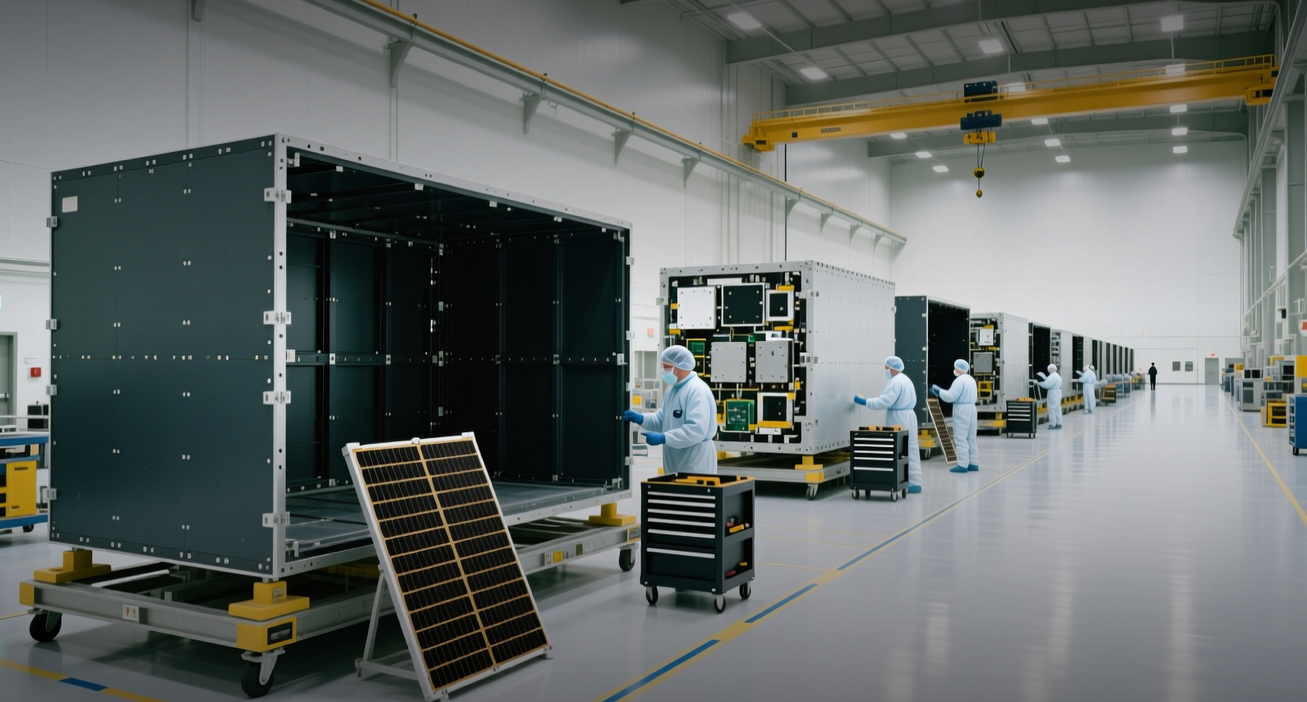
Starcloud's near-term hardware milestone is Starcloud-2, planned for launch later in 2026 with the largest commercial deployable radiator ever sent to space. Early customers include Crusoe, alongside partnerships with AWS, Google Cloud, and NVIDIA. The company's 100,000-square-foot manufacturing facility in Woodinville, Washington — near where SpaceX and Amazon build their own satellites — is being fitted for Starcloud-3 production lines.
The company's stated trajectory of 88,000 satellites and 20 gigawatts of orbital compute capacity requires Starship to reach routine, reusable flight and for launch prices to fall with it. The round gives Starcloud the capital to buy its way into that queue. Whether the rockets arrive on schedule is the variable no funding round can underwrite. NVIDIA's direct investment in Starcloud shows the chipmaker sees orbital compute as a credible extension of its data center franchise, even as terrestrial hyperscalers continue to dominate the near-term market.
This article is for informational purposes only and does not constitute investment advice.
