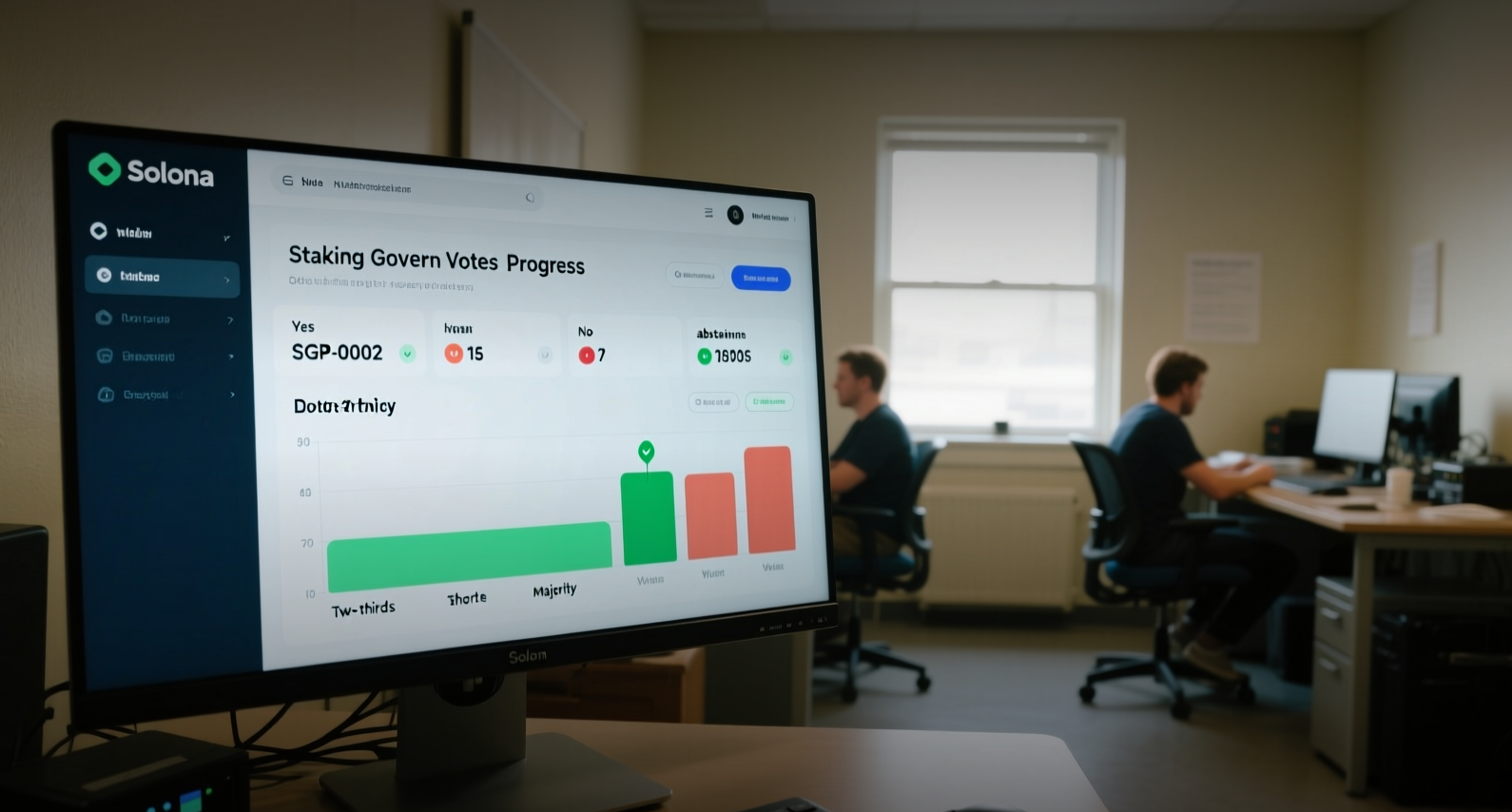
SOL trades at $105 as Solana's first on-chain governance vote nears its close, with SGP-0002 support at 65.15 percent against a 66.67 percent pass threshold.
Helius CEO Mert Mumtaz publicly accused exchanges of mathematical irrationality for initially blocking the reform, while the Solana Governance Dashboard shows turnout at 60.17 percent across 169.91M SOL.
Kraken, holding 8.92M SOL, reversed its vote from "NO" to "YES" after retail community pressure, having initially joined Figment, Everstake and P2P.org in opposing the inflation reform to preserve staking yields. Supporters remain 1.52 percentage points short of the two-thirds threshold, with 25.39 percent (66.22M SOL) voting against and 9.47 percent (24.69M SOL) abstaining. The related SGP-0003 fee reform has already failed as major validators abstained en masse.
The stakes are material. SGP-0002, wrapping SIMD-0550, doubles Solana's annual disinflation rate from 15 percent to 30 percent, cutting 18.9M SOL from future emissions over six years — worth roughly $1.5 billion at current prices — and pulling the network's 1.5 percent terminal inflation target forward from 2032 to 2029. Even if the proposal passes, activation requires the SIMD-0550 technical upgrade, whose rollout will take validators at least 4.5 months.
Kraken's flip reshapes the vote
The reversal shifted the balance between whales and the retail community. Kraken initially joined Figment, Everstake and P2P.org in blocking the inflation reform to preserve staking yields. Community pressure turned the process around, with activists calling on Solana founder Anatoly Yakovenko to help mobilize remaining validators.
SGP-0002 would reduce SOL emissions by 18.9M tokens over six years, according to 21Shares modeling, while SGP-0003 would have pushed daily burns from 600-800 SOL to 7,500-9,000 SOL. The fee reform's failure leaves the burn mechanism unchanged for now. Staking yield compression — from 5.25 percent to 4.34 percent in year one under 21Shares' model — is a real cost holders must weigh against supply-side benefits.
SOL's 13.4 percent daily gain also reflects Charles Schwab's plans to offer spot SOL trading, expanding its crypto accounts beyond Bitcoin and Ethereum. The exchange will charge a 0.75 percent flat fee, with trading available across all U.S. states except New York and Louisiana.
The vote outcome provides only a political mandate. Implementation of SIMD-0550 requires coordination and rollout across validators, with a timeline of at least 4.5 months before tokenomics changes take effect.
This article is for informational purposes only and does not constitute investment advice.