
SK Hynix's record $29 billion US listing plan and a 13% Micron selloff are testing whether the AI memory chip boom can sustain its triple-digit valuations.
SK Hynix's record $29 billion US listing plan and a 13% Micron selloff are testing whether the AI memory chip boom can sustain its triple-digit valuations.
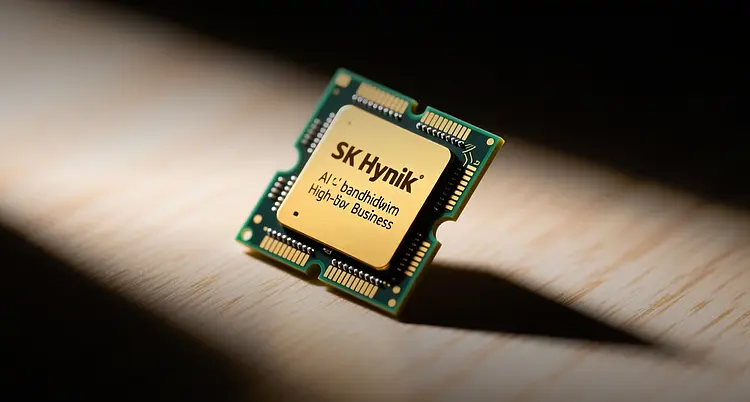
SK Hynix's plan to raise $29 billion in a US listing next month and a 13% plunge in Micron shares are forcing investors to reassess whether the AI memory chip boom has outpaced reality.
"The market continues to oscillate between 'AI is going to be great' and 'this is all one big bubble,'" Gil Luria, head of technology research at D.A. Davidson, said.
SK Hynix, the world's second-largest memory chipmaker, said Wednesday it will issue 17.79 million American depositary receipts on the Nasdaq on July 10. The proceeds — which would eclipse Alibaba's 2014 New York debut as the largest-ever ADR offering — will fund a new chip factory in Yongin, an advanced packaging facility in Cheongju, and extreme ultraviolet lithography equipment. The announcement came as Micron shares closed at $1,052.91, down 13.08%, ahead of its fiscal third-quarter earnings due after the bell Wednesday.
The selloff reflects a growing tension: more than $1.5 trillion in corporate AI investment over the past five years has yet to produce clear returns for many investors, even as companies like SK Hynix, Micron, and Samsung have posted triple-digit stock gains in 2026. Micron's earnings will be the first major test of whether demand for high-bandwidth memory chips — essential for AI data centers — can justify valuations that have pushed the stock up 269% this year alone.
SK Hynix's US listing adds a new competitive dimension. The company plans to channel the entire $29 billion into fabrication plants and equipment, potentially boosting memory chip supply and putting pressure on pricing across the sector. For investors, the ADRs also offer a direct alternative to Micron for exposure to the memory chip boom, raising the risk of fund rotation out of the US chipmaker.
The broader market rout this week has deepened the uncertainty. The Nasdaq Composite fell 2.21% to 25,587, while the S&P 500 dropped 1.43% to 7,365.46. Alphabet shares slid 5% on Monday, and Intel and Advanced Micro Devices each lost about 6% on Tuesday. Samsung, which surged 9.8% on reports of a 90 trillion won ($58 billion) share buyback over three years, was a rare bright spot.
"Are we going to start to see returns?" Mark Vena, CEO of SmartTech Research, said, summarizing the question hanging over the sector. According to Stanford University's AI Index Report, corporate AI investment exceeded $580 billion globally in the past year alone, on top of more than $1 trillion in the four preceding years.
For Micron, the stakes are especially high. The stock has skyrocketed about 800% over the past year, making it one of the biggest beneficiaries of the AI buildout. But Tuesday's selloff — the steepest single-day drop in months — shows how quickly sentiment can shift when investors question the payoff. Analysts will scrutinize Micron's HBM revenue, DRAM and NAND pricing, gross margins, and fourth-quarter guidance for signs that the AI investment cycle is continuing at pace.
The competitive landscape is also shifting. SK Hynix is already the leading supplier of high-bandwidth memory chips to Nvidia, the dominant AI chip designer. Its Nasdaq listing would give it a US currency for acquisitions and a broader investor base, while Samsung's massive buyback plan signals confidence in its own memory chip business. Micron, which has agreements with AI companies including Anthropic, must now prove it can hold its ground as the memory market becomes more contested and capital-intensive.
This article is for informational purposes only and does not constitute investment advice.
