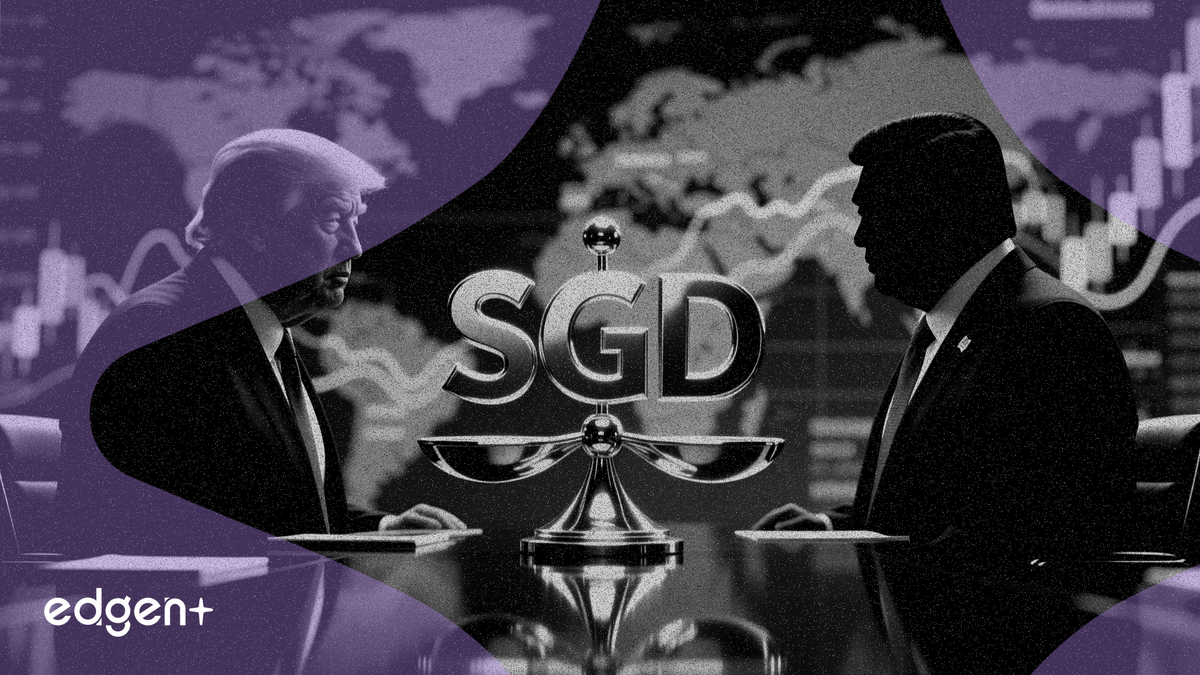
The Singapore dollar is holding its ground as global currency markets adopt a cautious stance, focusing intently on a high-stakes summit between U.S. President Donald Trump and Chinese President Xi Jinping.

The Singapore dollar is steady against its U.S. counterpart, with the pair trading near 1.2724 as traders focus on a summit between Washington and Beijing aimed at improving their deeply strained economic relationship.
"Whatever the outcome of this summit, U.S.-China strategic competition remains the defining geopolitical story of this era,” Lombard Odier Global Chief Investment Officer Michael Strobaek said in a commentary.
The cautious mood has led to consolidation across Asian currencies, with the U.S. dollar little changed at 157.92 Japanese yen, while it gained 0.2 percent against the Korean won to 1,492.00. The summit follows a decade of escalating trade friction that saw U.S. tariffs on Chinese goods peak near 48 percent, which has since halved China's share of U.S. trade to 6.4 percent last year from over 13 percent in 2016.
The summit's outcome could significantly influence foreign exchange markets. A positive result may boost risk-sensitive currencies like the Singapore dollar, while a breakdown in talks could spur a flight to the safety of the U.S. dollar, increasing volatility.
President Trump is in China with a high-profile contingent of business leaders, including tech billionaires Elon Musk and Jensen Huang, signaling a focus on trade and technology. While trade is the priority, the ongoing conflict in Iran remains a significant backdrop, Commerzbank Research analysts noted. The meeting aims to repair damage from a trade war that has forced companies like Apple Inc. and Nike Inc. to shift production out of China to countries such as Vietnam and India.
The U.S. trade deficit in goods and services with China has narrowed to $168 billion last year, its lowest since 2004, down from a peak of $377 billion in 2018. This reduction, however, masks the complexity of global supply chains. Many Chinese firms have dodged U.S. tariffs by relocating to Southeast Asian countries and transshipping goods. "Chinese goods are still coming into the U.S.," said Zongyuan Zoe Liu, a senior fellow for China studies at the Council on Foreign Relations.
The tit-for-tat measures, which included U.S. blocks on advanced chip shipments and Chinese restrictions on rare earth minerals, have created immense uncertainty. American manufacturers who relied on Chinese components found themselves grappling with unpredictably fluctuating costs. The previous tariff escalation to triple-digit levels, though brief, was a stark reminder of the risks, prompting a strategic diversification of supply chains that is unlikely to be reversed, regardless of the summit's tone.
This article is for informational purposes only and does not constitute investment advice.