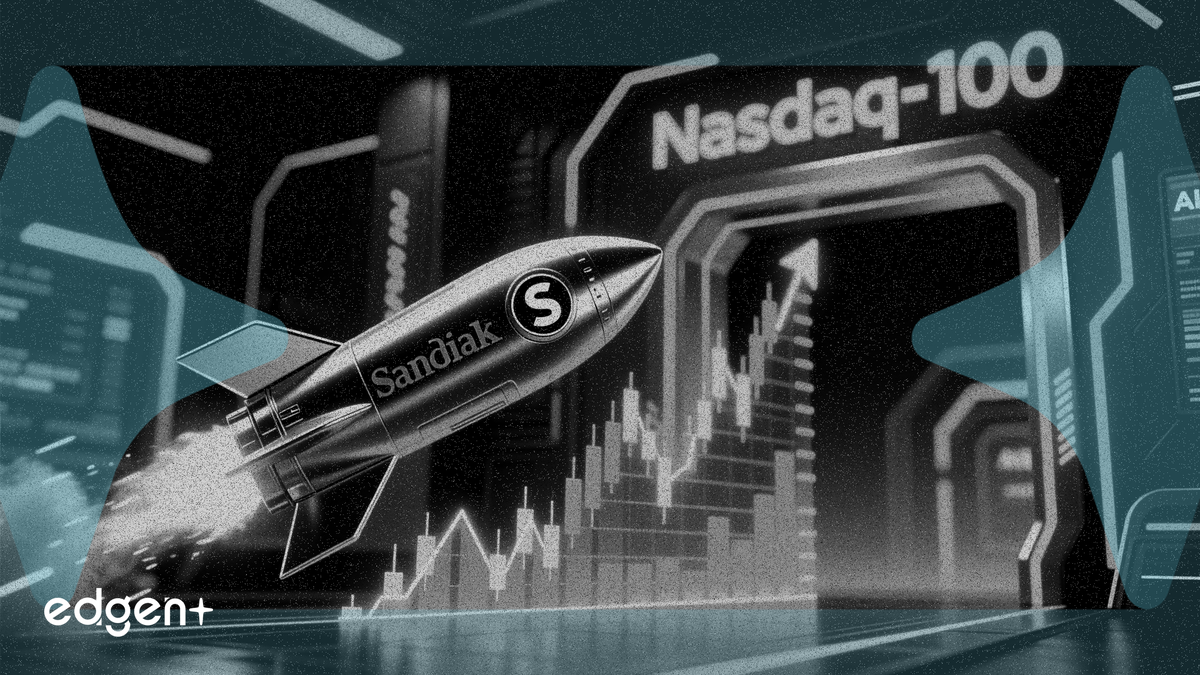
Sandisk’s inclusion in the Nasdaq-100 index solidifies its place among tech giants, capping a year where AI infrastructure demand propelled its valuation to historic highs.
Sandisk is set to join the Nasdaq-100 index, a milestone that reflects its critical role in the artificial intelligence boom and a stock rally that has seen its shares climb more than 500 percent over the past year. The move validates the company’s strategy since spinning off from Western Digital in February 2025.
The inclusion in the widely tracked index of large-cap technology names is a significant step for Sandisk, with Wall Street firms highlighting the company as a key way to gain exposure to AI-driven memory demand. The stock has become a primary beneficiary of the AI infrastructure buildout, alongside peers like Micron and Nvidia.
The change, which follows a 295 percent year-to-date rally that pushed its share price to roughly $930, is expected to trigger automatic buying from passive funds that benchmark against the Nasdaq-100. The rally has been mirrored across the memory sector, with competitors Micron Technology (MU) and Western Digital (WDC) up 71 percent and 126 percent year-to-date, respectively.
For investors, the index inclusion cements Sandisk as a pure-play vehicle for the AI memory cycle. However, the stock’s sharp ascent has pushed it near the consensus analyst price target of $928 and comes as the broader Philadelphia Semiconductor Index is at its most extended level since the dot-com era, signaling potential for a near-term pullback ahead of its Q1 earnings report on April 30.
AI Demand Fuels Historic Rally
Sandisk’s ascent is rooted in the explosive growth of AI workloads, which require vast amounts of high-speed storage. The company’s specialization in NAND flash memory and enterprise solid-state drives (SSDs) positions it directly in the path of massive capital expenditure from hyperscale data center operators. This structural demand has created what some analysts call an early-cycle memory supercycle, lifting the entire sector.
Since its separation from Western Digital, Sandisk has focused on this high-value enterprise market. Unlike competitors with broader exposure, its revenue is diversified across datacenter SSDs, client computing, mobile, and automotive flash storage. This mix provides a degree of resilience and pricing power, insulating it from a slowdown in any single segment. The narrative is supported by strong fundamentals, with the company reporting 76 percent year-over-year growth in its datacenter division in its January earnings report.
Index Inclusion Meets Valuation Concerns
While inclusion in the Nasdaq-100 provides a new layer of institutional demand, it also brings heightened scrutiny. The stock’s parabolic move—up nearly 3,000 percent since its post-spinoff lows according to some market commentary—has priced in significant future growth. The key question for investors is whether the powerful tailwind from AI can continue to justify the current valuation.
The broader market context adds a note of caution. The PHLX Semiconductor Index (^SOX) has posted a historic winning streak, adding over $3 trillion in market value in just 17 trading days. Analysts note the index is now the most extended above its 200-day moving average since 2000, a technical indicator that often precedes a correction or consolidation. With Sandisk’s upcoming earnings on April 30, investors will be watching closely for guidance on hyperscaler order visibility and gross margins to determine if the rally has further to run.
This article is for informational purposes only and does not constitute investment advice.