
The global AI race is shifting from compute power to memory capacity, a trend that could deepen an unprecedented chip supply crunch.
The global AI race is shifting from compute power to memory capacity, a trend that could deepen an unprecedented chip supply crunch.
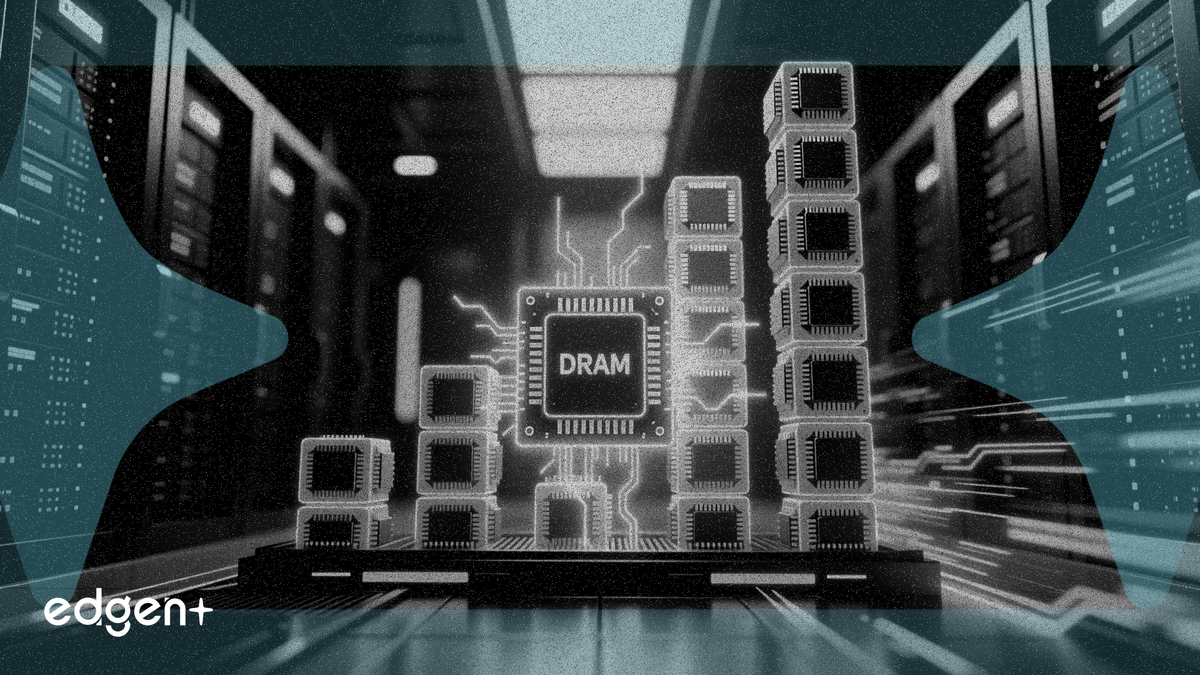
The global AI race is shifting from compute power to memory capacity, a trend that could deepen an unprecedented chip supply crunch.
Sandisk Corp.'s chief technology officer said the artificial intelligence race is becoming "memory-centric" rather than focused on raw computing power, a shift that is already driving customers to sign long-term supply agreements amid an unprecedented chip shortage.
"As large language models become bigger and more intelligent, they require more memory to operate effectively," Alper Ilkbahar, CTO and executive vice president of Sandisk, said in an interview with Nikkei Asia.
Ilkbahar cited three trends driving the shift: the growing size of large language models, the increasing reliance on key-value (KV) cache — which functions as AI's short-term memory — and the adoption of mixture-of-experts architectures that reduce computation but demand more memory. Sandisk's stock has surged about 5.7 times year to date and more than 35 times over the 12 months since May 2025.
The memory-centric shift threatens to exacerbate supply tightness in the memory chip market. Customers are now proactively making advance commitments and signing long-term procurement agreements to secure future supply, Ilkbahar said, signaling that the industry's capacity constraints may persist as AI workloads scale.
HBF Aims to Reshape AI Memory Hierarchy
The company is betting its next major product on this thesis. Sandisk is designing High Bandwidth Flash (HBF) chips, a new memory architecture that the company says offers significantly higher capacity and density than High Bandwidth Memory (HBM) while maintaining comparable bandwidth. HBF memory dies are expected to begin sampling by the end of this year, with full products equipped with controllers scheduled for launch next year.
Sandisk has partnered with SK Hynix, the world's second-largest memory maker, to jointly develop technical standards for HBF. The collaboration positions both companies to capture demand from AI inference workloads, which require larger memory capacity than training tasks. HBM, currently the dominant memory technology for AI accelerators, is produced primarily by SK Hynix, Samsung Electronics and Micron Technology.
The shift toward memory-centric AI computing challenges the prevailing narrative that graphics processing units and raw compute power alone determine AI performance. Nvidia Corp., whose H100 and Blackwell GPUs dominate the AI training market, relies on HBM memory co-packaged with its processors. If HBF gains adoption, it could reshape the memory hierarchy in AI data centers, potentially reducing reliance on HBM for certain inference workloads.
For investors, the implications cut across the semiconductor supply chain. Sandisk, trading at elevated multiples after its 5.7x year-to-date rally, faces the question of whether the market has fully priced in the HBF opportunity. SK Hynix, which supplies HBM to Nvidia, must balance its existing HBM business against the potential cannibalization from HBF. Samsung and Micron, the other major HBM producers, face similar strategic calculations.
This article is for informational purposes only and does not constitute investment advice.
