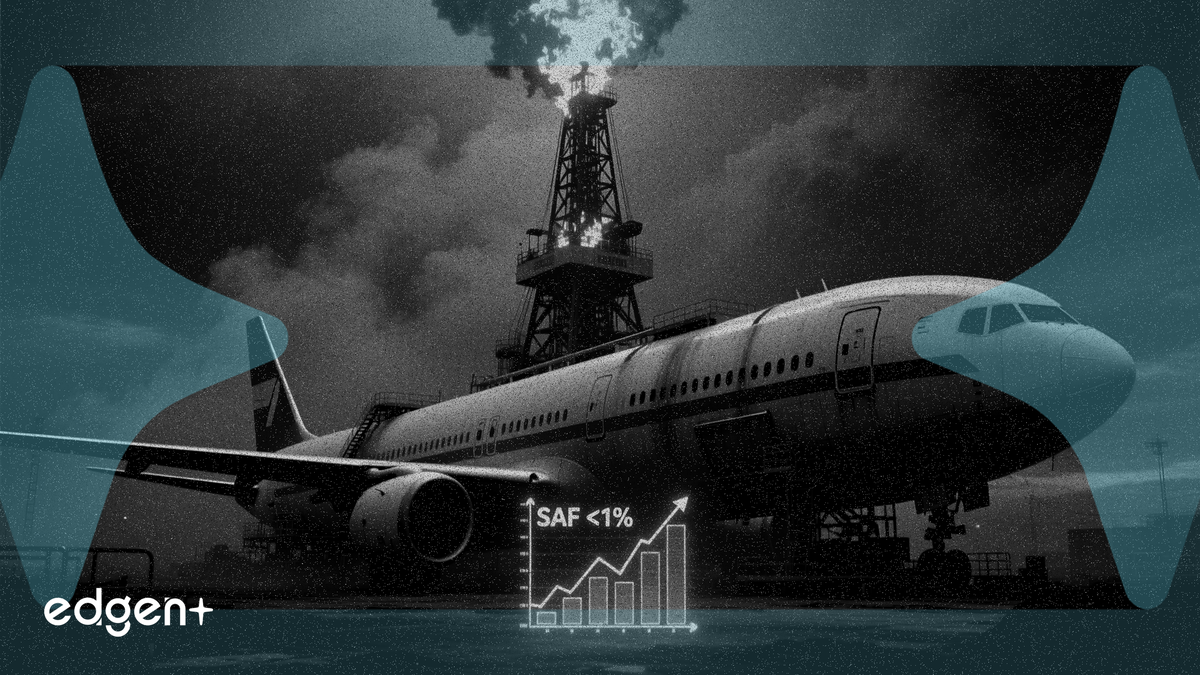
The Iran war has exposed a decade of underinvestment in sustainable aviation fuel, leaving airlines with no buffer against the worst oil supply shock in years.
The war in Iran has sent oil prices soaring while sustainable aviation fuel accounts for just 0.6% of total jet fuel consumption, IATA data show, leaving airlines exposed to the worst supply shock in years.
"Where we are today, because volumes are so small, we're not at a point where SAF can play that role" as a buffer against oil shocks, said Kevin Welsh, chief sustainability officer at Airlines for America, a trade group.
SAF production reached just over 2 million tons in 2025, far short of the 5 million tons the UN's International Civil Aviation Organization had projected four years ago, against total jet fuel consumption of close to 300 million tons. Delta Air Lines told investors earlier this year that available SAF supply "does not meet global airline demand for even one week." A ton of SAF cost about $1,500 more than traditional jet fuel before the conflict, according to Argus Media.
The supply gap means airlines are absorbing the full force of the Iran-driven oil spike with no alternative fuel to cushion costs, threatening margins across an industry already operating on thin profits. With 260 SAF projects planned globally but only a handful operational, the buffer Welsh describes remains years away at best.
Production Costs Stall the Transition
SAF's high cost is the primary bottleneck. Unlike solar and wind, where production costs have fallen sharply, "you're not getting that cost curve going down as much or as fast," said Aidan Lea, associate editor of Argus Media's SAF division. Manufacturing relies on converting used cooking oil, animal fats and forestry waste into jet fuel — a process that remains expensive and difficult to scale.
Energy majors including BP, Eni and Repsol have invested in the field but largely focused on distributing traditional fuel rather than reconfiguring refineries. Shell shuttered its Rotterdam biofuels facility in September 2025, a project that would have produced 820,000 tons of biofuel annually. "It became clear that the project would be insufficiently competitive," Machteld de Haan, Shell's downstream president, said at the time.
Mandates Arrive, But Supply Lags
The European Union and the UK rolled out mandates in 2025 requiring 2% of jet fuel supplied from European airports to be made from SAF, escalating to 70% by 2050. The regulations have shifted the industry away from voluntary demand, but supply has not kept pace. Of 260 planned SAF projects globally, only 42 have reached construction stage and just a handful are operational, Argus Media data show.
In the US, production jumped to about 240 million gallons in 2025 from 39 million gallons the year before, according to EPA data. But the One Big Beautiful Bill Act cut the SAF production tax credit to $1 a gallon from $1.75, and output remains 12.5 times below the Biden administration's 3-billion-gallon target.
SAF producers report a shift in buyer behavior since the war began. "We've seen a dramatic uptick in buyers wanting to talk about security of supply," said Trevor Best, chief executive of Syzygy Plasmonics, a Texas-based SAF startup. But with production volumes still negligible relative to global jet fuel demand, the industry's green-fuel buffer remains theoretical — a gap that will take years and billions of dollars to close.
This article is for informational purposes only and does not constitute investment advice.