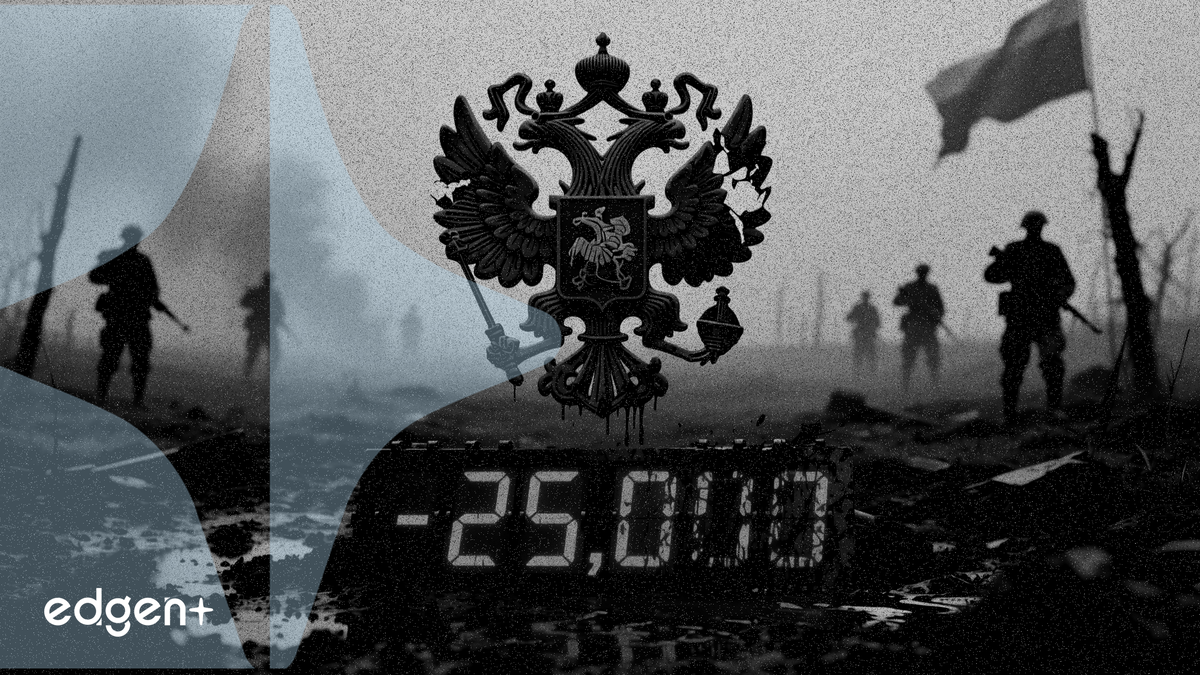
Russia's high-casualty "infiltration" tactic is yielding diminishing returns, with territorial gains of just three square miles per day despite staggering losses.

Russia's military is losing an estimated 25,000 soldiers per month in eastern Ukraine as its shift to small-group "infiltration" tactics fails to deliver a decisive breakthrough, according to Western officials and battlefield reports. The strategy, a response to Ukraine's drone superiority, has turned the front line into a high-attrition gray zone with minimal Russian advances.
"They’re saving on equipment but hemorrhaging men instead. The approach is yielding diminishing gains," said Michael Kofman, a senior fellow at the Carnegie Endowment for International Peace. "Much of the land gained via these tactics becomes a gray zone they do not fully control."
The shift from armored assaults to sending pairs of foot soldiers on high-risk missions has resulted in daily gains of just over three square miles, at a severe human cost. Ukrainian commanders report a sharp increase in Russian casualties, with some units now inflicting 50 to 60 kills per day, up from 20 a year ago. This comes as Russian President Vladimir Putin vaguely suggested the war could be "coming to an end," a statement analysts view as aimed at a domestic audience feeling the strain of a multi-year conflict.
The unsustainable casualty rate suggests Russia's goal of capturing the entire Donbas region could take years and cost hundreds of thousands more lives, undermining claims of an inevitable victory. The Kremlin's reliance on ex-convicts and poorly trained recruits for these near-suicidal missions indicates a critical strain on its military manpower, a vulnerability Ukraine continues to exploit with precision drone and artillery strikes.
The grim reality of Russia's tactical shift is personified by soldiers like Vyacheslav Kudryashev, an ex-convict missing part of his arm who was sent on an infiltration mission near Kreminna. Captured by Ukrainian forces after his two-man team lost communications, his experience reflects a broader strategy that many Russian soldiers reportedly believe is designed to purge society of its most vulnerable, including prisoners and the homeless.
This brutal calculus on the battlefield coincides with mixed signals from Moscow. A temporary May 9-11 ceasefire was marred by mutual accusations of violations, with both sides reporting continued, albeit limited, offensive operations. While President Putin excluded most military hardware from the recent Victory Day parade to "focus on the final defeat of Ukraine," his hints at the war's end are contradicted by Russia's unchanged maximalist goals.
While Russia pursues its costly infiltration strategy, Ukrainian forces have demonstrated tactical adaptability, launching successful counterattacks and leveraging drone technology to blunt Russian advances. In western Zaporizhia Oblast, Ukrainian operations have pushed back Russian infiltrators and reversed gains Moscow had made since mid-2025. Ukrainian military observer Kostyantyn Mashovets reported that drone strikes have effectively halted the Russian advance in the Hulyaipole direction by preventing the concentration of forces necessary for a breakthrough.
Geolocated footage from May 9 and 10 confirms recent Ukrainian advances in the Borova and Slovyansk directions, as well as south of Kostyantynivka. These localized successes highlight Ukraine's ability to exploit the weaknesses of Russia's small-group tactics, picking off isolated assault units before they can consolidate.
To compensate for the lack of significant battlefield victories, Russia appears to be intensifying its cognitive warfare efforts. The Institute for the Study of War has observed an increase in sophisticated, AI-generated videos purporting to show Russian flags being raised in contested areas. This campaign aims to create the false impression of a collapsing Ukrainian frontline, particularly around key dates like May 9, and to demoralize Ukrainian forces and their international partners.
Simultaneously, the Kremlin is tightening its grip on the domestic information space, punishing pro-war milbloggers who criticize the military command. The reported punishment of figures like Yegor Guzenko, allegedly sent to a frontline assault unit for his criticism of Putin, reveals the leadership's sensitivity to dissent over the war's staggering human cost and stalled progress. Russia's tactics, from the front lines of Donbas to the digital battleground, point to a strategy under immense strain.
This article is for informational purposes only and does not constitute investment advice.