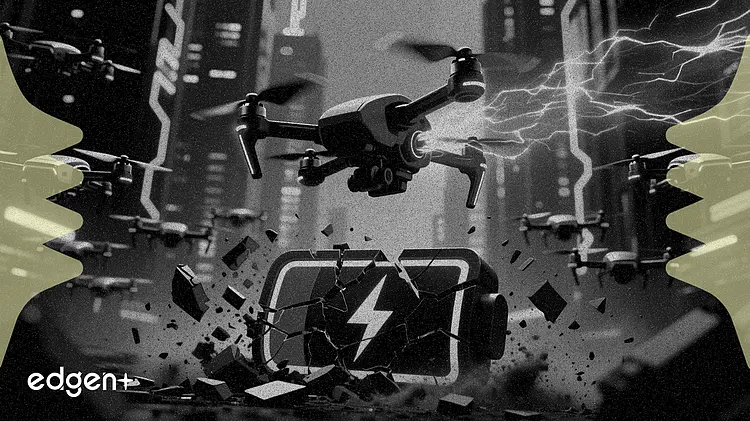
Red Cat's acquisition of Quaze Technologies aims to solve the most significant barrier to robotic autonomy: keeping the power on.
Red Cat Holdings (Nasdaq: RCAT) acquired Québec-based Quaze Technologies to integrate its wireless power transfer system across its drone and robotic platforms, a move aimed at solving the critical operational bottleneck of in-field recharging that limits mission duration for a market projected to exceed 1 million drones by 2026.
"Autonomous systems are only as effective as their ability to stay in the fight," said Jeff Thompson, CEO of Red Cat. "Quaze gives us a critical advantage by removing one of the biggest operational constraints, which is how systems recharge in the field. This enables longer-duration missions, supports distributed operations across air, land and sea, and strengthens our ability to deliver fully integrated, all-domain solutions for the warfighter."
At the core of the deal is Quaze’s QU6 electronic architecture, which enables large surfaces to function as wireless energy access points without requiring precise alignment or physical connectors. This technology allows drones and robots to recharge even when debris, sand, or snow are present, a direct challenge to the manual battery swaps and failure-prone connectors that dominate the industry.
The acquisition positions Red Cat to capture a larger share of the defense and commercial drone market by offering persistent operational capability. The move comes as competitors across the industry race to solve the power problem, with firms like Amprius Technologies developing high-density silicon anode batteries and European players like Tulip Tech building resilient, non-Chinese supply chains to meet growing defense demand.
The Race to Unplug the Drone Market
The effectiveness of unmanned systems has been consistently held back by the limitations of their power source. Most commercial and military drones rely on conventional lithium-ion batteries with graphite anodes, which typically provide an energy density in the 200-270 Wh/kg range. This imposes a hard ceiling on flight time and payload capacity, creating a major opportunity for technological disruption.
The market is responding with multiple solutions. Fremont-based Amprius Technologies is supplying drone makers like Matternet with silicon anode batteries that deliver up to 450 Wh/kg, nearly doubling the energy density of standard cells. This allows Matternet’s M2 drones to extend their 20-kilometer delivery range or carry heavier payloads for medical logistics. Similarly, Dutch firm Tulip Tech is scaling production of high-endurance battery packs, explicitly targeting Europe’s push for sovereign industrial capacity and supply chain independence from China. These efforts highlight a sector-wide consensus: the next phase of drone adoption depends entirely on solving the power and endurance challenge.
A New Power Play for Red Cat
Red Cat's acquisition of Quaze is a strategic play that combines a technology solution with a new business model. Quaze will operate as an independent business unit within Red Cat, tasked with scaling its wireless power architecture not only for Red Cat’s own Family of Systems but also for third-party OEMs. This platform-agnostic approach opens a new revenue channel, positioning Quaze as a potential power standard across the robotics ecosystem and allowing Red Cat to profit from systems it does not manufacture.
"Our goal is to make power as accessible and reliable as fuel is for traditional vehicles and something every drone or robot can tap into, anywhere, without friction," said Xavier Bidaut, Co-founder of Quaze Technologies.
The technology is particularly relevant for Red Cat’s expansion into maritime systems and multi-platform autonomy. Integrating wireless charging into uncrewed surface vessels (USVs) could enable them to act as mobile "mothership" recharging stations for drone swarms, unlocking persistent surveillance and reconnaissance missions over vast areas. For investors, the acquisition transforms Red Cat from purely a drone manufacturer into a company providing a core enabling technology for the entire autonomous systems market, a move that could significantly expand its addressable market and competitive moat.
This article is for informational purposes only and does not constitute investment advice.