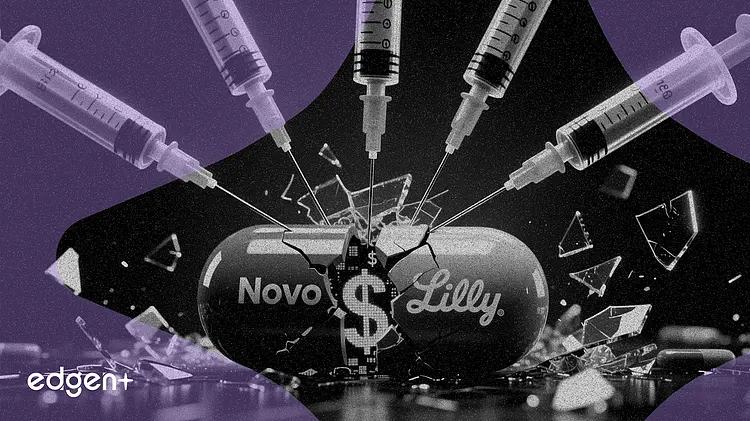
Five years after Wegovy's approval reshaped medicine, the obesity drug market has become the most competitive battleground in global pharma — with a dozen companies racing for a slice of a market projected to exceed $100 billion by 2030.
Novo Nordisk and Eli Lilly, which together control nearly 90% of the obesity treatment market, both launched oral GLP-1 pills this year, opening a new front in the rivalry. Novo's oral Wegovy reached 1 million patients in its first 16 weeks on the US market, generating about $355 million in Q1 sales, according to the company. Lilly's Foundayo received FDA approval shortly after and has been gaining share, buoyed by the Indianapolis-based company's dominant position in injectable GLP-1s.
"The oral formulations represent a step-change in patient access, removing the injection barrier that kept many patients from starting treatment," said Sam Goldstein, a healthcare analyst covering pharma and biotech. "The question now is whether Novo can defend its first-mover advantage in pills or whether Lilly's superior efficacy data will win out."
The numbers underscore the scale of the opportunity. Novo's semaglutide franchise — Ozempic, Wegovy and Rybelsus — generated $36.19 billion in worldwide sales last year, while Lilly's tirzepatide portfolio, including Mounjaro and Zepbound, brought in $36.51 billion. The combined obesity and diabetes market is estimated between $87 billion and $101 billion this year, according to industry estimates. Lilly's obesity treatments alone accounted for 63% of its $19.8 billion in Q1 revenue, while Novo's obesity products represented about 30% of its total sales — or 94% when including diabetes.
Behind the two leaders, a wave of challengers is advancing. Zealand Pharma, in partnership with Boehringer Ingelheim, is developing survodutide, a dual GLP-1/glucagon agonist that targets not only weight loss but also liver fat reduction in patients with metabolic fatty liver disease. Structure Therapeutics, a South San Francisco-based biotech, is developing an oral GLP-1 candidate designed to compete directly with the pills from Novo and Lilly. Amgen, Roche, AstraZeneca, Pfizer and Viking Therapeutics all have candidates in clinical development, targeting different mechanisms and indications.
The competitive dynamics are already reshaping market valuations. Novo Nordisk's stock has fallen about 73% from its all-time high in June 2024, as investors priced in concerns about the company's ability to maintain leadership against Lilly's broader portfolio. Lilly's shares, by contrast, have gained roughly 90% since the launch of its first obesity product, pushing its market capitalization past $1 trillion — the first healthcare company to reach that milestone. Novo's market cap stands at about $197 billion.
Efficacy data will likely determine the next phase of competition. Lilly's next-generation candidate, Retatrutide, achieved weight loss approaching 30% at the highest dose after 104 weeks in clinical trials. Novo's CagriSema, a combination of semaglutide and cagrilintide, delivered 23% weight loss after 84 weeks. By comparison, tirzepatide — the molecule in Zepbound and Mounjaro — showed 25.5% weight loss over the same period in a head-to-head study.
Regulatory and reimbursement decisions are also accelerating. The UK granted the first European approval for oral Wegovy this year, and the European Medicines Agency's Committee for Medicinal Products for Human Use issued a positive opinion on May 22, with commercialization expected in the second half of 2026. France will begin reimbursing Wegovy and Mounjaro on June 15 at a 65% rate under its national health insurance system, with most patients receiving full coverage due to comorbidities.
The implications for investors are significant. The market is projected to exceed $100 billion in annual revenue by 2030, with some estimates reaching $190 billion when including combined diabetes-obesity indications. But the path to that prize is narrowing: dozens of Phase 3 trials are competing for the same patient populations, driving up study costs, while manufacturing capacity for GLP-1 peptides remains constrained. Companies that can demonstrate superior efficacy, better tolerability, or differentiated indications — such as cardiovascular risk reduction or muscle preservation — will have the best chance of capturing share. Investors will watch for Phase 3 data readouts from Zealand Pharma, Structure Therapeutics and Amgen over the next 12 to 18 months as the next inflection point for the sector.
This article is for informational purposes only and does not constitute investment advice.