

Jensen Huang's prediction that AI supercomputers will become common in homes opens a new growth frontier for Nvidia beyond its data center business.
Jensen Huang's prediction that AI supercomputers will become common in homes opens a new growth frontier for Nvidia beyond its data center business.
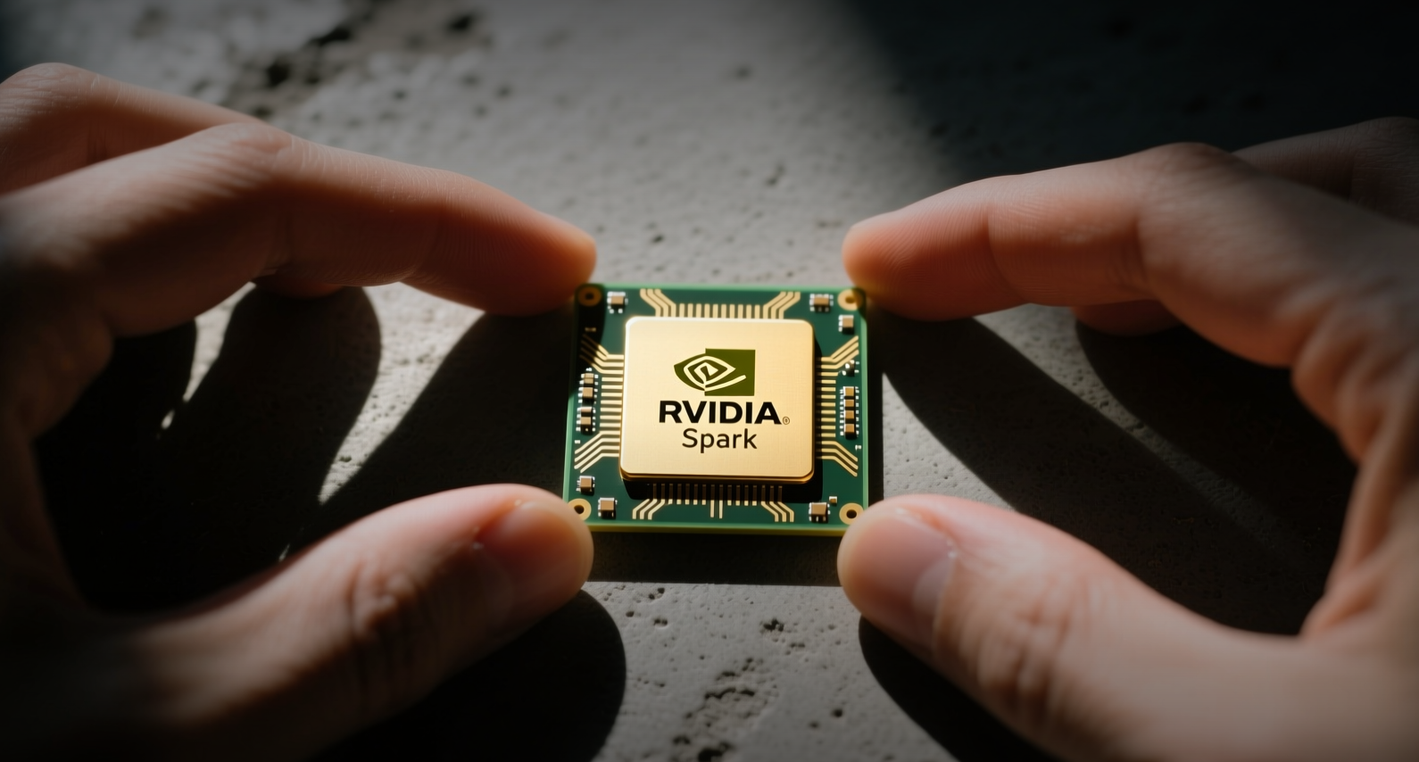
Nvidia's push into consumer AI computing — spanning RTX Spark superchips, Apple M-series integration and Microsoft partnerships — positions the chipmaker to capture a home market that could rival its data center business as the P/E multiple slips below 30 times for the first time in years.
"AI supercomputers will become common in the home," Jensen Huang, chief executive officer of Nvidia, said. "The implications for consumer-side compute are huge."
Nvidia's RTX Spark superchip, designed for desktop AI workloads, and Apple's latest foundation models using Instruction-Following Pruning — which requires a minimum of 12 gigabytes of RAM — already demonstrate the hardware foundation for local AI inference. AI PCs have seen sluggish adoption so far, but Huang's vision suggests a shift from cloud-dependent token consumption toward on-device compute, a transition that could reshape the $600 billion-plus semiconductor market.
For investors, the edge AI opportunity represents a valuation disconnect. Nvidia shares trade below $200 with a forward P/E under 30 times, levels that price the company as a cyclical GPU supplier approaching peak demand rather than a platform spanning cloud, edge and consumer markets. Vera Rubin, Nvidia's next-generation architecture now in full production, ensures data center demand remains robust, but the home market could add a new revenue stream the market has not yet modeled.
The Edge AI Thesis Gains a Powerful Backer
Consumer backlash against recurring AI subscriptions and growing NIMBYism toward new data center construction are pushing compute toward the edge, according to industry analysts. Apple's iPhones already pack significant AI capability through Instruction-Following Pruning, a technique that compresses large language models to run on devices with as little as 12 gigabytes of RAM. On the PC side, Nvidia's RTX Spark and its partnership with Microsoft aim to bring data-center-grade inference to the desktop.
The Mac versus PC competition could intensify as edge AI becomes a differentiator. Nvidia's hardware advantage in GPU compute — honed across data center, automotive and robotics markets — gives it a structural edge in consumer AI chips, though Apple's tight integration of hardware and software remains a formidable moat.
Competition Looms as Custom Silicon Rises
The edge opportunity does not come without threats. Hyperscalers including Alphabet's Google are investing heavily in custom silicon — Google's TPU business could unlock a significant profit stream by selling to firms that would otherwise buy Nvidia GPUs. As token costs collapse and large language models become more efficient, the inference inflection point may favor purpose-built ASICs over general-purpose GPUs.
Still, Huang's framing of Nvidia's business as an "AI cake" spanning all layers — from data center training to edge inference to robotics — suggests the company's total addressable market extends far beyond GPU sales. With agentics and robotics on the horizon, demand for compute at every layer is likely to grow, not shrink.
Nvidia shares, trading below 30 times forward earnings, appear to price in a cyclical peak that may never arrive. If Huang's home supercomputer vision materializes, the consumer-side compute market could add billions in annual revenue — a growth vector the current valuation has not yet discounted. Morgan Stanley and other Street analysts have maintained overweight ratings on NVDA, citing Vera Rubin demand and the broadening AI opportunity beyond data centers.
This article is for informational purposes only and does not constitute investment advice.
