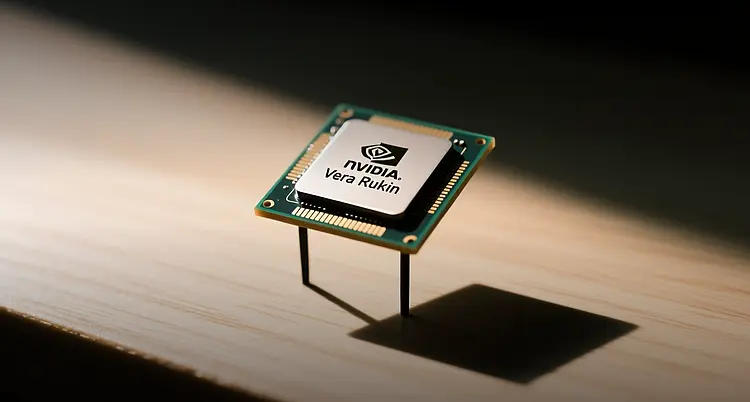
Nvidia's Vera Rubin architecture, now in full production, has Wall Street projecting a stock price of $743 per share — a level that would value the company at more than $15 trillion and test whether even the AI boom's biggest winner can sustain such multiples.
The artificial intelligence chipmaker's next-generation platform, Vera Rubin, consists of six chips combined into an AI supercomputer designed for agentic AI and inference workloads, marking a shift from the training-dominated demand that powered Nvidia's (NASDAQ: NVDA) rise to a $5 trillion market cap. Chief Executive Officer Jensen Huang said the company expects $1 trillion in total orders between Vera Rubin and the current Grace Blackwell architecture by 2027, according to comments reported by multiple outlets.
"The Vera Rubin architecture expands Nvidia's chip footprint across the server rack at a time when the AI industry is moving from training to inference," said Stacy Rasgon, senior analyst at Bernstein. "That pipeline gives the company visibility into revenue growth that most hardware businesses can't match."
Nvidia generated $253.5 billion in total sales over the past 12 months, and the stock trades at 20 times that figure. Reaching $743 within 12 months would require the price-to-sales multiple to expand significantly even as revenue grows — a dynamic that has become harder to sustain as the company's base expands. The stock has traded at higher multiples historically, but analysts caution that maintaining such ratios becomes more difficult at a $5 trillion valuation.
The $1 Trillion Order Pipeline
The Vera Rubin platform represents Nvidia's most aggressive architectural expansion to date. Each system integrates six chips — a graphics processing unit, a central processing unit based on the company's Grace design, and supporting memory and networking components — to create a supercomputer purpose-built for inference, the process of running trained AI models rather than building them. The architecture also uses a new interconnect design that Huang has described as expanding Nvidia's "footprint across the rack," meaning the company captures more value per server sold.
The $1 trillion order forecast through 2027 covers both Vera Rubin and Grace Blackwell, the current-generation flagship. For context, Nvidia's data center revenue totaled $115.2 billion in fiscal 2025, meaning the pipeline represents roughly nine years of data center sales at that run rate — though the company's revenue has been growing at triple-digit rates annually.
The production timeline aligns with early customer commitments. Ineffable Intelligence, a London-based AI startup founded by AlphaGo creator David Silver, selected Google Cloud as its exclusive infrastructure partner to deploy one of the world's largest clusters of Nvidia Vera Rubin NVL72 GPUs. The startup, which raised a $1.1 billion seed round in April at a $5.1 billion valuation, plans to use the hardware for reinforcement learning research aimed at building systems that discover knowledge through experience rather than human-provided data.
Can the Multiple Hold?
The bull case for $743 rests on two assumptions: that Nvidia's revenue continues compounding at rates that justify a premium valuation, and that the market is willing to pay a higher multiple for that growth. Nvidia's price-to-sales ratio has fluctuated between 15x and 35x over the past three years, according to data compiled by Bloomberg. At 20x trailing sales today, the stock sits near the lower end of that range.
A move to $743 within 12 months would imply a market capitalization above $15 trillion — roughly the combined value of the entire S&P 500 energy sector today. Even if Nvidia's revenue doubles to $500 billion by fiscal 2027, the stock would still need to trade at roughly 30x sales to hit that price, a multiple it has only briefly sustained.
Still, 94% of the 69 analysts surveyed by CNN Business rate Nvidia a buy, and the consensus view is that Vera Rubin extends the company's competitive moat against rivals such as Advanced Micro Devices (NASDAQ: AMD) and custom chip efforts from Amazon.com's (NASDAQ: AMZN) Annapurna Labs and Alphabet's (NASDAQ: GOOGL) Google Tensor Processing Unit. AMD's MI300X accelerator, built on TSMC's (NYSE: TSM) 5nm node, has struggled to gain meaningful market share against Nvidia's CUDA software ecosystem, which remains the industry standard for AI development.
For investors, the question is less about whether Nvidia will grow and more about what price already reflects that growth. Vera Rubin's production ramp and the $1 trillion pipeline provide a concrete revenue trajectory through 2027. Whether the stock reaches $743 in 12 months or takes longer, the architecture cycle gives Nvidia a multiyear visibility advantage that few semiconductor companies can claim.
This article is for informational purposes only and does not constitute investment advice.