

Nvidia launched its Agent Toolkit and Nemotron 3 Ultra model at GTC Taipei, enlisting Cadence, Siemens and Synopsys to build autonomous AI engineers that compress weeks of simulation work into hours.
Nvidia launched its Agent Toolkit and Nemotron 3 Ultra model at GTC Taipei, enlisting Cadence, Siemens and Synopsys to build autonomous AI engineers that compress weeks of simulation work into hours.
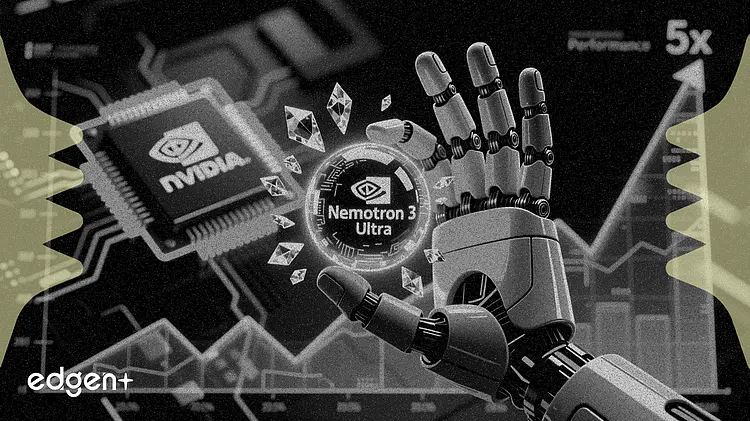
Nvidia's new Agent Toolkit and Nemotron 3 Ultra model aim to turn weeks of engineering simulation work into hours, as the chipmaker pushes deeper into enterprise AI software.
Nvidia introduced a suite of open-source software for building autonomous AI agents at its GTC Taipei conference on Monday, enlisting Cadence, Siemens, Synopsys and Dassault Systèmes as early adopters in a push that extends the company's reach beyond hardware into enterprise AI workflows.
"The world's software leaders are bringing AI agents into the systems where work gets done — showing how AI coworkers help employees think faster and execute complex tasks to solve bigger problems," Jensen Huang, founder and chief executive officer of Nvidia, said in a statement. "Nvidia NemoClaw provides enterprise software developers with the open building blocks to create more secure, long-running AI coworkers."
The centerpiece of the launch is Nemotron 3 Ultra, a 550-billion-parameter mixture-of-experts model that delivers up to five times faster inference and as much as 30 percent lower cost versus comparable open frontier models, according to Nvidia. The model, expected to be available June 4 through Hugging Face, ModelScope and Nvidia's own platform, is purpose-built for long-running autonomous agents that can execute coding, research and enterprise workflows without human intervention.
Nvidia shares closed at $211.26 on Friday, down 1.45 percent, though trading volume reached 264.9 million shares — 1.59 times the 20-day average of 166.1 million — suggesting elevated investor attention ahead of the announcement. The stock trades 10.69 percent below its 52-week high of $236.54.
Design and Simulation Partners Lead Adoption
Cadence, Siemens, Synopsys and Dassault Systèmes are using Nvidia's NemoClaw blueprints to build autonomous AI engineers that handle simulation and verification workflows — among the most time-intensive tasks in semiconductor and industrial engineering. Cadence's ChipStack AI Super Agent, secured by Nvidia's OpenShell runtime, is already being used by Nvidia itself to autonomously verify chip designs. Siemens is integrating NemoClaw and OpenShell into its Fuse EDA AI Agent for multi-tool workflows across semiconductor and printed circuit board design.
Foxconn is piloting NemoClaw for its Nurabot and CoDoctor healthcare platforms and building a factory operations agent called MoMClaw that connects sensor data with AI agents for real-time decision-making.
On the cybersecurity and enterprise side, CrowdStrike is using Nemotron models for agents that continuously identify and remediate vulnerabilities, while Palantir is integrating the models into its AI Forward Deployed Engineer platform for autonomous task execution in air-gapped environments.
OpenShell and CUDA-X Expand the Platform Play
Nvidia's OpenShell secure runtime, available in early preview, provides adjustable privacy and security controls for autonomous agents. Microsoft is collaborating with Nvidia to integrate OpenShell with new Windows security primitives, while Canonical and Red Hat are embedding the runtime into Ubuntu and Red Hat AI, respectively. SAP and ServiceNow have also integrated OpenShell into their enterprise agent platforms.
Nvidia is also exposing its CUDA-X libraries — including cuDF for data processing, cuOpt for routing optimization, PhysicsNeMo for scientific simulation and CUDA-Q for quantum computing — as callable skills that AI agents can use directly. The verified skills are available in the Claude Code plug-in marketplace and the Hermes Skills Hub.
What This Means for Investors
The launch positions Nvidia to capture a larger share of enterprise software spending by providing the full stack — from silicon to models to agent runtimes — rather than just the GPUs underneath. Nvidia's data center revenue, which reached $35.6 billion in its most recent fiscal quarter, could benefit as enterprises shift from experimentation with AI to deploying autonomous agents in production. The company's ability to convert its hardware dominance into a software platform business would improve margin profiles over time, though Nvidia did not disclose pricing for the Agent Toolkit or Nemotron model access. Competitors including AMD and Intel are developing their own AI software stacks, but neither has announced an equivalent end-to-end agent toolkit with this breadth of enterprise partnerships.
This article is for informational purposes only and does not constitute investment advice.
