


Arm's CPU architecture now powers half of all compute at the world's largest cloud operators, a milestone that arrived on the same day AMD began volume production of the industry's first 2nm server chip and Intel launched its 18A-node Xeon.
Arm's CPU architecture now powers half of all compute at the world's largest cloud operators, a milestone that arrived on the same day AMD began volume production of the industry's first 2nm server chip and Intel launched its 18A-node Xeon.
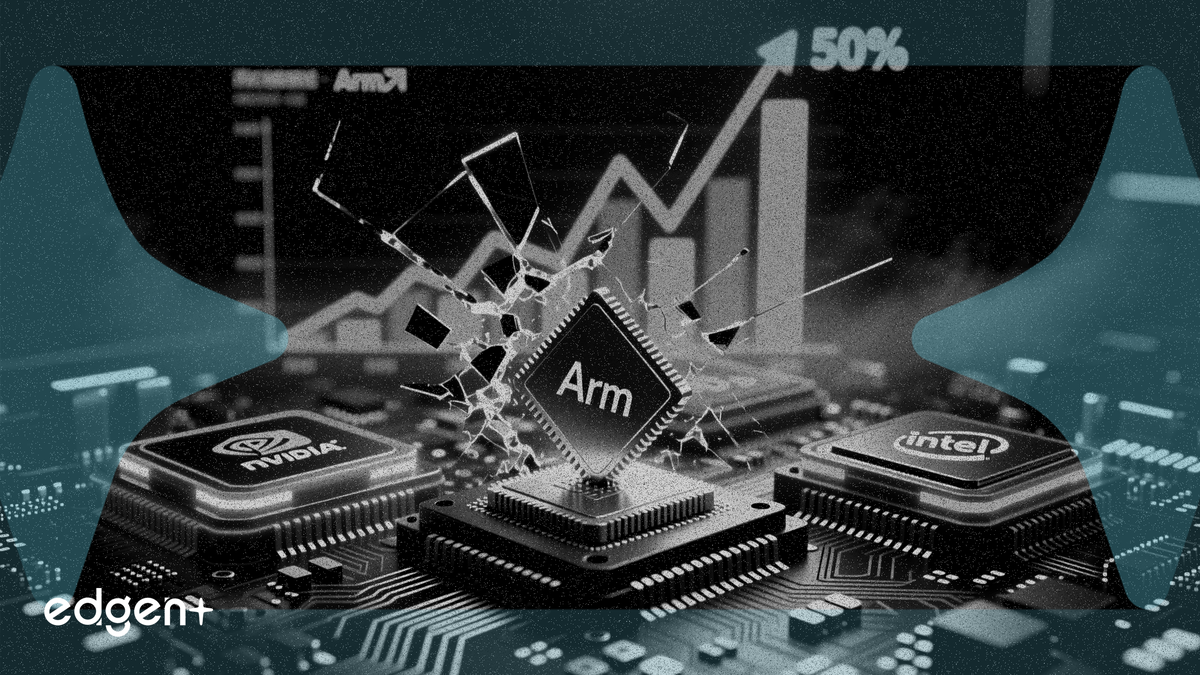
Arm's CPU architecture now commands roughly 50% of hyperscaler compute, a structural shift confirmed at Computex 2026 as AMD entered volume production on the industry's first 2nm server processor and Intel formally launched its 18A-node Xeon 6+.
"This reinvention of the computer is as big of a deal as the reinvention of the phone into what we now know as the smartphone," Nvidia Chief Executive Officer Jensen Huang said at a Computex press conference, referring to the company's new RTX Spark PC chip co-developed with MediaTek.
Arm's hyperscaler share stood at roughly 18% in mid-2024 before compressing to 50% in about two years, coinciding with the industry's pivot to AI infrastructure investment. Amazon Web Services disclosed that its custom silicon business — including Arm-based Graviton CPUs alongside Trainium AI accelerators and Nitro networking chips — has crossed a $20 billion annual revenue run rate growing at triple-digit rates year-over-year. Google announced its next-generation TPUs will replace x86 host processors with custom Arm-based Axion CPUs, delivering up to 2x better performance-per-watt than their prior x86-based generation. Microsoft continues to advance its Arm-based Cobalt CPU strategy, now deployed across Azure regions and powering production workloads for customers including Databricks, Siemens, and Snowflake.
For the $200 billion cloud compute market, the implication is direct: enterprises now choose between architectures, not just vendors. Nvidia shares rose more than 6% Monday after the RTX Spark announcement, while Intel fell roughly 6% and AMD dropped about 5% as investors priced in Nvidia's entry into a PC processor market the two companies have jointly controlled for four decades.
AMD's 2nm Venice Arrives First
AMD entered Computex carrying a credential no competitor can yet match. EPYC "Venice," the company's sixth-generation server processor, has entered full-scale volume production on TSMC's 2nm process — making it the first high-performance computing product in the industry to reach that node. The 2nm node packs more transistors per square millimeter, improving performance per watt while reducing die size.
Per-socket memory bandwidth more than doubles to 1.6 TB/s, up from 614 GB/s on the prior generation, while CPU-to-GPU bandwidth receives a 2x boost — numbers that directly address the memory throughput bottleneck in AI inference and training workloads. The flagship configuration scales to 256 cores per socket, with a claimed 70% performance improvement over the prior EPYC generation. AMD's Helios rack-scale platform, pairing Venice CPUs with Instinct MI450X GPUs, is on track for multi-gigawatt deployments in the second half of 2026.
Venice does not travel without supply chain risk. AMD's production shares TSMC's N2 capacity with Apple, which has secured approximately half of TSMC's available 2nm output for its iPhone 18 A20 processor and M-series chips, along with Qualcomm, Nvidia, and MediaTek. Hyperscaler procurement teams in Taipei are tracking 2nm wafer allocation dynamics closely this week; supply, not specification, may determine which buyers gain access to Venice first.
Intel's 18A Answer and Nvidia's PC Ambition
Intel arrived with its most direct answer yet to the Arm and AMD challenge. The Xeon 6+ family — codenamed Clearwater Forest — places Intel's 18A process node in shipping server hardware for the first time. The flagship Xeon 6990E+ packs 288 Darkmont efficiency cores into a single socket, with 576 MB of L3 cache and 12-channel DDR5-8000 memory support, and is available immediately through Dell Technologies, Hewlett Packard Enterprise, Lenovo, and Supermicro.
Intel claims the 6990E+ delivers 30% higher average performance per thread than AMD's 192-core EPYC 9965. That comparison targets a chip that AMD's Venice roadmap will supersede before most enterprise refresh cycles complete. Intel's Senior Director of Product Management for the Client Computing Group, Nish Neelalojanan, acknowledged competitive pressure from Nvidia's RTX Spark with candor at a Computex media roundtable, saying Intel is handling the challenge with "a healthy dose of paranoia" while pointing to x86's software compatibility moat.
Nvidia's RTX Spark Superchip, co-developed with Microsoft and MediaTek, pairs 20 Arm CPU cores with a Blackwell-class GPU carrying 6,144 CUDA cores, 128 GB of LPDDR5x unified memory, and a stated AI compute target of 1 petaflop. Nvidia committed to a multi-generation roadmap, outlining future chip generations for laptops and desktop systems. Confirmed OEM launch partners include Microsoft, Dell, HP, ASUS, Lenovo, and MSI, with consumer devices expected this fall. Morgan Stanley estimates RTX Spark chip shipments of 5 million to 8 million units in 2026, with premium devices priced at $2,899 for the N1X variant and $1,799 for the N1.
The competitive threat carries real limitations. Windows on Arm still faces documented gaps in anti-cheat software support, peripheral driver coverage, and specific professional application compatibility — issues Intel's Neelalojanan cited directly at Computex. Nvidia and Microsoft have promised a compatibility certification program, but no third-party testing data exists ahead of a product that has not yet shipped.
What the Shift Means for Investors
The cost of chip development at advanced nodes — between $200 million and close to $1 billion at 3nm and 2nm, with development timelines of three to five years — makes this a structural shift, not a cyclical one. Hyperscalers that have already committed engineering resources to custom Arm silicon are not reversing course. AWS's Graviton, Google's Axion, and Microsoft's Cobalt represent capital investments that cannot be redirected without multi-year consequences.
Every percentage point of CPU compute share that Arm captures from x86 represents displaced revenue in a market that generates hundreds of billions of dollars annually. For Intel and AMD, the question is no longer whether x86's data center supremacy is being challenged — it is how fast the floor is moving, and whether their performance-per-watt and node roadmaps can slow the rate of displacement. Nvidia, meanwhile, has confirmed it secured sufficient TSMC capacity to support growth through 2027, with Huang stating the company still expects supply to remain constrained as demand outpaces capacity additions.
This article is for informational purposes only and does not constitute investment advice.
