
The National Association of Insurance Commissioners, a Kansas City-based nonprofit, writes the rules governing America's $3 trillion insurance market — and states are starting to ask why.
The National Association of Insurance Commissioners, a Kansas City-based nonprofit, writes the rules governing America's $3 trillion insurance market — and states are starting to ask why.
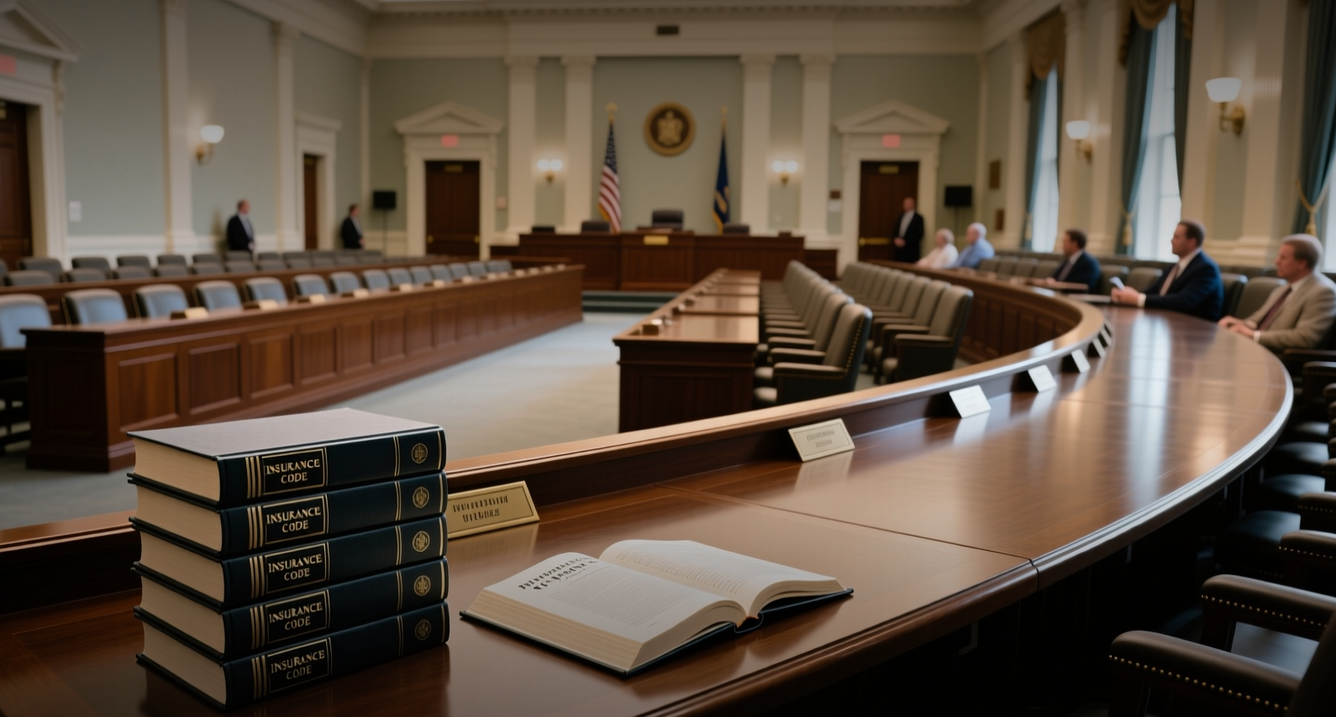
The National Association of Insurance Commissioners, a Kansas City-based nonprofit, writes the rules governing America's $3 trillion insurance market — and states are starting to ask why.
NAIC reported $161.4 million in 2024 revenue, 94 percent from the industry it regulates, as states cede insurance rule-making to the private nonprofit.
"This arrangement effectively means that an unelected body holds control over states," Daniel Schwarcz of the University of Minnesota Law School wrote in a 2018 paper published in the Connecticut Insurance Law Journal.
New Mexico's Insurance Superintendent Alice Kane told state lawmakers that insurers declined to renew more than 6,200 homeowner policies in 2025, the highest number ever. The state's insurance code requires insurers to file forms "prescribed by the national association of insurance commissioners" — language that replaced direct superintendent oversight in 2014. New Mexico's policy-form filings must use transmittal documents matching "the appropriate current" NAIC uniform documents, according to the state's administrative code, which directs regulators to the NAIC's dynamic website rather than a fixed edition.
The Government Accountability Office reported in June that NAIC's accreditation committee doesn't make its findings public and that its discussions on the subject are limited to regulators. Accreditation determines whether other states accept a state's solvency examinations and, in practice, pressures legislatures to enact specified model laws. Americans paid more than $3 trillion in premiums in 2025.
Lawyers call the mechanism "dynamic incorporation by reference." When a statute adopts an outside body's manual as that manual currently stands, the next revision can alter binding obligations under the law without a vote, a hearing, or a governor's signature. The GAO report describes the machinery without naming it: Accreditation requires states to enact NAIC model laws, and those model laws in turn require regulators to follow NAIC standards.
NAIC is designated a 501(c)(3) charitable organization and has been exempt from filing IRS Form 990 since 1955. Its published conflict-of-interest policy covers member commissioners but not its chief executive, according to the GAO. Its 2026 filing fees are capped at $108,817 for a single company and $544,085 for a group. The Conference of State Bank Supervisors and the North American Securities Administrators Association both file Form 990 — NAIC does not.
The scrutiny comes as NAIC also faces questions about its oversight of private credit held by insurers. Delaware Life Insurance Company corrected its annual filing to classify roughly $17 billion of investments as related-party holdings, about 39 percent of invested assets, and federal prosecutors have issued grand jury subpoenas. NAIC now requires more detail behind private ratings, including Private Rating Letter Rationale Reports. Michigan has required NAIC annual reporting since 1998 — no other state has followed. New Mexico's lawmakers are already asking why 6,200 homeowners lost their coverage, and whether they will demand more from the rule makers governing their market remains the open question.
This article is for informational purposes only and does not constitute investment advice.
