Three quantum computing companies — Microsoft, Atom Computing, and EeroQ — published incremental but meaningful hardware advances in recent weeks, each solving a distinct physics problem that has held back commercial quantum machines.
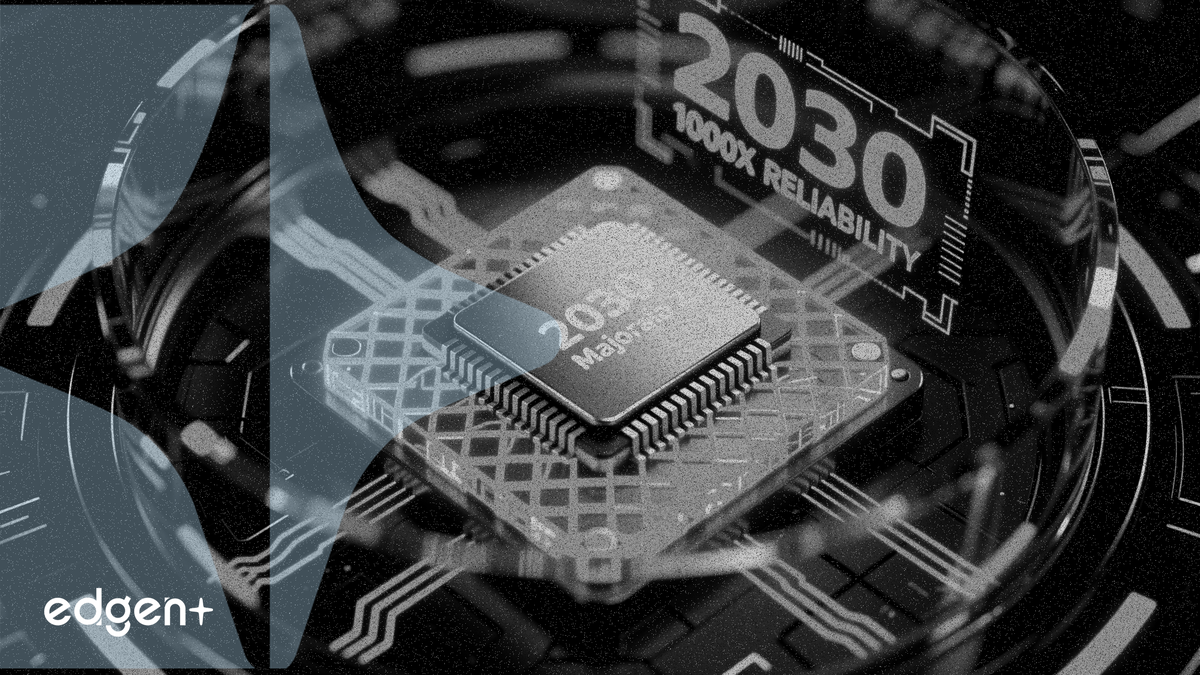
Microsoft's Majorana 2 quantum chip delivers qubits with a mean lifetime of 20 seconds — 1,000 times more reliable than its predecessor — using a redesigned material stack that swaps aluminum for lead as the superconductor. The company now targets a commercial-scale quantum computer as soon as 2029.
"We need to make improvements each year that will get us closer to delivering a computer that we believe will have massive commercial and societal value," Chetan Nayak, technical fellow at Microsoft, said. "We're 1,000 times better."
The company replaced aluminum with lead in its superconducting nanowires and added tin to the underlying semiconductor to improve spin-orbit coupling. Parity states that previously flipped every 10 milliseconds now remain stable for more than 20 seconds, with some exceeding 60 seconds. Microsoft credited its agentic AI platform, Microsoft Discovery, with helping manage fabrication workflows and identifying material flaws that had limited earlier devices.
If realized by 2029, a commercial-scale quantum machine could solve problems in pharmaceuticals and engineering that would take conventional computers thousands of years — and would accelerate the timeline for post-quantum cryptography standards that directly affect blockchain security.
Atom Computing's Spare-Atom Strategy
Atom Computing, whose hardware is accessible through Microsoft's Azure Quantum cloud service, tackled a different problem: error correction drift. The company uses lasers to trap neutral atoms in a grid, but computational operations heat the atoms, causing them to escape their optical traps and introduce errors.
The company's solution involves maintaining a reserve of pre-cooled spare atoms that can be swapped into logical qubits during error-correction measurements. In a manuscript published this month, Atom showed that performing error correction without the swap caused error probability to rise with each successive measurement. With the swap, the probability stayed roughly constant, keeping some logical qubits stable for up to 90 rounds of error correction.
The technique does not eliminate errors entirely — eventually, too many individual atoms flip state simultaneously and recovery fails. But it extends coherence time meaningfully, a prerequisite for any useful quantum calculation.
EeroQ's Resonator Coupling Breakthrough
EeroQ, a startup pursuing an unusual qubit architecture, published a separate manuscript describing a chip that traps single electrons on droplets of liquid helium. The company showed that a small resonator placed next to the helium pool can couple with the electron's quantized motional states, creating the building block of a qubit.
The approach had been theoretically established for years, but no company had demonstrated a practical method to interact with the electron in a useful way. EeroQ's chip now provides that interface, though the company remains far from a functional quantum processor.
What This Means for Investors
The three advances, while incremental, address fundamental physics bottlenecks that have kept quantum computing from achieving commercial utility. Microsoft's topological qubit approach — long viewed as the highest-risk, highest-reward path — now has experimental evidence supporting its stability claims. Atom's error-correction technique is directly applicable to any neutral-atom architecture, and EeroQ's resonator design opens a new experimental pathway.
Microsoft shares have not yet reacted to the Majorana 2 announcement. The company trades at roughly 35 times forward earnings, with quantum computing representing a negligible portion of current revenue but a potential long-term catalyst if the 2029 timeline holds. Nvidia, whose GPUs currently dominate the high-performance computing market, could face a competitive threat from quantum systems that solve certain problem classes exponentially faster — though analysts at Morgan Stanley have called that scenario "years away from material revenue impact."
This article is for informational purposes only and does not constitute investment advice.