
Google's decision to add Marvell as a custom AI chip partner — with warrants implying up to $120 billion in potential purchases — directly challenges Broadcom's position as the search giant's primary TPU supplier.
Google's decision to add Marvell as a custom AI chip partner — with warrants implying up to $120 billion in potential purchases — directly challenges Broadcom's position as the search giant's primary TPU supplier.
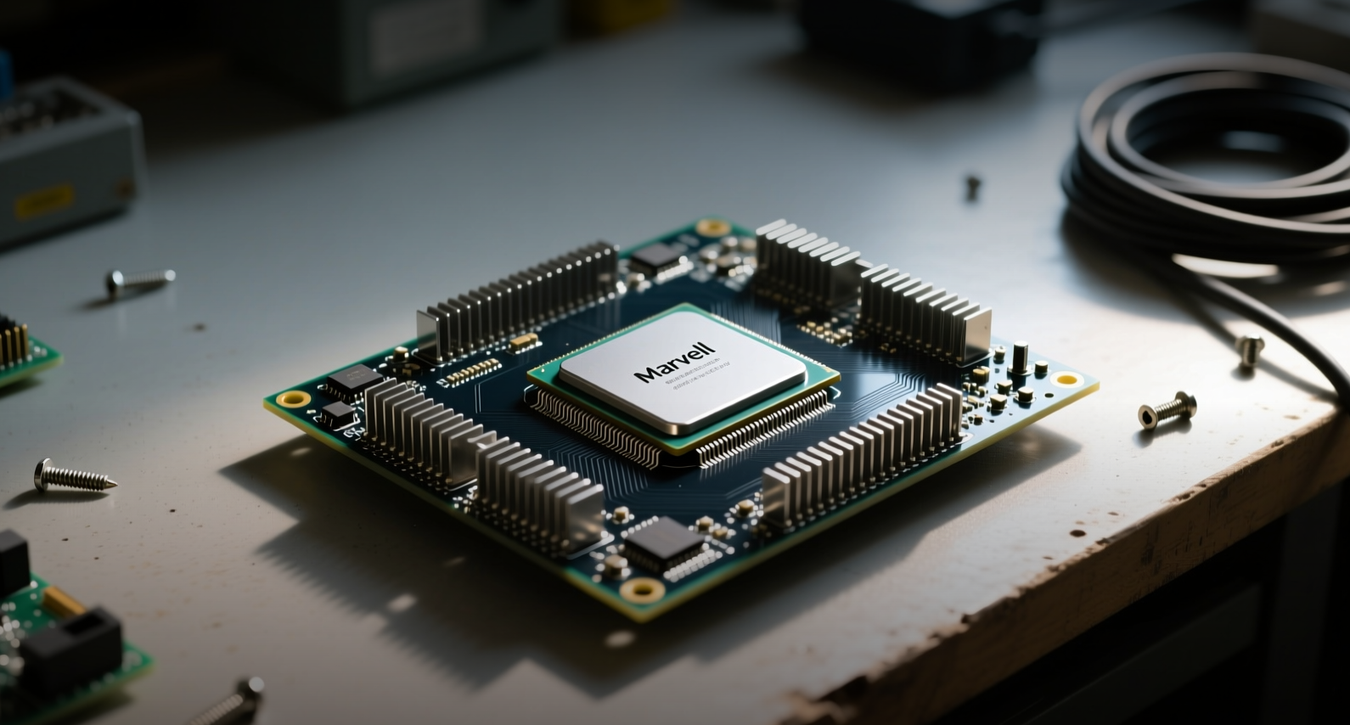
Marvell has signed a commercial agreement with Google to develop custom AI silicon for the TPU product line (Tensor Processing Unit, Google's custom AI accelerator), a deal whose warrant structure implies up to $120 billion in potential purchases — threatening Broadcom's grip on Google's custom chip business.
The agreement, disclosed in a Marvell SEC filing, covers custom silicon programs attached to Google's Tensor Processing Unit product family, including AI inference accelerators, storage controllers, network interface controllers, memory interface controllers, and near-memory compute. The filing states Marvell "entered into a commercial agreement relating to the Company's development of custom semiconductor products to Google."
Marvell issued warrants allowing Google to buy nearly 59 million shares — over 6 percent of the company at current share counts. The warrants vest in 240 tranches, each requiring $500 million in discretionary product purchases, meaning Google would need to spend $120 billion cumulatively to unlock full vesting. That figure is more than 13 times Marvell's trailing twelve-month revenue of $8.7 billion and over 11 times Broadcom's $10.8 billion in AI semiconductor revenue last quarter.
Broadcom shares have fallen more than 10 percent from a recent high near $428, with the Marvell deal accelerating the decline. The company's decision not to raise its fiscal 2027 AI semiconductor revenue guidance in its latest earnings report was already a concern; intensifying competition raises questions about whether Broadcom is being conservative or facing genuine headwinds.
What the Warrant Structure Reveals
The scale of the Marvell-Google relationship is unprecedented for a custom silicon supplier. Google's potential 6 percent equity stake in Marvell aligns the two companies economically, giving Google an added incentive to direct business toward Marvell. But the $120 billion figure is so large — more than 13 times Marvell's last twelve months' revenue of $8.7 billion — that it's difficult to believe it will fully materialize. Still, even a fraction of that amount would be significant for Marvell's custom AI chip business.
The deal also shows Google is actively diversifying its TPU supply chain. Broadcom signed a TPU and networking deal with Google through 2031 in April, so it remains a key partner. But Marvell isn't the only challenger. Analysts believe MediaTek is one of Google's alternate TPU partners, and rumors have surfaced that Advanced Micro Devices is working with Google on future TPU generations. NVIDIA, the dominant player in general-purpose AI accelerators, also faces pressure as hyperscalers increasingly build custom silicon to cut costs.
Broadcom's Guidance Is the Key Catalyst
Broadcom's upcoming earnings report is shaping up as the critical test for investor confidence. The company's decision not to raise its fiscal year 2027 AI semiconductor revenue guidance was one of the main reasons shares tanked after its latest earnings report. With competition intensifying, investors may wonder whether Broadcom is being conservative or whether it's uncertain about its growth prospects.
Raising its 2027 guidance significantly could go a long way in putting these fears to bed, although it would not dispel general competition concerns. This makes Broadcom's fiscal year 2027 AI semiconductor revenue guidance likely the biggest factor to watch in its upcoming earnings report.
Broadcom currently trades at $362.08 with a P/E ratio of 60.39, while Marvell trades at $224.36 with a P/E of 76.97. Both carry Moderate Buy consensus ratings, with price targets of $491.97 for Broadcom and $253.61 for Marvell. The market's reaction to the Google deal — Marvell shares jumped more than 9 percent while Broadcom fell roughly 5 percent — suggests investors are already pricing in a shift in the competitive balance. Marvell's expected earnings growth rate for the current year is 42.3 percent, with the Zacks consensus estimate of $4.05 per share up 19.8 percent year over year.
This article is for informational purposes only and does not constitute investment advice.
